TRANSMISSION // 2606.11976v2
For Code-Finding Agents, Exploration Beat Extra Structure
Source published
An abstract reports that, in tests of 105 multi-file software issues, a small model localized files better with repeated repository exploration than with added agent structure. The result is preliminary and limited to the tested setup.
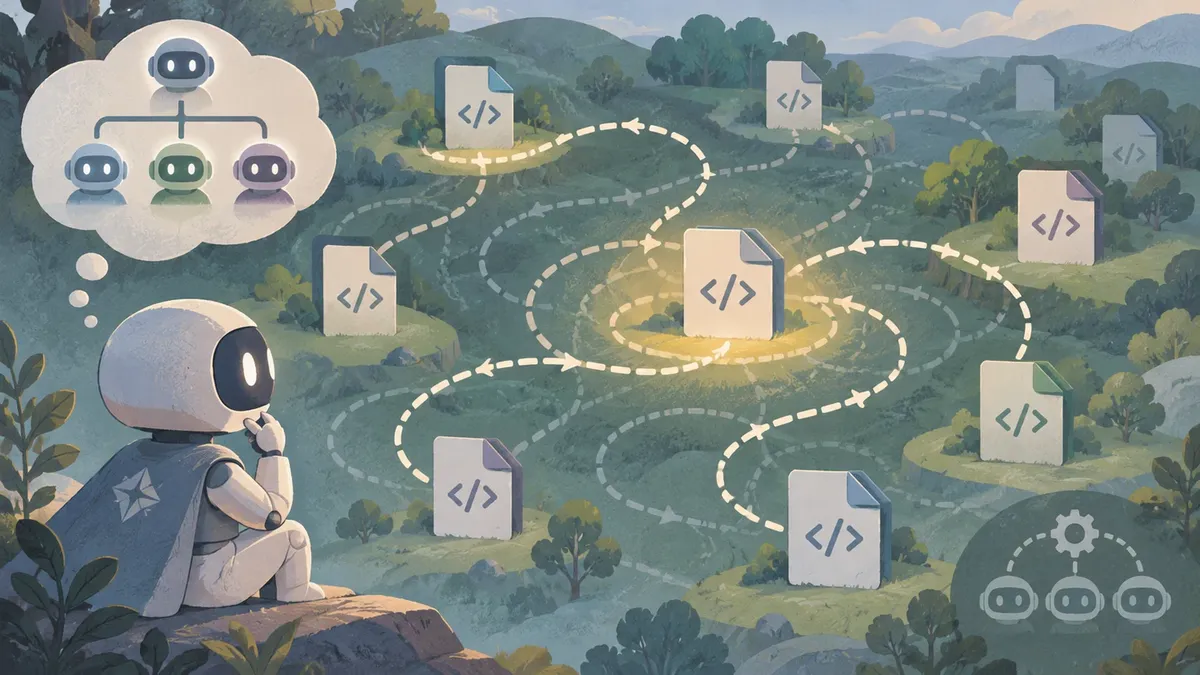
Before an AI can fix a software issue, it must find the files that need changing. An arXiv preprint’s abstract reports that, for a small model in its tests, exploring a repository over multiple turns mattered more than adding specialist agents. The evidence available here is limited to that abstract.
When a software issue involves several files, finding the files that need changing is an important step toward a fix. The preprint Exploration Structure in LLM Agents for Multi-File Change Localization asks which additions help a small language model locate those files: repeated opportunities to inspect a codebase, repository-specific tools, or a structure involving specialist agents.
The abstract describes six configurations that add structure step by step, beginning with the model alone. The sequence adds a Python REPL, a coordinator, repository tools, a registry of subsystem-focused agents, and consultation with those agents. The evaluation covered 105 multi-file issues from three Python repositories. According to the abstract, the researchers used audited checkouts containing a single commit for each issue and measured source-file localization.
The abstract reports that the largest gain came from giving the model a multi-turn way to explore the repository. Pooled source-file F1 rose from 0.199 for the model alone to 0.677 for a coordinator using only the REPL. The abstract does not define the F1 calculation, so these figures are best read as the study’s reported scores rather than a fully assessable measure from the material available here.
Repository tools added a small gain that the abstract describes as not statistically significant. The registry did not improve the result; pooled F1 was lower by 0.031. The abstract also reports a score of 0.695 for a small model in a plain multi-turn agent loop. Four published localizers were run with the same model, and their best reported score was 0.586; the abstract does not establish that the 0.695 result is a controlled, same-model comparison with those systems. A Codex system scored 0.751 using a larger model, so that result is not a like-for-like comparison.
The authors’ narrow conclusion, as summarized in the abstract, is that for a small model, the agent loop mattered more than adding agents. This is a comparison among particular configurations and tasks, not evidence that specialist agents are generally ineffective. The abstract also says that new files and narrative documentation remained largely missed, pointing to limitations in what the tested systems could locate.
Finding files is not the same as making a correct fix. The abstract reports localization results, not evidence that the systems produced correct patches or resolved the issues. And because the available source is only the abstract, details needed to assess the methods, score aggregation, and uncertainty cannot be checked here. The work is an arXiv preprint, not a settled result. The authors say they release the benchmark, predictions, tool logs, and scripts, which may support further examination.
For now, the evidence suggests that repeated repository exploration was more useful than added agent structure in this specific small-model evaluation. Whether the result carries over to other languages, repositories, models, or complete software-fixing tasks remains uncertain.
- AI coding agents
- software engineering
- code localization
- large language models
- repository exploration
- preprint
Reviewed cross-references
These connections were reviewed by a model, not independently fact-checked by a human. Similarity does not imply agreement; consult the original papers and the evidence below.
When a Bug Report Screenshot Is Too Blurry, the Codebase May Help
Supporting evidence: Both studies report that repository access can aid file localization, in distinct settings: Fattha et al. found multi-turn REPL exploration raised pooled source-file F1 from 0.199 to 0.677 on 105 multi-file issues, while Yohena et al. found repository-rendered reference images raised gold-file matches from 28% to 42% under severe screenshot degradation. These are compatible examples, not a direct comparison: the tasks, added context, and evaluation measures differ.
Model review: · openai-codex/gpt-6-luna
Evidence and provenance
Selected excerpts, not complete papers. PDF extraction can omit figures or damage equations, tables and reading order; sources may be preprints.
2606.11976v2 — Original paper
Excerpt reference:
static/papers/2606.11976v2.md:18-59
Basis: Paper text
Source SHA-256:dc50709732475472614691037468a21e484319e1bf53bc0381c91bda1e8353582611.13026v1 — Original paper
Excerpt reference:
static/papers/2611.13026v1.md:76-135
Basis: Paper text
Source SHA-256:472e8cd302242857370edfa7d0aef2917646add19c19c55ebf7033dde91e0d7f
Related reading
Automatically matched by shared topic keywords. These links do not imply that the sources agree or establish a consensus.
When a Bug Report Screenshot Is Too Blurry, the Codebase May Help
Source published
Shared keywords: ai coding agents
Why AI Coding Prompts Keep Growing—and How Comments May Help
Source published
Shared keywords: ai coding agents, large language models, software engineering
CodeTeam gives AI repository coding a team structure
Source published
Shared keywords: ai coding agents, large language models, software engineering
Teaching Coding Agents the Hidden Structure of On-Device AI
Source published
Shared keywords: software engineering
A tougher coding benchmark finds leading AI agents still struggle to finish the job
Source published
Shared keywords: ai coding agents, software engineering