TRANSMISSION // 2606.11300v2
A New Way to Compare the Polarisation Angles of CMB Telescopes
Source published
A proposed method compares observations of the same sky patch to estimate the relative polarisation-angle offsets of two cosmic microwave background experiments. Forecasts suggest it could calibrate the Simons Observatory’s Large Aperture Telescope and Planck using the Small Aperture Telescopes as a reference—but the estimates rely on an assumed reference calibration and idealised instrument conditions.
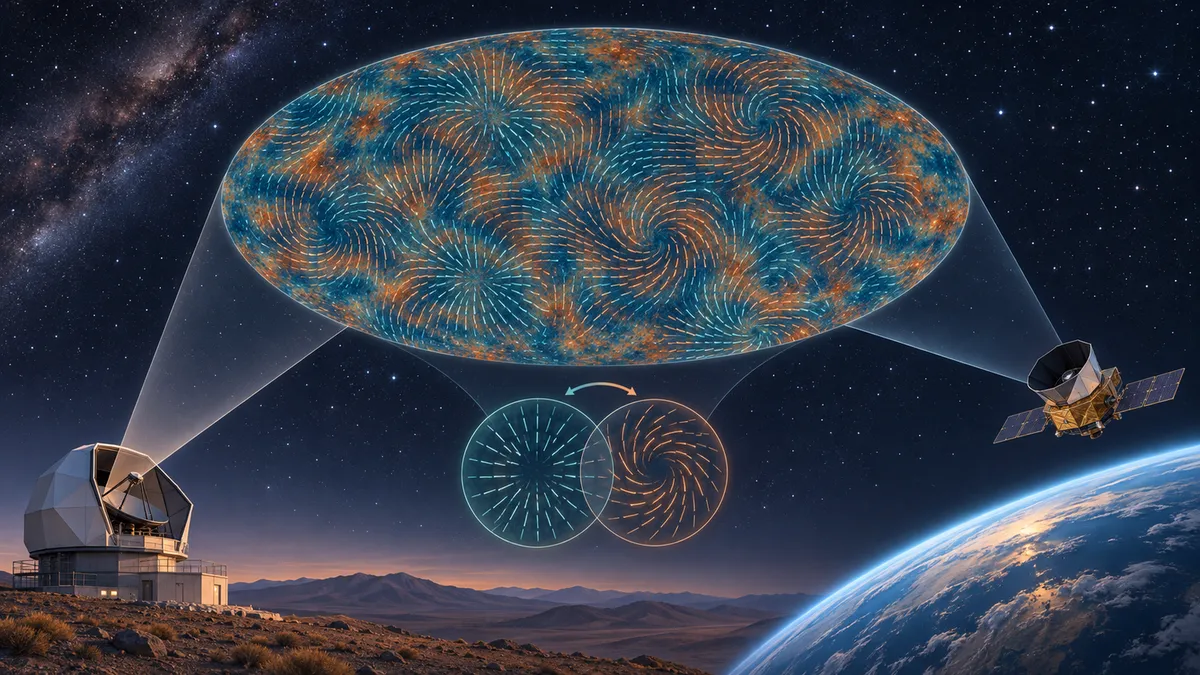
Could comparing two telescopes looking at the same patch of sky help distinguish an instrument’s misalignment from a genuine cosmic signal? A preprint proposes a method to measure the *relative* polarisation angle between experiments without assuming that certain parity-violating signals are absent. Its precision estimates are forecasts, not results from applying the method to real observations.
The cosmic microwave background (CMB) is faint afterglow from the early Universe. Along with temperature variations, it carries a pattern of polarisation. Cosmologists separate that pattern into two kinds, called E and B modes. Some proposed forms of parity-violating physics could create a correlation between them. But an instrument’s orientation can also mix the modes, producing a similar-looking signal. Even a small error in the angle at which a telescope measures polarisation can complicate the search for new physics.
Claire Rigouzzo, Eugene Lim, Susanna Azzoni and Yiqi Liu propose a way to tackle one part of this problem: compare measurements from different experiments observing the same region of sky. Their method estimates the difference between the instruments’ polarisation-angle misalignments. Unlike self-calibration, which estimates an angle by assuming certain parity-violating signals are absent, the proposed comparison does not require isotropic cosmic birefringence or primordial E–B correlations to be zero.
That distinction matters. A sky signal is shared by instruments observing the same patch, while their instrumental angle errors can differ. The authors derive an estimator from cross-correlations between the instruments’ measurements. In their formulation, the estimator isolates the relative angle without assuming the shared sky has no E–B signal. It cannot, however, determine a shared absolute rotation: a rotation affecting every telescope equally remains indistinguishable from a uniform cosmic signal using these cross-correlations alone.
Forecasting a cross-check
The authors assess the method analytically and with simulations. As an example, they use the Simons Observatory’s Small Aperture Telescopes (SATs) as the reference and forecast comparisons with its Large Aperture Telescope (LAT) and with Planck. The calculation uses instrument noise models, assumes overlapping sky observations, and combines the reference instrument’s calibration uncertainty with the statistical uncertainty in the relative-angle estimate.
The forecast assumes SAT calibration uncertainty of 0.08 degrees, anticipated from its wire-grid system. On that basis, at roughly 145 GHz for the Simons Observatory and 143 GHz for Planck, the projected total uncertainty is 0.10 degrees for the LAT and 0.17 degrees for Planck. These are forecasts, not measurements showing either instrument has achieved those calibration precisions.
The paper also reports simulations testing whether the estimator recovers an injected relative angle. Under the simulated setup, it recovers the offsets without bias across the tested range. This is a check of the estimator in simulations, not a demonstration using real telescope maps.
What the method can—and cannot—tell us
The approach could help align datasets without imposing an assumption that would rule out the very sky signal researchers want to study. But it needs at least one independently well-calibrated instrument and sufficient shared sky coverage. If the reference calibration is less precise than assumed, the resulting calibration of other instruments would also be less precise.
Several assumptions limit how directly the forecasts apply to observations. The analysis assumes perfectly characterised beams and fully beam-deconvolved spectra; the authors leave a detailed assessment of beam uncertainties to future work. The forecast also assumes independent noise between instruments. That assumption may be less suitable for the SAT–LAT comparison because the instruments share a site and may have shared atmospheric conditions or scan strategies. Assessing this would require map-level simulations or data-based tests. The paper further assumes negligible Galactic-foreground E–B correlations at the frequencies considered, while noting that this may not hold in real observations. More complete treatment of foregrounds and frequency channels remains necessary.
This is a preprint describing a proposed method and forecasts, not a settled demonstration on real observations. The authors state that the assumed 0.08-degree SAT calibration has not yet been fully demonstrated on the sky, and identify instrument effects and foreground modelling as areas for further work. The study does not report a detection of cosmic birefringence or other parity violation. Instead, it sets out a possible cross-check that, if validated, could help experiments compare their polarisation angles without assuming in advance that parity-violating physics is absent.
- cosmic microwave background
- polarisation calibration
- cosmic birefringence
- Simons Observatory
- Planck
- parity violation
Related reading
Automatically matched by shared topic keywords. These links do not imply that the sources agree or establish a consensus.
Which early-universe patterns could carry a cosmic handedness signal?
Source published
Shared keywords: parity violation
A simpler route through Planck’s large-scale polarization data
Source published
Shared keywords: cosmic microwave background
Cosmic microwave background could limit exceptionally massive primordial black holes
Source published
Shared keywords: cosmic microwave background
Planck reanalysis finds a modest hint of inflation-era particle signatures
Source published
Shared keywords: cosmic microwave background
Can Ripples in the Universe’s Oldest Light Reveal When New Physics Acted?
Source published
Shared keywords: cosmic microwave background