TRANSMISSION // 2606.10244v2
A finger-guided gripper aims to scale robot learning
Source published
YUBI pairs a finger-aligned gripper with a large demonstration dataset. Early tests show promise, but evidence for wider robot skills remains limited.
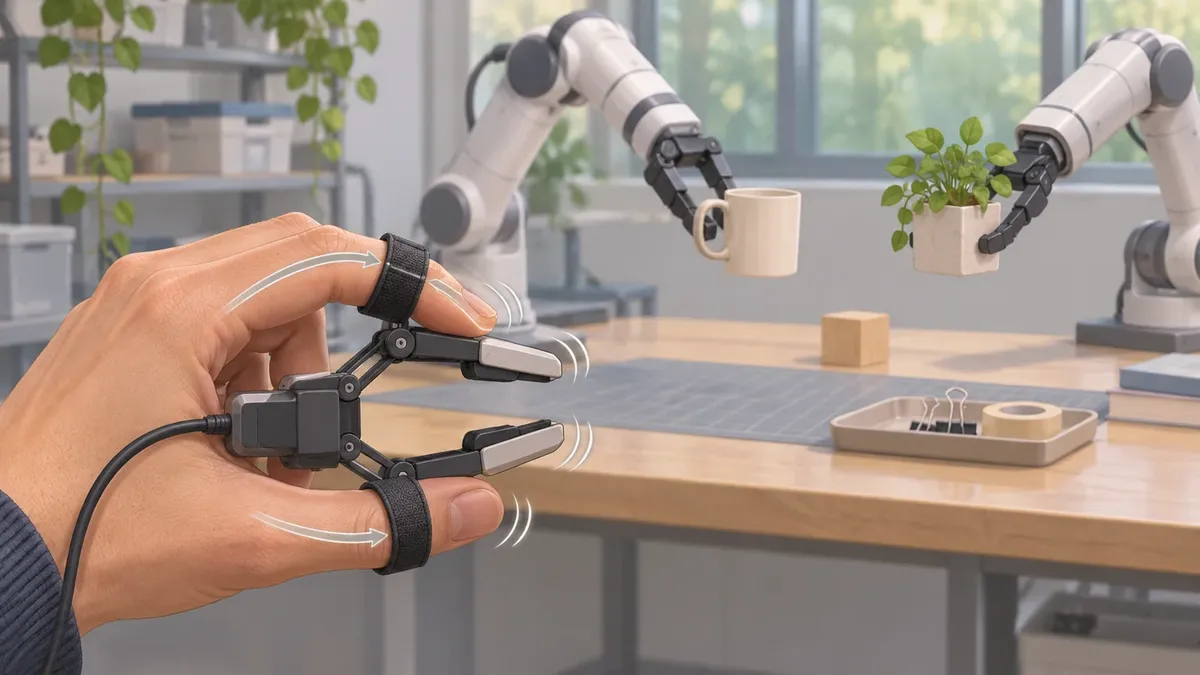
Teaching robots to use both hands takes many demonstrations—and collecting them can be tiring or cumbersome. YUBI is a handheld gripper designed to make that process more natural, alongside a system for recording human demonstrations. Its authors report a large dataset and robot tests, but the results are early evidence, not proof that the approach will work broadly.
Robots can learn manipulation skills from examples, but those examples have to be collected somehow. Operating a robot directly can require specialist equipment and training. Handheld grippers offer another route: a person moves a device that resembles the robot’s gripper, while cameras and sensors record the motion. The challenge is making that device comfortable and precise enough for tasks involving small objects or two hands working together.
A team of researchers introduces YUBI, short for Yielding Universal Bidigital Interface, as a redesign of this kind of handheld interface. The central question is whether a finger-aligned gripper and a streamlined recording setup can support more precise, sustained data collection—and whether the resulting demonstrations can train policies that run on different robot arms.
A gripper that follows the fingers
Many earlier handheld interfaces use a pistol-like handle, placing the operator’s fingers away from the point where the gripper holds an object. YUBI instead makes the gripper jaws move with a natural pinch: the thumb drives one jaw, while the index and middle fingers drive the other. The researchers describe the mechanism as “yielding,” meaning the jaws follow finger movement rather than resisting it with motorized actuation during data collection. A support grip helps stabilize the device.
For recording, the system combines cameras and a jaw-aperture sensor with virtual-reality (VR) tracking of the gripper’s position and orientation. In the main setup, the VR headset is attached to a fixed rig rather than worn on the operator’s head. The team also describes a portable configuration for recording tasks outside a tabletop workspace. The hardware is designed to be made with 3D-printed parts; the paper estimates a gripper cost below US$200, excluding the VR tracking system.
The report says the resulting dataset contains 54,560 hours of recordings, 5.56 million episodes and 1,300 tasks. Episodes are broken into smaller action demonstrations with language labels. Tasks span activities such as sorting, assembly, insertion and clothing-related manipulation. These totals describe recorded data, not necessarily demonstrations that are all equally useful or successful.
What the tests show
The authors compared YUBI with an earlier UMI-style gripper in a user study involving 10 operators. In a pick-and-place test with hex nuts, both devices performed well on larger nuts; YUBI did better on several smaller ones. For the smallest, M3 nut, the paper reports success in 44% of YUBI attempts and 14% of UMI attempts. In a separate set of five tasks, operators completed tasks faster with YUBI than with UMI. These findings suggest an advantage in those particular tests, not a general measure of performance across all users or manipulation tasks.
The team also trained a vision-language-action policy using the demonstrations and tested it on three bimanual robot platforms fitted with YUBI grippers. The policy succeeded on some tasks, including stacking cups and unfolding glasses. In a focused comparison on sorting YUBI parts, task-specific training after pretraining on an 8,434-hour subset produced 13 successful trials out of 20, compared with 2 out of 20 without that pretraining. That is encouraging evidence for this task and setup, but the trial counts are small and do not establish that the same benefit will hold across other tasks.
What remains uncertain
The paper is a technical report available as an arXiv preprint, rather than evidence here of independent peer review. The user study is small, and robot evaluations report only 20 trials per task. The authors also acknowledge that very fine precision and tactile-sensitive tasks—such as tight cable insertion or handling fragile materials—remain challenging. They call for broader tests of how YUBI data combine with other data and how policies generalize across tasks.
There is also a version discrepancy worth noting: the abstract supplied with the arXiv record describes a dataset of 8,434 hours, 1.20 million episodes and 119 tasks, while the retrieved November 2026 report describes 54,560 hours, 5.56 million episodes and 1,300 tasks. The report itself identifies 8,434 hours as the subset used in its pretraining study. These figures should not be treated as interchangeable; readers should check the specific paper version and dataset release when interpreting them.
Overall, YUBI’s contribution is a proposed data-collection tool and an open hardware-software-dataset stack, paired with initial demonstrations of usability and robot transfer. Whether that approach leads to robust, broadly capable bimanual robots remains an open research question.
- robotics
- robot manipulation
- robot learning
- human demonstrations
- bimanual robots
- data collection
- YUBI
Reviewed cross-references
These connections were reviewed by a model, not independently fact-checked by a human. Similarity does not imply agreement; consult the original papers and the evidence below.
How CHORD helps robot hands learn from human demonstrations
Supporting evidence: Both studies report that human demonstrations can contribute useful supervision for dexterous robot manipulation: YUBI reports improved sorting after pretraining on an 8,434-hour dataset and task-specific post-training, while CHORD uses contact-wrench-guided reinforcement learning to learn from human references. The evidence supports this bounded proposition, not a direct performance comparison: the methods, tasks, robots, and evaluation protocols differ.
Model review: · openai-codex/gpt-6-luna
Evidence and provenance
Selected excerpts, not complete papers. PDF extraction can omit figures or damage equations, tables and reading order; sources may be preprints.
2606.10244v2 — Original paper
Excerpt reference:
static/papers/2606.10244v2.md:155-211
Basis: Paper text
Source SHA-256:401eb9e868b66e7d063a2af4e2448fc5c39496d479eeff99d08d47ebb1cce2c22607.00033v3 — Original paper
Excerpt reference:
static/papers/2607.00033v3.md:57-95
Basis: Paper text
Source SHA-256:ba19d5c15c6b4677114e92ead861c1be71889701ad0cce409c614d6f3903a59b2607.00033v3 — Original paper
Excerpt reference:
static/papers/2607.00033v3.md:1025-1035
Basis: Paper text
Source SHA-256:ba19d5c15c6b4677114e92ead861c1be71889701ad0cce409c614d6f3903a59b
Related reading
Automatically matched by shared topic keywords. These links do not imply that the sources agree or establish a consensus.
ToolDex records human tool improvisation—and tests where AI falls short
Source published
Shared keywords: human demonstrations, robot learning
H2RB preprint explores how human demonstrations can teach robots new tasks
Source published
Shared keywords: human demonstrations, robot learning
Teaching Robots Through Verified Synthetic Touch
Source published
Shared keywords: robot learning, robot manipulation
How CHORD helps robot hands learn from human demonstrations
Source published
Shared keywords: human demonstrations
Can a general AI model control a robot arm?
Source published
Shared keywords: robot learning, robot manipulation