TRANSMISSION // 2606.10089v2
A Mathematical Case for Neural Flow Matching
Source published
A theory paper studies when neural networks can learn the velocity fields behind flow-matching generators, deriving training, generalization and sample-quality guarantees under specific assumptions.
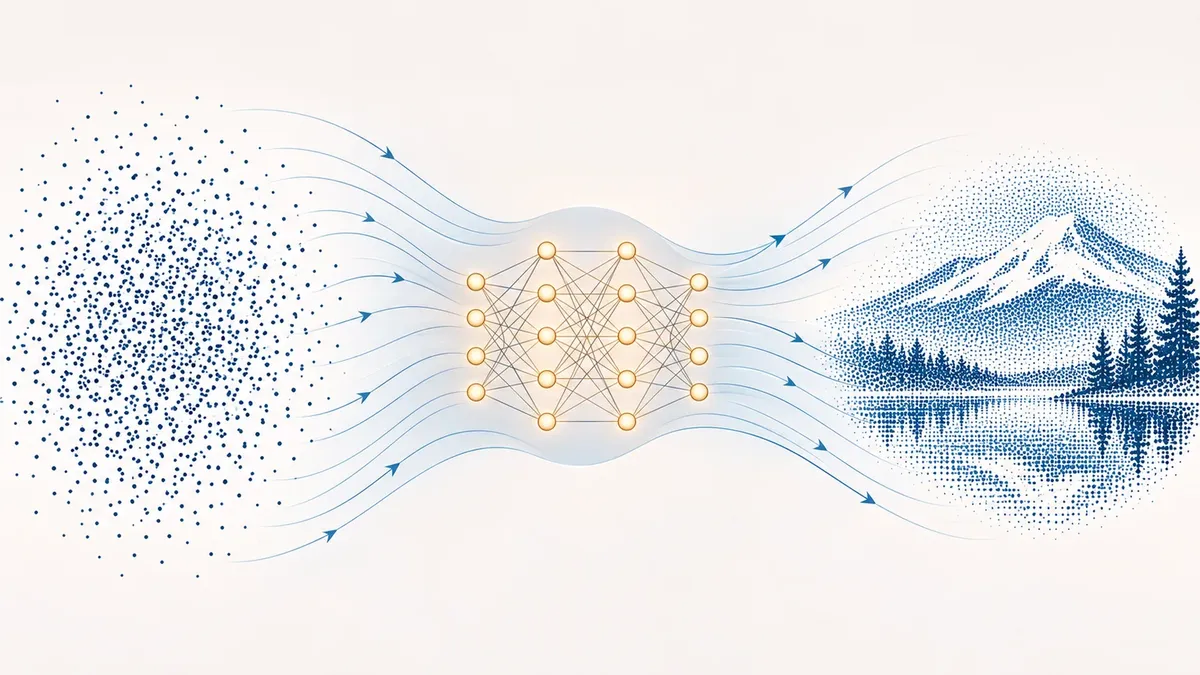
Flow matching gives a generative model a route from simple random inputs to data by learning how samples should move. A new theory paper asks what can be guaranteed when neural networks learn that motion—and how errors in learning it affect generated samples.
Flow-matching models generate data by learning a moving path between an easy-to-sample distribution, such as random noise, and a distribution resembling the training data. At each point along the path, a model predicts a velocity: the direction and speed in which a sample should move. Following those predictions produces a final sample.
The approach is used in generative modeling, but its theoretical behavior is not automatic. How reliably can a neural network learn the conditional velocity field used for training? And if that learned field is imperfect, what can be said about the distribution of the samples it generates?
In A Theory on Flow Matching with Neural Networks, Yihan He and colleagues develop mathematical guarantees for one particular setting: conditional velocity fields represented by two-layer ReLU neural networks in an over-parameterized regime. “Over-parameterized” means the network has enough adjustable parameters for the analysis to apply; the results are not a blanket guarantee for every network size or architecture.
From learning motion to generated samples
The paper’s theoretical results connect three stages of the process. First, the authors establish convergence guarantees for gradient descent when training the neural network to match the conditional velocity field. In broad terms, these results describe conditions under which the optimization procedure can make progress toward a solution of the training objective.
Second, they derive generalization bounds for that velocity-field matching objective. A training objective measures how well the model fits its training examples; a generalization bound addresses how well that fit carries over beyond those examples. The authors say their analysis builds on results for multi-task representation learning with unbounded losses—a framework they argue may also matter beyond flow matching.
Finally, the paper uses the training and generalization analysis to give guarantees in Wasserstein distance for samples produced by the induced flow. Wasserstein distance is one way to measure how far apart two probability distributions are, by considering the effort needed to transport probability mass between them. Here, it provides a mathematical bridge between errors in learning the model’s motion and differences between the generated distribution and the intended one.
This chain is the central contribution: rather than treating training, generalization and generated output as separate questions, the paper relates them. The abstract reports that the authors also validate the theoretical results through experiments on synthetic data and real-world image benchmarks, and that they have released code. It does not provide the experiment designs, benchmark names, numerical results or comparisons, so the experiments cannot be described in more detail from the available evidence.
What the guarantees do—and do not—say
These are conditional mathematical guarantees, not a promise that any flow-matching system will reliably produce high-quality images. The abstract specifies the two-layer ReLU, over-parameterized setting for the gradient-descent convergence result, but does not state the assumptions or exact forms of the bounds. Without those details, it is not possible to assess how restrictive the conditions are, how the guarantees scale, or how closely practical models meet them.
The abstract also does not establish that the method outperforms other generative approaches, or that the experimental results demonstrate a real-world advantage. Mathematical bounds can clarify what follows when their assumptions hold; they do not, on their own, settle how useful those conditions are in a given application.
This account is based on the paper’s abstract, not a full-text examination. The source is an arXiv preprint, so its claims should be treated as research findings reported by the authors rather than as independently validated conclusions. The abstract’s broad description supports the outline of the contribution, but not a detailed appraisal of its proofs or experiments.
- flow matching
- generative AI
- neural networks
- machine learning theory
- generalization bounds
Reviewed cross-references
These connections were reviewed by a model, not independently fact-checked by a human. Similarity does not imply agreement; consult the original papers and the evidence below.
ChainFlow drafts several AI tokens by predicting where a model’s internal states go next
Shared method: Both papers use flow matching with neural networks, but for different tasks: He et al. analyze training and sampling guarantees for conditional velocity fields in generative modeling, while ChainFlow uses few-step flow matching over a language model’s hidden-state latents to draft tokens. This connects their methods, not their theoretical guarantees or task-specific results.
Model review: · openai-codex/gpt-6-luna
Evidence and provenance
Selected excerpts, not complete papers. PDF extraction can omit figures or damage equations, tables and reading order; sources may be preprints.
2606.10089v2 — Original paper
Excerpt reference:
static/papers/2606.10089v2.md:13-100
Basis: Paper text
Source SHA-256:3975e7b702ad1479ba47c1614c97e4dbd0d32cfbadf76f7a15a134f640515c9e2611.08669v1 — Original paper
Excerpt reference:
static/papers/2611.08669v1.md:100-158
Basis: Paper text
Source SHA-256:19020db1027c73a1cea96f8181f722cb9a641c80061e522e698ed8f23bd934b9
Keeping Generated Graphs Within Mathematical Bounds
Shared method: Both papers use flow matching, but in distinct settings: He et al. study neural conditional velocity fields for generative sampling, whereas Yang et al. formulate flow matching on a constrained Stiefel manifold for spectral graph generation. The shared method does not establish that either paper’s guarantees or experimental outcomes transfer to the other setting.
Model review: · openai-codex/gpt-6-luna
Evidence and provenance
Selected excerpts, not complete papers. PDF extraction can omit figures or damage equations, tables and reading order; sources may be preprints.
2606.10089v2 — Original paper
Excerpt reference:
static/papers/2606.10089v2.md:101-159
Basis: Paper text
Source SHA-256:3975e7b702ad1479ba47c1614c97e4dbd0d32cfbadf76f7a15a134f640515c9e2611.05436v1 — Original paper
Excerpt reference:
static/papers/2611.05436v1.md:102-188
Basis: Paper text
Source SHA-256:f461c5100aa225f6b4cb69474a130646d22f83fa38db58d1ec10b0b355a2aea2
Related reading
Automatically matched by shared topic keywords. These links do not imply that the sources agree or establish a consensus.
Teaching Image and Video Generators to Forget Specific Concepts
Source published
Shared keywords: flow matching, generative ai
CoMoFlow Gives Protein Shape Generation a Set of Motion Controls
Source published
Shared keywords: flow matching, generative ai
Why robot actions may need only one generative step
Source published
Shared keywords: flow matching, generative ai
How rare features can fade while their numbers hold steady
Source published
Shared keywords: generative ai
Why sparse attention’s wiring can shape its gradients
Source published
Shared keywords: machine learning theory