TRANSMISSION // 2606.10017v3
Updated antimatter cosmic-ray models for dark matter
Source published
Researchers calculate updated antiproton and antideuteron fluxes from dark-matter annihilation or decay. The MIN–MAX spread narrows for antiprotons under newer transport benchmarks; this is a model result, not a detection.
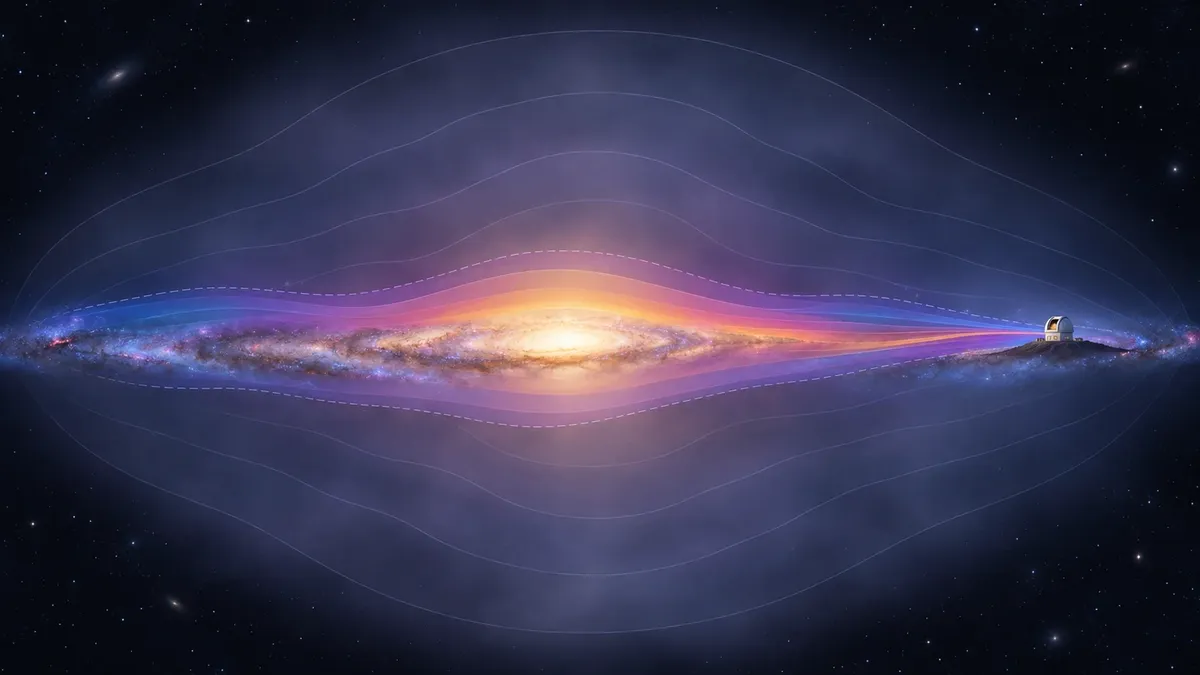
Could antimatter cosmic rays help test ideas about dark matter? Marco Cirelli, Mattia Di Mauro and Arpan Kar calculate how antiprotons and antideuterons from dark-matter annihilation or decay might propagate through the Milky Way. Their work supplies updated model inputs for future searches—not evidence that dark matter has been found.
Antiprotons and antideuterons arriving from space could carry clues about dark matter. If dark-matter particles annihilate or decay in the Milky Way, they may produce these cosmic rays. But predicting what an instrument might detect requires more than estimating production: particles diffuse through the Galaxy, lose or gain energy, and interact with interstellar gas.
A study by Marco Cirelli, Mattia Di Mauro and Arpan Kar asks how updated production spectra and Galactic transport models affect the predicted fluxes. It also examines how much antiproton predictions vary across selected transport benchmarks. The authors provide calculated flux tables for other researchers to use in indirect searches.
Modeling production and travel
The team combines particle-production spectra from CosmiXs with updated models of cosmic-ray propagation. They calculate antiproton and antideuteron fluxes for dark-matter annihilation and decay, across a range of masses and possible final states. For antideuterons, the production spectrum uses the Wigner coalescence model with an Argonne wavefunction.
For Galactic transport, the researchers use three schemes—Slim, Big and Quaint—with MIN, MED and MAX benchmark settings. These represent different choices for how cosmic rays move through the Galaxy. A semi-analytic calculation includes spatial diffusion, convection, energy losses and diffusive reacceleration, which can change particle energies. The study also considers three dark-matter halo profiles—NFW, Einasto and Burkert—and updated models for antinucleus interactions with interstellar matter, informed by ALICE measurements.
The authors compare their calculations with older PPPC4DMID results and check them against results in the literature and publicly available numerical tools. Such comparisons are checks on the calculations; they do not establish scientific consensus. The paper provides tables of interstellar fluxes over a broad kinetic-energy range for reuse in further studies.
What changes—and what does not
The paper’s central uncertainty finding concerns antiprotons: the spread between the MIN and MAX transport benchmarks is reduced compared with the older propagation models used in PPPC4DMID. The authors report this reduction for the updated schemes, with a more prominent effect in Big and Quaint. They present antideuteron flux predictions too, but do not establish the same comparative MIN–MAX reduction for antideuterons.
A narrower benchmark spread can help when researchers compare a possible dark-matter contribution with cosmic-ray measurements and an astrophysical background. The paper illustrates this potential using antiproton observations. It does not report a dark-matter signal in those data. The authors note that current antiproton measurements are broadly consistent with a predominantly secondary origin: ordinary cosmic-ray interactions can also produce antiprotons.
The updated fluxes are not simply the older estimates with narrower uncertainty. The paper reports an upward shift in many of its new predictions, especially for annihilating dark matter. It attributes much of this to updated halo profiles and a higher adopted local dark-matter density than in the older comparison. Differences in production spectra also affect predictions by channel and energy. Thus, the comparison reflects several changed inputs, not transport alone.
How to read the results
These are model calculations, not direct measurements. Predictions depend on choices including dark-matter mass, annihilation or decay products, halo profile and cosmic-ray transport. MIN, MED and MAX explore variation within specified benchmark frameworks; a smaller spread among those benchmarks does not remove all theoretical or observational uncertainty.
The authors also make choices relevant to applications. They omit tertiary antiprotons—particles altered by non-annihilating interactions in interstellar gas—citing computational complications and describing the choice as conservative. They discuss an average solar-modulation treatment using a Fisk potential to estimate top-of-atmosphere fluxes, particularly relevant at low energies. This is distinct from the publicly tabulated interstellar fluxes, which are the fluxes before that solar-modulation treatment.
The work is available as an arXiv preprint, which has not necessarily been peer reviewed. This account is based on the provided paper text and abstract, not an independent reanalysis. The study’s practical contribution is updated, reusable flux inputs and a comparison showing reduced antiproton transport spread within the selected newer benchmarks—not a general guarantee of predictive accuracy or an experimental confirmation of dark matter.
- dark matter
- antiprotons
- antideuterons
- cosmic rays
- Galactic propagation
- CosmiXs
Related reading
Automatically matched by shared topic keywords. These links do not imply that the sources agree or establish a consensus.
GAPS: A balloon-borne search for rare cosmic antimatter
Source published
Shared keywords: cosmic rays, dark matter
A Southern Window on the Highest-Energy Gamma Rays
Source published
Shared keywords: cosmic rays, dark matter
Jupiter’s atmosphere offers an indirect way to study faint cosmic gamma rays
Source published
Shared keywords: cosmic rays
How ground-based telescopes are tracing the Universe’s most extreme particles
Source published
Shared keywords: cosmic rays
Fermi’s unidentified gamma-ray sources yield no convincing dark matter signal
Source published
Shared keywords: dark matter