TRANSMISSION // 2606.07700v3
A graph-based model for spotting essential genes
Source published
EssentialGIN combines protein-interaction networks with gene data to predict which genes are vital to cells. Its reported results are strongest for human genes, but dataset limits and evaluation details matter.
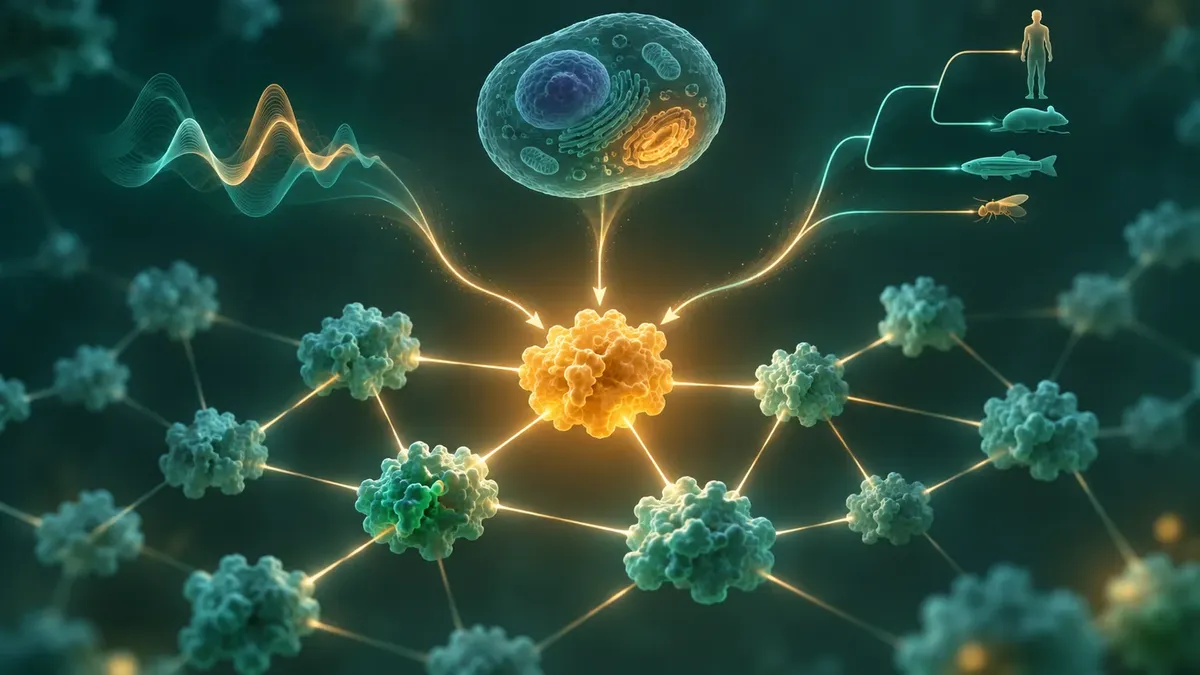
Genes do not work alone: the proteins they encode interact in networks, and other biological information may help identify which genes are essential for cell survival. A new model, EssentialGIN, combines those signals. Its authors report better human-gene predictions than several tested methods, while results vary across species and network datasets.
Why predict essential genes?
An essential gene is one whose loss can prevent a cell from surviving. Finding such genes can help researchers investigate basic cell biology and identify candidates for laboratory study. But testing genes one at a time can be slow and costly, so computational methods may help prioritize which ones to examine.
A common approach ranks proteins by their position in a protein–protein interaction (PPI) network. In such a network, proteins are nodes and reported interactions are links. A protein with many connections, for example, may look important. But network links can be incomplete or inaccurate, and a gene’s importance may depend on more than its network position.
The authors of EssentialGIN ask whether predictions improve when a model considers both network structure and other biological information. They focus on a graph isomorphism network, or GIN, a type of graph neural network designed to distinguish patterns in graphs.
What the researchers did
The team adapted a GIN for node classification: rather than classify a whole network, the model predicts whether each gene is essential. It first learns representations of proteins using their connections in a PPI network. It then combines those representations with gene-level information, including expression measurements, subcellular localization and orthology—whether genes in different species share an evolutionary relationship.
The researchers evaluated the approach using gene-essentiality labels from the OGEE database and three PPI resources: DIP, BioGRID and STRING. They compared it with methods including network centrality measures, machine-learning models, Node2Vec embeddings followed by a multilayer perceptron, and the graph-attention model EPGAT. The evaluation included E. coli, yeast, fruit fly and human genes. The paper describes stratified training and test splits, repeated runs, and reporting average performance; it also refers to ten-fold cross-validation in its dataset description.
Because essential genes are a minority in the human dataset, the authors report several measures. AUROC assesses how well a method ranks positives above negatives across thresholds. Precision–recall measures such as AUPR can be especially informative when positives are relatively rare: they focus on how many predicted positives are correct and how many actual positives are found.
What they found
The results are not a single across-the-board win. In E. coli, other methods performed best on the reported AUROC comparisons; results for yeast and fruit fly also varied by PPI network and comparator. The authors describe EssentialGIN as comparable to strong alternatives for these organisms, rather than consistently superior.
For human genes, EssentialGIN with expression data performed strongly in the authors’ comparisons. For example, on STRING, the paper reports an AUROC of 92.89 and an AUPR of 68.61 for that configuration. On DIP, the corresponding reported values are 87.09 and 63.53. Adding expression data generally improved results in the study, while localization and orthology data had smaller, mixed effects. The authors also note that centrality-based methods can look better under AUROC than they do under precision–recall measures, a caution when interpreting results on imbalanced data.
These findings support a practical point: combining network structure with biological features can help rank candidate genes, and the best-performing inputs depend on the organism and interaction network. They do not show that a model’s predictions establish whether a gene is essential in a living system. Experimental validation remains necessary.
What remains uncertain
The work is a preprint on arXiv, not evidence here of peer review. Its comparisons also have limits. The authors say the EPGAT implementation was unavailable, so some EPGAT results were taken from a previous publication rather than produced in the same evaluation pipeline. Results depend on the chosen PPI dataset, labels and features; interaction networks can contain missing or erroneous links. The paper’s descriptions of evaluation include both repeated train/test splits and ten-fold cross-validation, so readers should consult the full methods and code to clarify exactly how each comparison was conducted.
There are also apparent inconsistencies or extraction problems in some reported tables, including a STRING precision entry for Node2Vec-MLP that does not align clearly with the surrounding results. That makes it prudent to avoid over-interpreting individual values. The overall message is promising but bounded: EssentialGIN is a candidate-ranking method whose reported advantage is clearest in the human-gene experiments, not a replacement for laboratory tests or independent validation.
- essential genes
- graph neural networks
- protein interaction networks
- bioinformatics
- gene prediction
- EssentialGIN
Related reading
Automatically matched by shared topic keywords. These links do not imply that the sources agree or establish a consensus.
SIMBAD tests when traffic forecasts should trust the past
Source published
Shared keywords: graph neural networks
GraphToolbox puts electricity-forecasting models on a common track
Source published
Shared keywords: graph neural networks
A graph-learning method updates its view as connections appear
Source published
Shared keywords: graph neural networks
A New Geometry for Graphs Whose Neighbors Differ
Source published
Shared keywords: graph neural networks
Combining reviews, photos and descriptions helps recommend less-popular products
Source published
Shared keywords: graph neural networks