TRANSMISSION // 2606.07007v2
What Does It Mean for an AI to Learn a Concept?
Source published
A proposed geometric framework formalizes concept learning in sparse autoencoders and examines how concept learning and neuron interpretation can differ.
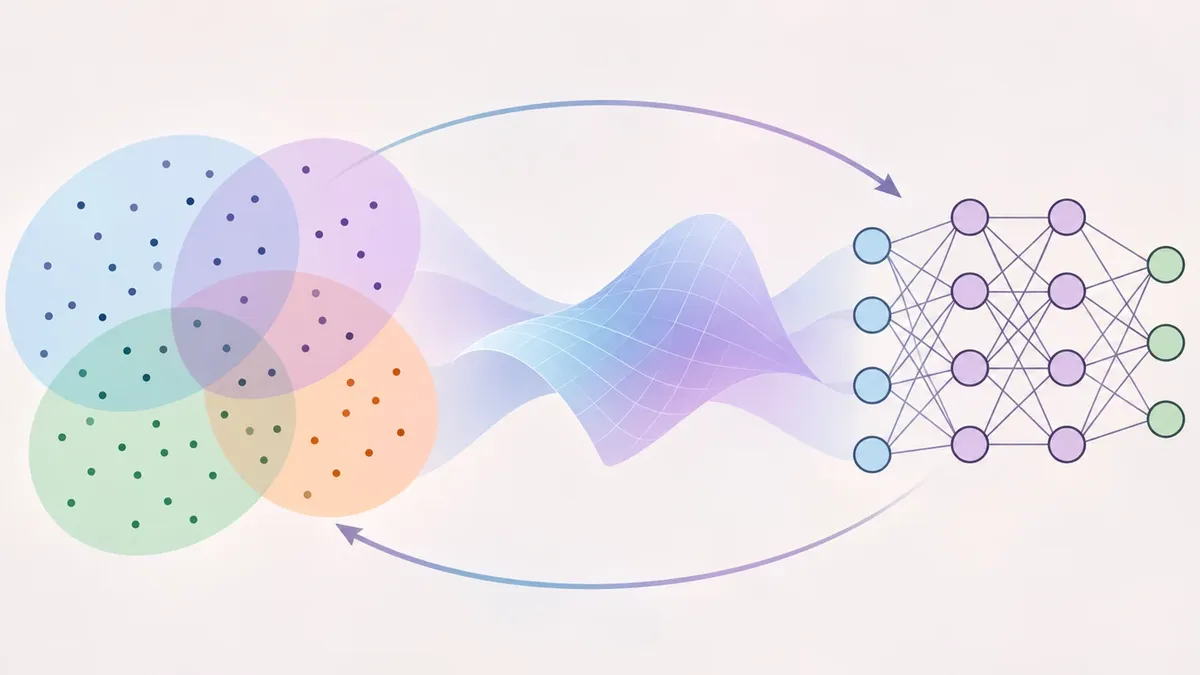
Sparse autoencoders are used to study neural-network features, but what does it mean for a feature to represent a human-defined concept? A theoretical preprint proposes a geometric framework for describing concept learning and its relationship to neuron interpretation.
The question: what counts as learning a concept?
Sparse autoencoders (SAEs) learn sparse feature representations of neural-network activity. Researchers use them to make internal patterns easier to study. But a principled definition of a “concept,” and of what it means for a model to learn one, remains unclear.
In an abstract-only preprint, Chenhao Zhang and colleagues propose a mathematical framework for addressing this problem. They formalize concepts as sets of data points and cast concept learning as a set-alignment problem: comparing human-defined concepts with concepts induced by a model.
This framing shifts attention from simply naming a feature to asking how a model’s representation relates to a defined set of examples. The abstract describes three increasingly strong notions of learning: detection, separation and approximation. It does not give their formal definitions, so their precise meanings cannot be established from the available source alone.
A geometric account of representations
The framework is intended to provide geometric conditions, error bounds and capacity constraints for when concepts can be represented by individual neurons or by multi-neuron units. In other words, it asks what properties of a concept and a model’s representation affect whether one unit—or a group of units—can capture it. The abstract does not supply the equations or bounds, so their assumptions and practical implications cannot be assessed here.
The authors also say their set-theoretic account addresses familiar SAE phenomena: feature splitting, feature absorption, feature families and hierarchical concepts. The abstract identifies these topics but does not detail the proposed explanations. It would therefore be premature to infer exactly how the framework describes any one of them.
Concept learning and neuron interpretation
The paper connects concept learning with neuron interpretation through formal concept analysis, a mathematical approach for organizing relationships between sets and attributes. The authors’ central point is that the two directions need not agree: the relationship between concepts and model units can have a many-to-many structure. They say concept lattices can organize that structure.
This challenges a simple one-to-one picture in which each human concept has one corresponding neuron, or each neuron has one definitive human-readable meaning. That is a broad implication of the reported many-to-many structure, not a detailed example supplied by the abstract. The available evidence does not explain how particular concepts or neurons are assigned within the framework.
What the experiments report
The authors say they illustrate their theory with synthetic-data experiments using ReLU and Top-K SAEs. They report that the experiments reveal effects of SAE size and sparsity on concept learning. The abstract gives no numerical results, specific direction of those effects, dataset details or evaluation procedures. It therefore does not support claims about which settings perform best or how large any effects are.
Because the evidence available here is limited to the abstract, it also does not let us evaluate the full mathematical derivations, experimental design or the authors’ discussion of limitations. The experiments are described as synthetic; the abstract alone cannot establish how well the framework applies to real-world models. That is a limit on what can be assessed from this source, not a finding that the paper’s results do or do not generalize.
A framework, not a settled answer
The proposal offers a vocabulary for making claims about concept representation more precise: it distinguishes several notions of learning, considers individual and multi-neuron representations, and treats concept–unit relationships as potentially many-to-many. Whether the framework’s definitions and bounds are useful in practice depends on details that are not available in the abstract.
This article is based only on the abstract of the arXiv preprint, not a full-paper review. The supplied source does not establish whether the work has been peer reviewed. Its claims should be read as the authors’ proposed framework and reported synthetic experiments, rather than as settled evidence about concept representation across neural networks.
- sparse autoencoders
- AI interpretability
- concept learning
- neural networks
- formal concept analysis
Reviewed cross-references
These connections were reviewed by a model, not independently fact-checked by a human. Similarity does not imply agreement; consult the original papers and the evidence below.
Can neural networks have representational atoms?
Supporting evidence: Both studies describe semantic structure as potentially many-to-many rather than one feature per human concept: Zhang et al. frame concept learning and neuron interpretation as distinct directions of a relation, while Hu et al. report that sememes are more commonly represented by multiple atoms across layers than aligned to a single atom. This is a bounded conceptual parallel, not a direct replication: the papers use different definitions and analyses, and the cited findings concern different models and semantic units.
Model review: · openai-codex/gpt-6-luna
Evidence and provenance
Selected excerpts, not complete papers. PDF extraction can omit figures or damage equations, tables and reading order; sources may be preprints.
2606.07007v2 — Original paper
Excerpt reference:
static/papers/2606.07007v2.md:402-485
Basis: Paper text
Source SHA-256:749250f176032d8b1f3a89c224272626b33f7e523af372994a66848dd33984e92611.14168v1 — Original paper
Excerpt reference:
static/papers/2611.14168v1.md:60-99
Basis: Paper text
Source SHA-256:29a97a251154652c5ee4598b2ea8c06e0ef898b5ab7b9dd4cb351ced390b1449
Related reading
Automatically matched by shared topic keywords. These links do not imply that the sources agree or establish a consensus.
Glyph turns hidden medical AI features into testable disease-risk clues
Source published
Shared keywords: sparse autoencoders
Why AI explanations can look convincing and still be wrong
Source published
Shared keywords: ai interpretability
Why sparse autoencoders hit different limits in different layers
Source published
Shared keywords: ai interpretability, sparse autoencoders
How Moral Concepts Are Organized Inside Language Models
Source published
Shared keywords: ai interpretability, sparse autoencoders
Why crowded SAE features may be more stable
Source published
Shared keywords: ai interpretability, sparse autoencoders