TRANSMISSION // 2606.06479v3
Training recurrent networks without unrolling them
Source published
A proposed method trains recurrent networks through supervised memory updates rather than backpropagating through every time step. The authors report gains on language and pixel-sequence modeling, but the available evidence is only the paper’s abstract.
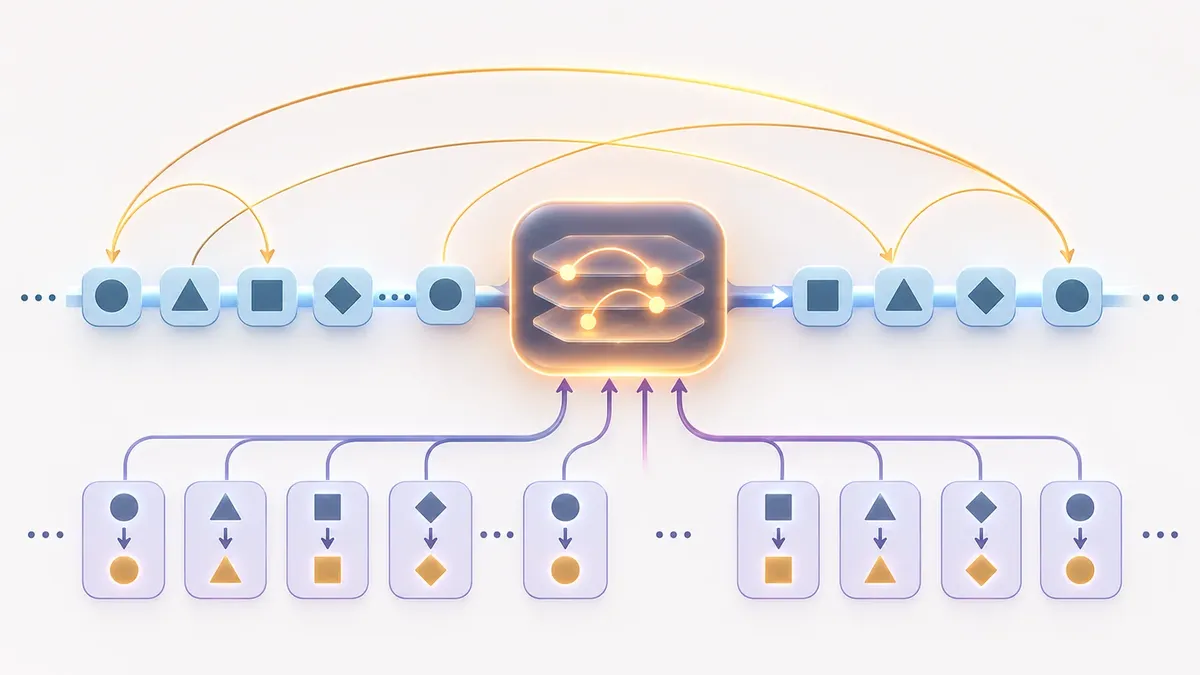
Recurrent networks carry a compact state from one step to the next, but learning which past information matters can be difficult. Akarsh Kumar and Phillip Isola propose a way to train these networks without tracing gradients through the full sequence.
Recurrent neural networks (RNNs) process sequences by updating an internal memory as each new input arrives. That setup can represent information over time, but training it poses a challenge: the model must learn how earlier inputs affect later outcomes. The usual method, backpropagation through time (BPTT), sends learning signals backward across successive steps. The authors say this is sequential, limiting parallel training, and that gradients can vanish or grow uncontrollably over long sequences.
In “Pretraining Recurrent Networks without Recurrence,” Akarsh Kumar and Phillip Isola propose Supervised Memory Training (SMT), which aims to train nonlinear RNNs without backpropagating through their recurrent steps. The central idea is to treat memory updating as a supervised prediction problem: given the current memory and the next input, predict the next memory. In other words, the model learns a one-step memory transition rather than learning through a fully unrolled sequence.
But where do the target memory states come from? The abstract says the researchers train a Transformer-based encoder using a predictive-state objective. The encoder is intended to retain information from the past that is needed to predict what comes next. SMT uses its outputs as labels for the RNN’s memory transitions. This separates two questions: what information should be remembered, and how should the RNN update that memory?
The authors report that this approach allows updates to be trained in parallel across sequence positions. They also describe a stable, constant-length gradient path between tokens, rather than a path whose length grows with the sequence. According to the abstract, SMT outperforms BPTT when pretraining several RNN architectures on language-modeling and pixel-sequence-modeling tasks, and helps the networks capture long-range dependencies.
Those are promising claims, not a general verdict on recurrent networks. The available source for this article is the paper’s abstract only; it does not provide the experimental setup, model sizes, datasets, numerical results, or details needed to assess how broad or substantial the reported improvements are. The abstract also does not establish that the method will be more effective across other tasks or at larger scales. It describes the work as an arXiv preprint, which may not have undergone peer review. The paper’s full methods and results are needed to judge the evidence and its limitations.
The proposal reframes a familiar training problem: instead of teaching a recurrent model by sending credit backward through every step, first construct useful memory-transition targets and teach the model to reproduce them. Whether that recipe delivers consistently in practice remains a question for the full paper and further evaluation. Read the source preprint.
- recurrent neural networks
- machine learning
- AI training
- Supervised Memory Training
- sequence modeling
Related reading
Automatically matched by shared topic keywords. These links do not imply that the sources agree or establish a consensus.
A Transformer-style model designed for tiny AI chips
Source published
Shared keywords: sequence modeling
Yggdrasil routes recurrent experts for state tracking
Source published
Shared keywords: machine learning, recurrent neural networks
Can Tiny Changes to Images and Text Discourage AI Training?
Source published
Shared keywords: machine learning
Why sign-based optimizers may beat SGD in some settings
Source published
Shared keywords: ai training
How Noisy Neural Networks Might Replay Experiences Faster
Source published
Shared keywords: recurrent neural networks