TRANSMISSION // 2606.06345v2
Can synthetic brain data make image decoding more efficient?
Source published
A pretrained fMRI model supplied synthetic brain responses that improved image retrieval in some low-data tests. The gains depended on the dataset and how much synthetic data was added.
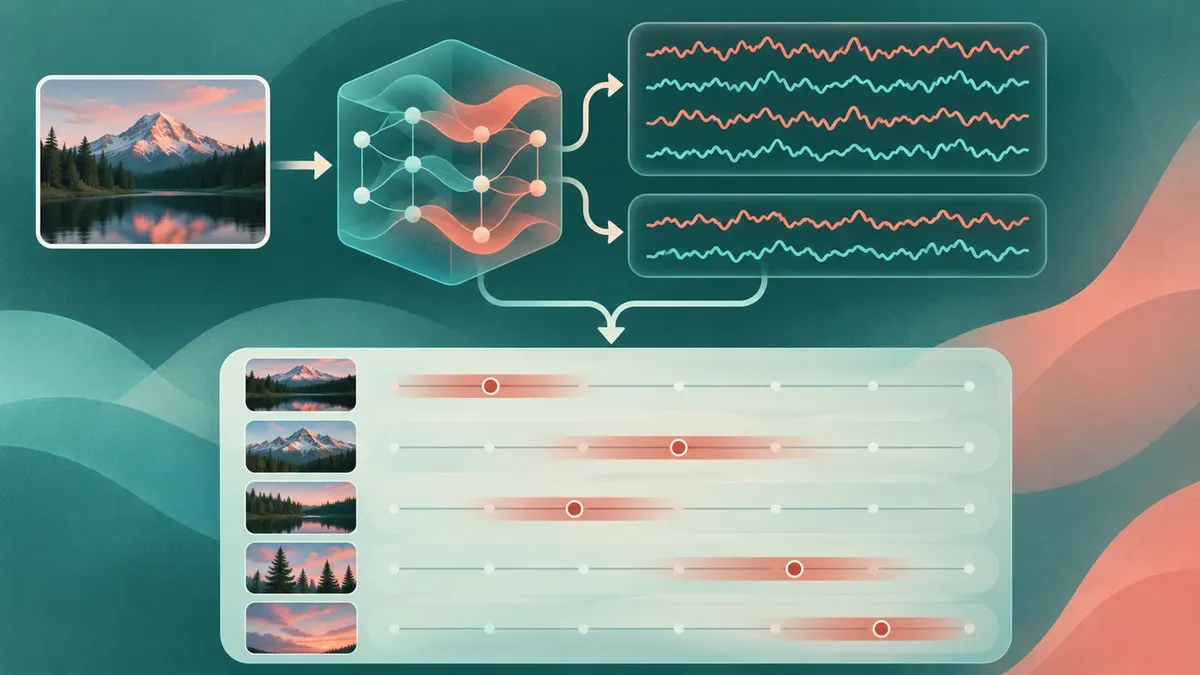
Brain-to-image systems learn to connect patterns of brain activity with visual content, but training them can require many hours of scanning. A new preprint tests whether a model trained to predict brain responses can generate extra examples—and finds that this can help, provided the synthetic data are used selectively.
The data bottleneck
Functional MRI (fMRI) records changes in blood oxygenation associated with brain activity. To decode images from fMRI, researchers train a system to map measured brain responses to a representation of the images people saw. Such systems can perform better with many stimulus–response examples, but collecting them takes time in a scanner.
The study asks whether a model trained to predict brain responses to stimuli can provide useful extra training examples for an image decoder. The authors use TRIBE v2, a model pretrained on more than 1,000 hours of fMRI responses to video, audio and language. TRIBE predicts population-level responses and was not adapted to the target participants for these experiments. The supplied evidence does not establish whether those participants were absent from its pretraining data.
From predicted responses to image retrieval
The researchers applied TRIBE v2’s visual pathway to still images by turning each image into a short video with repeated frames. TRIBE then predicted an fMRI response for each image. These predictions were paired with images not seen by the relevant participant in the study data and added to training sets containing different amounts of real fMRI.
The team tested the approach on two datasets: the 7-tesla Natural Scenes Dataset (NSD) and the 3-tesla BOLD5000 dataset. They trained both ridge-regression models and deeper neural-network decoders. Rather than test one synthetic-to-real mixture, they evaluated grids combining different proportions of measured data with different amounts of synthetic data. Performance was assessed on held-out, real fMRI, using Top-10 image retrieval: whether the correct image appeared among the ten highest-ranked candidates.
The experiments also included controls. In one, synthetic responses were replaced with random noise; in another, TRIBE responses were shuffled across images, breaking the image–response pairing. These tests help distinguish useful stimulus-linked information from gains due merely to adding more training examples.
Gains, with a tuning requirement
In selected low- and medium-data settings, TRIBE augmentation improved Top-10 retrieval compared with training on the same amount of real data alone. The largest reported relative improvement was up to 68%. The paper also describes settings where adding synthetic examples brought performance near that of a decoder trained on the full real-data set. These results varied across dataset, decoder type and amount of real data.
More synthetic data was not always better. Performance could level off or decline as the augmentation factor increased, and the useful real-to-synthetic balance differed between NSD and BOLD5000, as well as between decoder families. The shuffled and noise controls performed worse than TRIBE in the reported comparisons, supporting the interpretation that the pairing between image and predicted response matters.
The authors also tested image reconstruction with a separate fMRI-to-image model, DynaDiff, using NSD. At a moderate augmentation level, several reconstruction metrics improved across the four participants tested. This is an additional, small-scale result—not evidence that every reconstruction system or dataset would benefit in the same way.
Training only on synthetic responses produced above-chance retrieval in some settings: for the deep decoders on both datasets and for the ridge decoder on BOLD5000. But the ridge decoder’s synthetic-only result on NSD was around chance. The authors therefore do not present synthetic responses as a general replacement for measured, participant-specific fMRI.
What remains uncertain
A key mismatch is built into the method: TRIBE was trained on naturalistic videos, while the experiments use repeated-frame clips made from still images. That makes the input unusual for the model. Its predictions also represent population-level responses, not the individual response patterns of a particular participant. These mismatches may help explain why gains saturate and why the synthetic-data amount needs tuning.
The evidence comes from two datasets with four participants per dataset in the reported subject-level comparisons. The reconstruction experiment also involved four NSD participants. The findings therefore need testing across more people, datasets and decoding approaches before their broader reach is clear. The authors excluded exact images seen by each participant in NSD or BOLD5000 from the augmentation pool. Separately, they note that published training-data descriptions for DINOv2 and V-JEPA 2 do not list COCO, but their web-scale training corpora mean prior exposure to COCO images or perceptual near-duplicates cannot be ruled out.
The work is available as an arXiv preprint. The supplied source does not establish whether it has also been peer reviewed or published elsewhere. Its results describe controlled experiments on particular datasets and models; they do not establish that synthetic fMRI can eliminate the need for scanning or reliably improve brain decoding elsewhere. The central takeaway is narrower: predicted brain responses may help stretch limited training data, but the mixture must be tested and calibrated for the task at hand.
- fMRI
- brain decoding
- synthetic data
- TRIBE v2
- image retrieval
- data augmentation
- neuroscience
Reviewed cross-references
These connections were reviewed by a model, not independently fact-checked by a human. Similarity does not imply agreement; consult the original papers and the evidence below.
Can EEG stand in for slower brain imaging?
Supporting evidence: Both papers report gains in downstream decoding after adding generated neural data in limited-data settings: the TRIBE study reports improved image retrieval for selected real/synthetic training ratios, while Yao et al. report higher target-class F1 for generated BOLD examples in low-sample task decoding. This supports only the bounded possibility that generated neural examples can aid decoding; the modalities, generation methods, tasks and evaluation designs differ, so the results are not a direct replication or comparison.
Model review: · openai-codex/gpt-6-luna
Evidence and provenance
Selected excerpts, not complete papers. PDF extraction can omit figures or damage equations, tables and reading order; sources may be preprints.
2606.06345v2 — Original paper
Excerpt reference:
static/papers/2606.06345v2.md:1376-1422
Basis: Paper text
Source SHA-256:a6976d8b5b06a0ad0853d37527766610972a1ef9dbeca89499f41576da1b2c8d2611.28507v1 — Original paper
Excerpt reference:
static/papers/2611.28507v1.md:2238-2326
Basis: Paper text
Source SHA-256:1273588156dd01b29f5ac57c577e3f78b136cf2cf835e8277727c654fbcb3637
Related reading
Automatically matched by shared topic keywords. These links do not imply that the sources agree or establish a consensus.
Synthetic surgical images with labels: a bleeding-detection test
Source published
Shared keywords: data augmentation, synthetic data
Can synthetic speech features help AI distinguish memory-clinic groups?
Source published
Shared keywords: data augmentation, synthetic data
Can AI benchmarks renew themselves? VeRA’s answer
Source published
Shared keywords: synthetic data
Can AI-generated viewing histories help overlooked titles get recommended?
Source published
Shared keywords: synthetic data
How BOOST Weighs Synthetic AI Training Data
Source published
Shared keywords: synthetic data