TRANSMISSION // 2606.05166v3
A simpler route through Planck’s large-scale polarization data
Source published
A new compressed likelihood aims to make Planck’s low-multipole polarization measurements easier to use in analyses that rely on Gaussian statistics. Tests reported in the paper find close agreement with the original likelihood, while leaving important limits on the approximation clear.
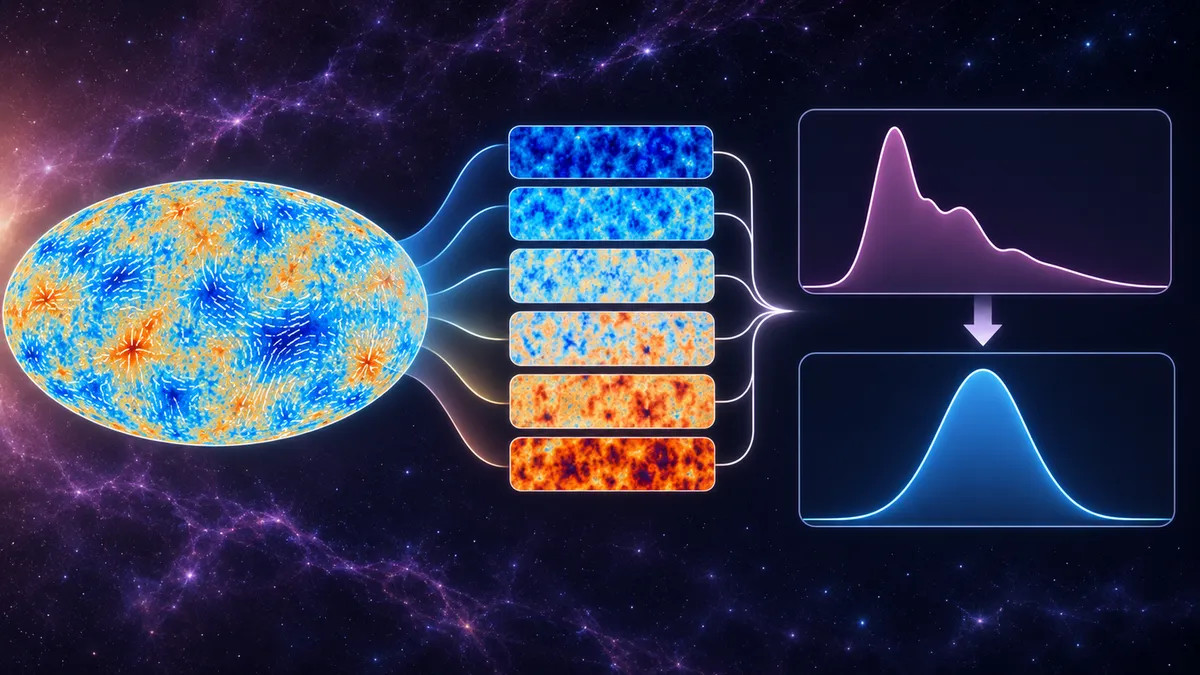
The cosmic microwave background carries clues about the universe’s reionization history. But extracting them from Planck’s large-scale polarization data is statistically tricky: the likelihood is not shaped like a simple bell curve, as some forecasting tools require. Nanoom Lee’s preprint offers a compact approximation designed to bridge that gap.
The cosmic microwave background (CMB) is the afterglow of the early universe. Its polarization on large angular scales includes a signal associated with reionization, when free electrons scattered CMB photons. The strength of this signal helps constrain the reionization optical depth, usually written as τ, a parameter in the standard cosmological model.
A challenge is that Planck’s low-multipole polarization likelihood—the statistical description of how well different theoretical signals fit the data—is not a simple Gaussian, or bell-shaped curve. That makes it awkward to use in tools such as Fisher matrix analyses, which estimate how precisely parameters can be measured and how errors may affect an analysis. Researchers may instead use a simplified prior on τ or leave out the low-multipole data, but those shortcuts can discard information or leave τ weakly constrained.
In this preprint, Nanoom Lee develops a compact approximation to Planck’s SRoll2 low-multipole E-mode polarization likelihood. E modes are one pattern of CMB polarization. The SRoll2 data processing was designed to reduce residual instrumental effects in Planck maps; the paper describes its likelihood as providing a particularly tight constraint on τ.
The approximation starts from an offset log-normal curve. In plain terms, this is a probability shape that becomes more nearly Gaussian after taking the logarithm of the measured power spectrum minus an offset. The paper’s mathematical point is that the resulting chi-squared statistic has a Gaussian quadratic form in that transformed quantity. This lets researchers use it in Fisher calculations without explicitly changing variables in the analysis.
To represent the original likelihood, the author groups multipoles from 2 to 29 into six bins and fits each binned probability curve with offset log-normal functions. A single curve can miss the uneven, asymmetric tails of some distributions. The piecewise approach uses separate segments, joined so the likelihood and its slope remain continuous. The fit is weighted toward regions where the likelihood is large, with the aim of representing the peak well while also improving the description of the tails.
The paper tests the approximation by comparing parameter estimates from it with estimates using the full SRoll2 likelihood. In Markov chain Monte Carlo analyses that combine Planck and ACT DR6 measurements, the author replaces only the low-multipole E-mode component. For the standard flat ΛCDM model, the resulting parameter distributions are reported to agree closely, with no visible bias in the means and negligible differences in their widths. The paper also reports good agreement in tests of a non-flat model and a model with a time-varying dark-energy equation of state; parameter mean shifts are reported as less than about one-tenth of a standard deviation.
The author also compares Fisher uncertainty estimates from the compressed likelihood with the full MCMC results for τ and the amplitude of primordial fluctuations. The estimates agree well. By contrast, the paper says a Fisher calculation that treats the original likelihood as Gaussian directly in the untransformed power spectrum overestimates these uncertainties. That comparison illustrates why the shape of the likelihood matters—not that the new method changes the measured cosmology.
There are limits to what this test establishes. The approximation is intended to reproduce the likelihood accurately near its peak, especially for Fisher analyses; the paper does not claim a perfect match everywhere in parameter space. Its extended-model tests are encouraging but cover only the models examined. The approach also depends on the chosen bins and fitted functional form, and the paper notes that departures may become more noticeable when extended models shift τ into regions where the approximation is less accurate.
Lee has released the Python package planck-gaussian-lowl, which includes this compressed E-mode likelihood and a previously developed compressed low-multipole temperature likelihood. The work is a methods contribution: it offers a practical way to reuse existing Planck measurements in analyses that need an analytic Gaussian form. It does not provide new observations or, by itself, establish a new result about the universe. This account is based on an arXiv preprint; preprints may not have completed peer review, and the reported validation should be understood within the tests described in the paper.
- cosmic microwave background
- Planck
- polarization
- likelihood
- Fisher matrix
- reionization
Related reading
Automatically matched by shared topic keywords. These links do not imply that the sources agree or establish a consensus.
Neutrino patterns could leave a different gravitational-wave imprint on the early sky
Source published
Shared keywords: cosmic microwave background
Can Ripples in the Universe’s Oldest Light Reveal When New Physics Acted?
Source published
Shared keywords: cosmic microwave background
Cosmic microwave background could limit exceptionally massive primordial black holes
Source published
Shared keywords: cosmic microwave background
Two early-universe changes improve a fit to cosmic expansion data—but not across every test
Source published
Shared keywords: cosmic microwave background
Planck reanalysis finds a modest hint of inflation-era particle signatures
Source published
Shared keywords: cosmic microwave background