TRANSMISSION // 2606.04493v3
How Frequency Helps AI Sort Image Matches
Source published
SFMambaNet groups candidate image matches and filters patterns along the resulting sequence. Benchmark tests report improvements over compared methods and reduced sensitivity to random shuffling in the tested settings, with limits including mutually agreeing errors.
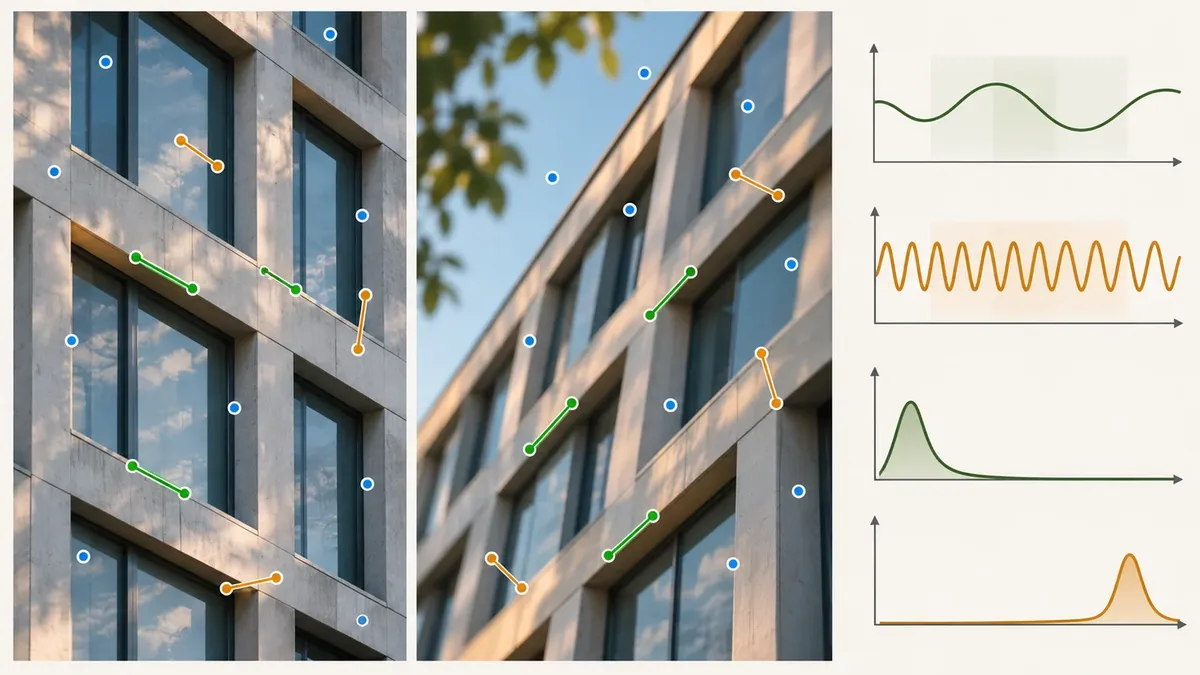
When two photographs show the same scene, software may find thousands of possible point matches, many of them wrong. A new arXiv preprint explores whether arranging matches into clusters and filtering their frequency patterns can help a model tell useful matches from misleading ones. The idea shows promising results in specified benchmarks, but agreement is not a guarantee of correctness.
Matching points between photographs helps computer-vision systems estimate camera movement, align images and reconstruct scenes. The task can be difficult: repeated windows, weak texture, lighting changes or different viewpoints can produce many plausible but incorrect pairings. A system must sort those candidate correspondences before using them to infer the geometry between the images.
In an arXiv preprint, Zhihua Wang and colleagues ask whether a sequence model called Mamba can improve that sorting. Mamba processes inputs in sequence, while a set of image matches has no natural order. The researchers’ approach, SFMambaNet, creates an order from learned clusters and examines how features vary along it. Their premise is that correct matches may show smoother patterns than incorrect ones. That is a useful pattern in their analysis, not a rule: incorrect matches can sometimes agree with one another, particularly around repeated structures.
Giving matches an order
A candidate correspondence pairs a keypoint in one image with a keypoint in the other. SFMambaNet first builds local neighborhoods and refines match features with a component called LSGA. It represents relative coordinates using sine and cosine features at multiple frequencies, then uses attention to combine information from nearby matches.
The model assigns correspondences to clusters and places each cluster in a contiguous section of the sequence. These clusters provide an order for processing; the paper’s premise is that patterns of agreement across matches can become easier to distinguish in this order. A Fourier transform, a mathematical way to separate a signal into different frequencies, lets the model represent slow and rapid changes in the sequence. The method does not guarantee that every cluster contains only correct matches or that all correct matches vary smoothly.
SFMambaNet scans the ordered features in both directions with Mamba. Learnable frequency gates filter the features between scans, controlling which patterns are passed along. The model applies two pruning rounds, each retaining half of its input, then estimates camera geometry and checks correspondences against it.
Results on specified benchmarks
The authors tested relative camera-pose estimation and outlier removal on YFCC100M and SUN3D, using SIFT and SuperPoint keypoints. They also evaluated homography estimation on HPatches, applying models trained on YFCC100M without fine-tuning. On these datasets and configurations, the paper reports leading results among the methods it compares; this is not evidence of superiority in settings beyond those tests.
For one example, on the unseen-sequence YFCC100M split with SIFT, SFMambaNet reached 73.83% mean average precision at a five-degree pose-error threshold. The authors report this as 3.60 percentage points above the published MatchMamba result and 6.23 points above their own retrained MatchMamba result. The model has 2.01 million parameters and uses 5.0 GFLOPs in the reported configuration. Some comparisons draw on prior MatchMamba results evaluated under the paper’s shared protocol.
The researchers also ran ablations to examine the frequency components. In their reported tests, replacing learned gates with point-wise layers of equal size removed most of the improvement; parameter-free low-pass filters retained more, while learned gates performed best. The trained gates tended to suppress higher-frequency patterns. These experiments support the authors’ account of why the approach helps in their tested setups, rather than establishing that filtering will help every matching system.
They also tested random permutations of the input correspondences. In those full-network tests, learned gates were associated with smaller mean changes in pose accuracy than identity gates: 0.08 versus 0.62 percentage points on YFCC100M, and 0.06 versus 0.42 on SUN3D. These results indicate reduced sensitivity to shuffling in the specific tested settings. The authors note that this is not an end-to-end guarantee of order invariance.
Limits and open questions
Consistency can be misleading. As the authors acknowledge, groups of mismatches can agree with each other, especially when patterns repeat; this is a challenge shared by consistency-based pruning methods. Explicitly reasoning about competing motions within a cluster is one possible next step.
The pose evaluations report the differentiable eight-point estimate without RANSAC, a separate robust-estimation step often used in practical pipelines. The authors suggest combining the pruned matches with a robust estimator as future work. Their benchmark results therefore do not by themselves show how the method would perform in a complete deployed system.
This is an arXiv preprint. Its experiments offer evidence for the proposed approach on the specified datasets and comparisons, but further evaluation would help establish how well the findings extend to other scenes, matching methods and downstream applications.
- computer vision
- image matching
- Mamba
- frequency filtering
- camera pose estimation
- arXiv preprint
Reviewed cross-references
These connections were reviewed by a model, not independently fact-checked by a human. Similarity does not imply agreement; consult the original papers and the evidence below.
How Event Cameras Learn Depth Without Dense Labels
Shared method: Both papers use bidirectional Mamba-style sequence processing: SFMambaNet scans correspondences in a learned cluster order and filters features between scans, while the event-depth method processes time-ordered events with bidirectional Mamba. The shared element is sequence modeling; the inputs, ordering principles, tasks, and additional frequency-filtering method differ, so their results are not directly comparable.
Model review: · openai-codex/gpt-6-luna
Evidence and provenance
Selected excerpts, not complete papers. PDF extraction can omit figures or damage equations, tables and reading order; sources may be preprints.
2606.04493v3 — Original paper
Excerpt reference:
static/papers/2606.04493v3.md:273-354
Basis: Paper text
Source SHA-256:6c8c43509dd35dea5df988e4e458e6b55f0241022793595b3fd668828d3cfdee2611.27509v1 — Original paper
Excerpt reference:
static/papers/2611.27509v1.md:334-449
Basis: Paper text
Source SHA-256:3c375fdd2e6f83936afc99b8f07eeef77224ed07ec2efe1d68a1831eb2601deb
Related reading
Automatically matched by shared topic keywords. These links do not imply that the sources agree or establish a consensus.
Can several camera views help find the same suitcase?
Source published
Shared keywords: computer vision
How FastD4RT Speeds Up 4D Video Reconstruction
Source published
Shared keywords: computer vision
SplatLab puts an AI research loop to work on 3D scenes
Source published
Shared keywords: computer vision
Teaching AI to Generate Event-Camera Signals
Source published
Shared keywords: computer vision
A DETR-Based Vehicle Detector Tested on Bangladeshi Roads
Source published
Shared keywords: computer vision