TRANSMISSION // 2606.04320v2
OpenRFM aims to make relational-data prediction more open
Source published
OpenRFM combines a learned relational adapter, a frozen tabular model and an optional AI-designed data harness. In tests across 32 benchmark tasks, it achieved the best mean rank among the compared methods, while leaving important questions about generalization and scale.
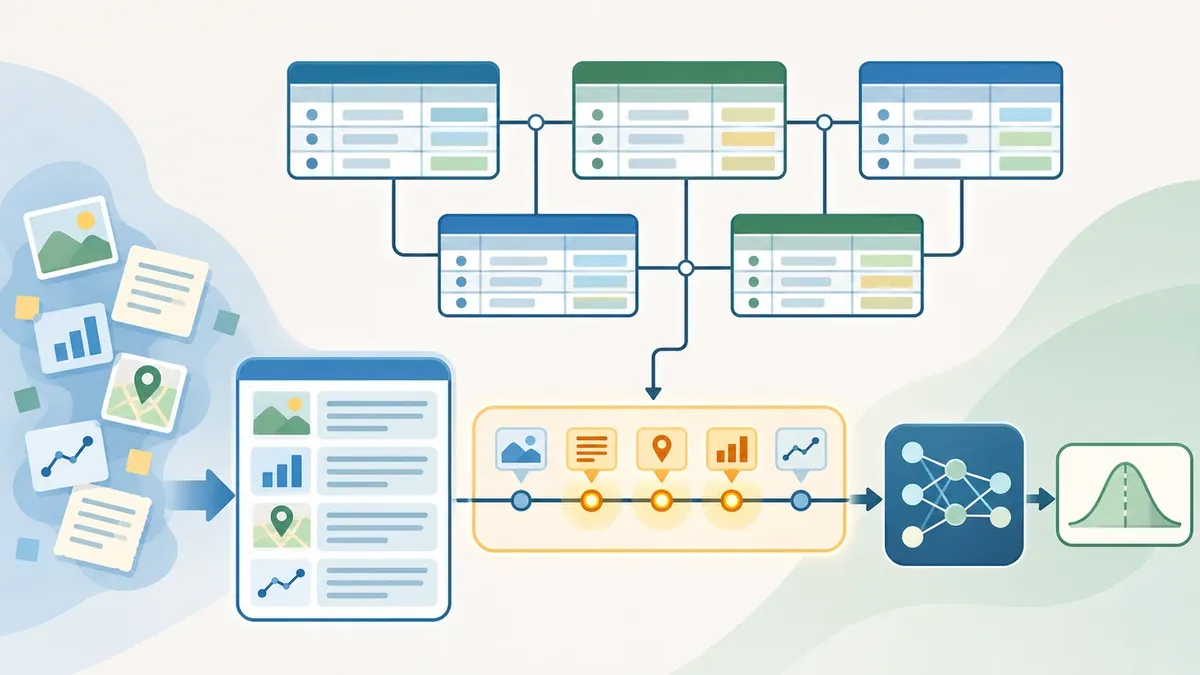
A new open recipe for predicting from connected database tables tries to address two overlooked problems: synthetic training data that misses history, and context windows that miss useful evidence.
Why relational databases are challenging
A database may spread information about the same person, product or organization across many linked tables. Predicting an outcome—such as whether a customer will stop using a service—can require connecting those tables and tracking what happened over time. Conventional approaches often require researchers to build features and train a separate model for each task.
Relational foundation models aim to make that work reusable: given a new database, a task and a small set of labelled examples, they make predictions without training a new model for that task. But the paper behind OpenRFM identifies two obstacles. Synthetic databases used to train open models may not capture history-dependent patterns, and a model that can inspect only a limited amount of data may not see the evidence its prediction needs.
A model with two kinds of context
OpenRFM pairs a learned relational adapter with a frozen tabular foundation model. The adapter reads a bounded sample of database cells and turns each entity’s relational context into a feature row. A memory module adds a compressed view of longer history that may not fit in that sample. The tabular model then predicts from those rows and labelled examples, called the support set.
The authors describe this as learning along two axes. The adapter works across relationships and an entity’s history; the tabular model learns from labelled examples across entities. In this way, the system attempts to use both “what happened to this entity before?” and “what patterns connect examples to their labels?”
The adapter is pre-trained on synthetic databases alone. Unlike the synthetic prior the paper compares against, OpenRFM’s generator creates event streams and labels that can depend on past events of an entity and its peers. The authors report tests on synthetic data where labels depend on history: OpenRFM substantially narrowed the gap to an oracle on window-count and event-order tasks, though not on every tested label type.
An optional third component is an LLM-designed harness. It can rewrite a task’s schema—how tables and links are presented—and adjust what data is sampled, so that useful evidence is more likely to fit within the model’s limited context. For example, the paper describes linking studies to earlier studies with shared sponsors, conditions or interventions, bringing their known outcomes closer to the prediction task.
Benchmark results—and what they mean
The evaluation covers 32 classification and regression tasks from RelBench-V1, RelBench-V2 and 4DBInfer. The authors compare OpenRFM with published methods, including RelAgent and KumoRFM-2, using a mean rank across tasks: lower is better. With the searched harness, OpenRFM’s reported mean rank is 3.00, compared with 3.625 for RelAgent and 5.344 for KumoRFM-2. Adding a small task-trained residual head produces a rank of 2.50, but that setting is not fully training-free: the head is trained on each target task’s training rows. The harness-only result is the more relevant comparison for the paper’s claim of prediction without target-database training.
A rank summarizes relative positions across tasks; it does not say that OpenRFM won every task or quantify a uniform improvement in prediction accuracy. The paper reports that the harness improved results over the default setup on 27 of 32 tasks. It also identifies remaining weaknesses: several activity-prediction tasks, including some churn and engagement tasks, still lagged the strongest methods by a few AUROC points. The authors suggest that larger or better-selected support sets, or task-specific training, might help, but present these as possibilities rather than established fixes.
Limits and open questions
The results are benchmark evidence, not proof that the system will work equally well on every real-world database. The model’s relational adapter was relatively small and trained with limited computing resources; the effects of larger models and longer pre-training remain untested. The harness also relies on an LLM to search for task-specific configurations, and the authors say it remains unclear whether relational capability is best added through an adapter or built directly into the tabular model.
OpenRFM’s release of its data generator, model and training code is intended to make the approach inspectable and usable by other researchers. That openness does not itself establish performance beyond the reported tests. This account is based on the paper text and abstract supplied for an arXiv preprint, rather than an independent reproduction or external review. Preprints may change and may not have undergone peer review; comparisons also depend on benchmark choices and baseline results. The findings should therefore be read as promising evidence for a design, not as a settled demonstration of general-purpose predictive intelligence.
- relational databases
- foundation models
- synthetic data
- in-context learning
- machine learning
Related reading
Automatically matched by shared topic keywords. These links do not imply that the sources agree or establish a consensus.
Why Tabular AI Can Work With Relational Data
Source published
Shared keywords: in context learning, machine learning, relational databases
RamanPFN gives spectral AI a more chemistry-aware view
Source published
Shared keywords: foundation models, machine learning
Can operator chains help scientific AI handle unfamiliar problems?
Source published
Shared keywords: in context learning
How well do synthetic training tasks match real tables?
Source published
Shared keywords: machine learning, synthetic data
Can a Robot Learn a New Task by Watching One Video?
Source published
Shared keywords: in context learning