TRANSMISSION // 2606.02719v2
A two-factor model helps reconcile cluster X-ray relations
Source published
A meta-analysis tests whether gas fraction and a modeled temperature adjustment can account for departures from gravity-only predictions in galaxy-cluster and group X-ray scaling relations. Across 39 published constraints on relation slopes and redshift evolution, the framework reduces the number exceeding specified tension thresholds. The fitted gas fraction falls toward lower-mass halos; its redshift trend is mild and differs from zero at roughly 2–3σ, while the temperature adjustment has a mild positive modeled trend with mass and redshift. The results depend on heterogeneous published summaries and have important statistical and calibration limitations.
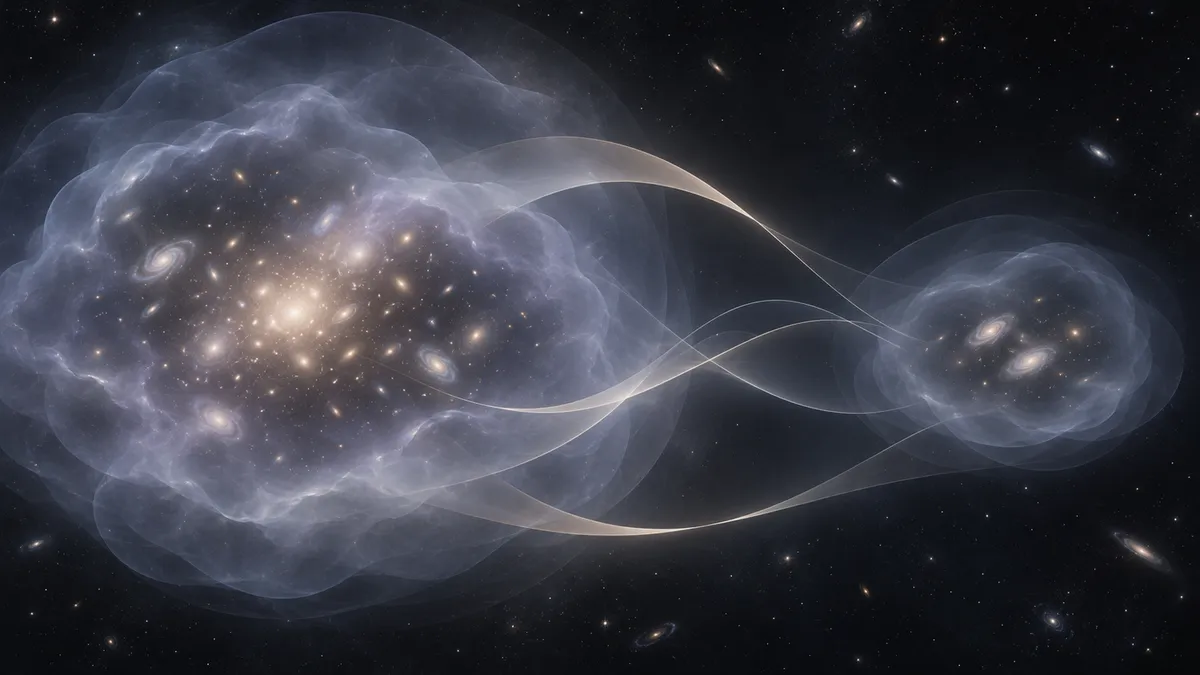
Galaxy clusters and groups contain hot gas that emits X-rays. Astronomers use relationships among its brightness, temperature and mass to study these systems. A gravity-based model predicts how such quantities should scale, but observations depart from those predictions, especially in lower-mass systems. Stefano Ettori’s analysis tests whether two modeled factors can describe many of those departures within a common framework.
Galaxy clusters are surrounded by hot gas whose X-ray emission helps astronomers estimate properties such as temperature and mass. In the simplest model, gravity governs how these properties relate, and different systems follow predictable scaling relations. This is called self-similarity: clusters and groups should behave like scaled versions of one another after accounting for their mass and cosmic epoch.
Observed scaling relations depart from those baseline predictions, particularly for lower-mass systems. Gas can be affected by processes such as star formation and activity around central black holes. Also, a temperature inferred from an X-ray spectrum may differ from the reference temperature used in a model. Stefano Ettori’s study asks whether two adjustments can describe these departures across a range of published relations.
Two modeled adjustments
The first factor is the gas mass fraction: the share of a halo’s mass in gas. The second, called the temperature variation, accounts for differences between measured, spectrum-based temperatures and a reference temperature.
Neither factor isolates a single physical cause. The paper describes the temperature factor as phenomenological: it can capture radial temperature gradients, projection effects that mix gas at different temperatures along the line of sight, and differences in how fully the gas has reached thermal equilibrium.
To calibrate the framework, the author assembled published best-fit slopes and redshift-evolution constraints for X-ray scaling relations—not the underlying raw measurements—and used a Markov chain Monte Carlo analysis to estimate how the two factors vary. The analysis uses 39 published constraints, including results based on XMM-Newton and eROSITA. It considers slopes and redshift evolution, but not relation normalizations.
What the fit suggests
The fitted gas fraction declines toward lower-mass halos. Its redshift trend is mild and differs from zero at roughly the 2–3σ level, rather than establishing a firm detection of cosmic evolution. The temperature factor has a mild positive fitted dependence on temperature, which the model translates into a positive trend with halo mass; it also has a mild positive fitted dependence on redshift. These are trends inferred within the model, not independent direct measurements of each effect.
Of the 39 constraints, 19 exceeded the 3σ tension threshold and 14 exceeded 5σ under self-similar predictions. With the two factors allowed to vary, four exceeded 3σ and one exceeded 5σ. These counts describe how this particular framework fits this particular set of published constraints. They do not establish general predictive performance or show that the remaining outliers are incorrect.
The paper also proposes a combination of X-ray luminosity, gas mass and temperature designed to cancel dependence on both adjustment factors. It interprets this quantity as a proxy for cluster volume and predicts how it should relate to mass and redshift. Comparisons with hydrodynamical simulations and eROSITA data are reported as marginally consistent overall, with a possible mismatch below 10¹⁴ solar masses. The author notes that this lower-mass range may be more affected by observational systematics.
Uncertainty and scope
The analysis combines results from different studies and instruments. The author specifically notes that it does not propagate covariance among the published quantities, and that published statistical errors may be underestimated. As a sensitivity test, imposing a 3% minimum relative statistical error leaves two constraints above 3σ; imposing a 5% floor leaves none above that threshold. The paper presents this as a diagnostic of possible error underestimation—not proof that the physical model is improved.
Instrument calibration also matters: separate fits to XMM-Newton- and eROSITA-based subsets yield slope parameters differing by about 0.05. Redshift trends are less tightly constrained, in part because relatively few datasets cover high redshifts. And because the temperature factor combines structural, projection and dynamical influences, this analysis cannot disentangle their individual contributions.
The supplied text identifies the manuscript as A&A proofs and mentions comments from an anonymous referee. Those details do not, by themselves, establish publication status or peer review. This account summarizes the reported analysis; it does not independently verify its conclusions or imply scientific consensus. The paper’s contribution is a compact framework for describing many departures from self-similar predictions, while showing how calibration and statistical limitations affect the interpretation.
- galaxy clusters
- galaxy groups
- X-ray astronomy
- scaling relations
- intracluster gas
Reviewed cross-references
These connections were reviewed by a model, not independently fact-checked by a human. Similarity does not imply agreement; consult the original papers and the evidence below.
Simulated galaxy clusters match X-ray outskirts—but their cores look too faint
Shared method: Both studies compare hydrodynamical-simulation predictions with eROSITA observations. Ettori tests a constructed X-ray mass proxy against FLAMINGO and eROSITA data; Kruglov et al. create mock observations and compare stacked surface-brightness profiles with eROSITA. The shared approach is simulation-to-observation comparison, not a shared observable or identical pipeline.
Model review: · openai-codex/gpt-6-luna
Evidence and provenance
Selected excerpts, not complete papers. PDF extraction can omit figures or damage equations, tables and reading order; sources may be preprints.
2606.02719v2 — Original paper
Excerpt reference:
static/papers/2606.02719v2.md:408-470
Basis: Paper text
Source SHA-256:97750a7cfa5590a16ca657782444202a250b8177f2c83fdb1fef7132f814d32a2608.06619v2 — Original paper
Excerpt reference:
static/papers/2608.06619v2.md:663-731
Basis: Paper text
Source SHA-256:8d9781ec60c4d148ba6aeb3f1867355de8758f14eee1ddad852c22725e4383e5
Related reading
Automatically matched by shared topic keywords. These links do not imply that the sources agree or establish a consensus.
Simulated galaxy clusters match X-ray outskirts—but their cores look too faint
Source published
Shared keywords: galaxy clusters, x ray astronomy
Fading radio lobes suggest a black hole disrupted its galaxy group’s cool core
Source published
Shared keywords: galaxy groups, x ray astronomy
How bright knots of gas complicate measurements of galaxy clusters
Source published
Shared keywords: galaxy clusters, x ray astronomy
Gas stripping leaves galaxy discs’ stellar spin largely intact
Source published
Shared keywords: galaxy clusters
Cluster galaxies show a subtle nitrogen–oxygen abundance offset
Source published
Shared keywords: galaxy clusters