TRANSMISSION // 2606.02717v4
Can faint radio galaxies clarify cosmic star formation?
Source published
Deep radio counts appear to conflict with estimates of cosmic star formation from ultraviolet and infrared light. Models suggest the radio–far-infrared link may evolve, but the best explanation remains uncertain.
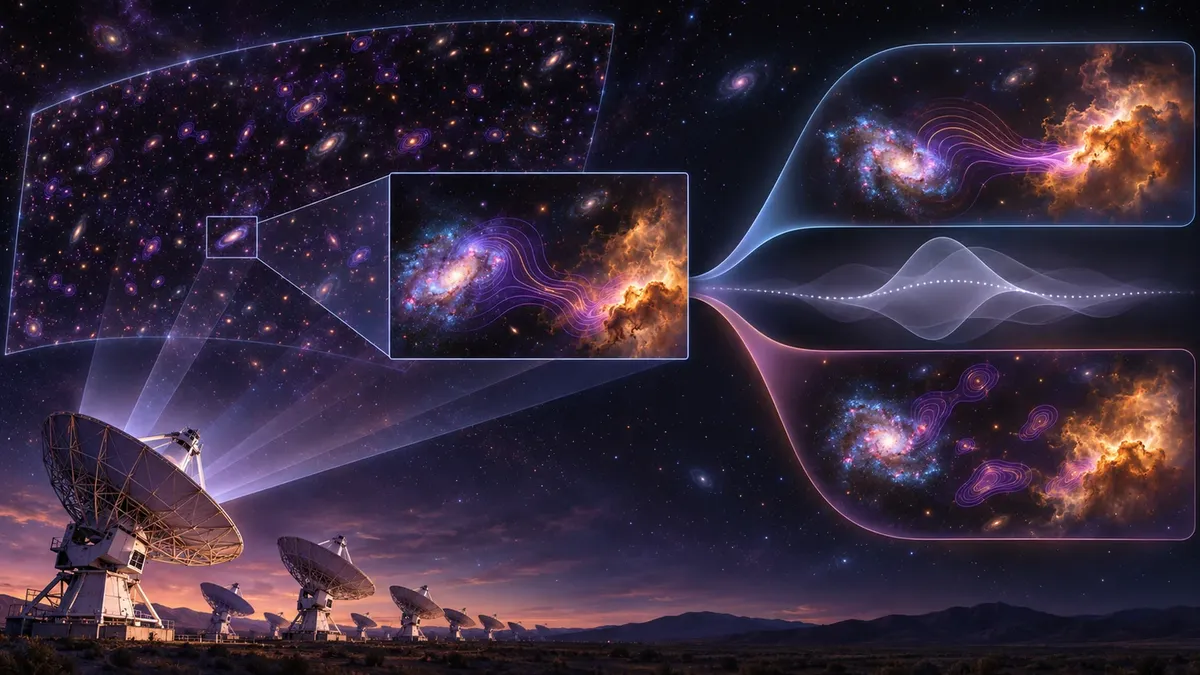
Radio telescopes can count galaxies too faint to study individually, offering a way to trace star formation across cosmic history. But translating radio brightness into star formation rates depends on a relationship between radio and far-infrared emission—and that relationship may change over time.
A mismatch in the cosmic star-formation story
Galaxies make stars, and their combined activity over time is described by the cosmic star-formation-rate density (SFRD). Astronomers estimate it in different ways, including from ultraviolet and infrared light. Radio emission offers another route: it is relatively unaffected by dust, which can hide ultraviolet light, and can be measured in very deep surveys.
To turn a galaxy’s radio luminosity into an estimate of its far-infrared (FIR) luminosity—and then its star-formation rate—researchers use the radio–FIR correlation. In this paper, the authors ask whether changes in that correlation with cosmic time could help explain a mismatch between radio source counts and SFRD estimates from ultraviolet and infrared observations.
The tension appears most clearly near a radio flux density of about 30 microjanskys, where star-forming galaxies contribute strongly to the counts. Under two models of how galaxy radio luminosities and numbers evolve, models that reproduce the observed ultraviolet and infrared SFRD predict fewer radio sources than are measured. The paper reports a discrepancy of more than three standard deviations in at least one bin, when the radio–FIR relationship is assumed not to evolve with redshift.
Modeling galaxies too faint to count directly
The team modeled radio source counts using measurements from the MeerKAT DEEP2 survey and the NRAO Very Large Array Sky Survey. In the DEEP2 image, confusion—overlapping emission from many faint sources—limits direct counts. A statistical technique called P(D) analysis uses the distribution of brightness values across the image to constrain counts below that limit. The paper uses these constraints alongside direct counts.
The researchers began with local radio luminosity functions: descriptions of how common galaxies are at different radio luminosities. They modeled how these functions change with cosmic time using two approaches. Pure luminosity evolution (PLE) changes galaxy luminosities; luminosity and density evolution (LADE) allows the abundance of galaxies to change as well. They fitted these models to ultraviolet and infrared measurements of the SFRD, then compared the radio counts they predicted with observed counts.
Next, they tested different assumptions about the evolving radio–FIR correlation, represented by qFIR. They considered a mildly decreasing qFIR at fixed radio luminosity, a model in which qFIR rises as cosmic-ray energy losses suppress synchrotron radio emission, and a model based on changes in the thermal fraction of radio emission. They also examined intrinsic scatter: real galaxies with similar radio luminosities need not have identical FIR luminosities. In the models, this scatter can affect inferred star-formation rates, particularly where the population of bright sources declines steeply.
No single explanation wins
The results depend on which evidence the models are asked to match. A mildly decreasing qFIR at fixed radio luminosity brings predicted counts closer to observations near the 30-microjansky peak, without adding a scatter correction. But this option fits observations of qFIR as a function of stellar mass less well than the authors’ thermal-fraction model.
That thermal-fraction model better matches the observed stellar-mass-dependent relationship, but predicts too few sources near the count peak unless the model includes substantial intrinsic scatter: about 0.3 dex. The authors also find that a model with increasing qFIR from cosmic-ray losses alone underpredicts the peak. Adding scatter of this size can improve agreement, particularly under the LADE model, but it is larger than the scatter reported for the local radio–FIR relationship.
These are comparisons between model predictions, not direct measurements of how the correlation evolves for every galaxy. The paper finds no statistically significant improvement over the baseline at more than three standard deviations, and its conclusions depend on assumptions about galaxy evolution, scatter, and the conversion from FIR light to star formation. The authors also note that the calibration connecting FIR emission to thermal radio emission could change; their main model does not fully capture that possibility.
The study therefore does not settle why the radio counts and ultraviolet/infrared estimates differ. Instead, it shows that source counts can help test competing assumptions about radio emission and galaxy evolution—and that deeper surveys and better observations of faint, distant galaxies will be important for narrowing the possibilities. This is a preprint, so its findings should be treated as provisional rather than as a settled scientific conclusion.
- radio astronomy
- galaxy evolution
- star formation rate density
- radio–FIR correlation
- MeerKAT
- cosmic rays
Related reading
Automatically matched by shared topic keywords. These links do not imply that the sources agree or establish a consensus.
A compact Bayesian model captures MeerKAT’s changing radio beam
Source published
Shared keywords: radio astronomy
A black-hole system reaches record radio lows after decades of activity
Source published
Shared keywords: radio astronomy
A Decade of Antarctic Radio Data Tightens the Search for Extreme Neutrinos
Source published
Shared keywords: cosmic rays, radio astronomy
Radio surveys reveal a faint signal from IX Velorum
Source published
Shared keywords: radio astronomy
Which galaxies could Euclid’s surveys miss?
Source published
Shared keywords: galaxy evolution