TRANSMISSION // 2606.00125v2
What happens when music recommenders listen beyond the play history?
Source published
MusicRec adds audio, lyric, structured song descriptions and listening completion to recommendation models. Tests on LastFM-1K show that content features can help, especially after fine-tuning, but gains vary by model and fusion method.
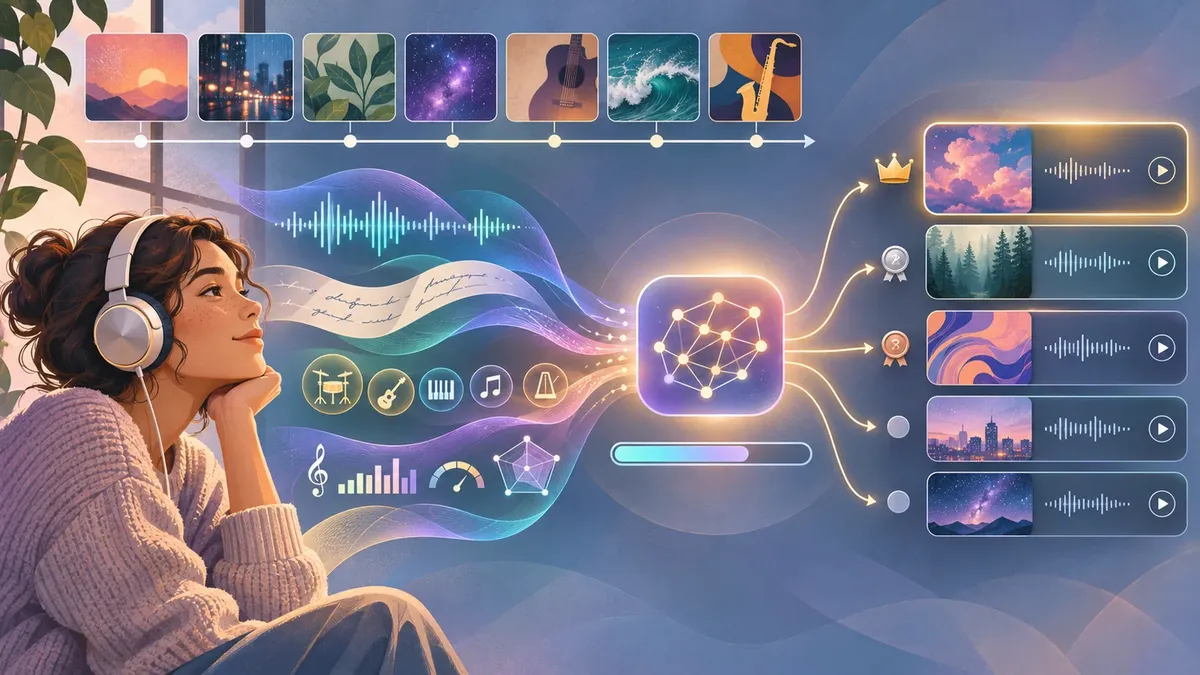
A song is more than an ID in a listening log: it has a sound, words and musical character. MusicRec tests whether adding those details—and whether a listener finished a track—can help models predict what comes next. The results are promising but uneven, and the benchmark leaves important questions about generalisation open.
Most music recommenders learn from sequences of track IDs: a person played one song, then another, so the system tries to predict the next. That approach can capture listening patterns, but it does not directly represent what songs sound like or what their lyrics mean. A research team behind MusicRec asks whether adding those kinds of content, alongside a clue about how long people listened, can improve next-song recommendations.
The team built its benchmark from LastFM-1K, a collection of timestamped listening histories. After filtering and grouping plays into sessions, the researchers report a dataset of 814 users, 4.2 million listening events and nearly 296,000 unique tracks. Their experiments focus on a catalog of about 50,000 tracks. They split data by time, reserving the most recent portion for testing, and compare models on whether the next track appears near the top of a ranked list. Two measures, Recall and NDCG, reward finding the correct track; NDCG also rewards placing it higher.
The added information came in several forms. Audio encoders turned recordings into numerical representations of their sound, while text encoders represented lyrics. The team also generated structured descriptions of musical traits—such as rhythm, vocals and instrumentation—using an AI model and the MGPHot annotation schema. Listening completion was estimated by comparing the time between plays with the track’s duration. Because LastFM-1K does not record actual playback duration, this is an estimate, not a direct measurement of how much of a song someone heard.
To test the features, MusicRec extended an existing recommendation framework with different sequence-model backbones and large language models. The researchers compared models used without task-specific fine-tuning against versions adapted on recommendation data, and tried multiple ways of combining the inputs. They also tested several audio and lyric encoders and compared generated MGPHot descriptions with Spotify-derived audio attributes.
The broad pattern is that song content can help, but not uniformly. In zero-shot tests—where the language model is not fine-tuned for this task—adding content sometimes improved results and sometimes did not. Which features helped depended on the language model, the sequence encoder and the method used to combine information. Fine-tuning generally improved performance over zero-shot use. After fine-tuning, the best audio- or lyric-based configuration exceeded the ID-only baseline for each tested backbone, although not every configuration did so.
The size of the gains also depended on the starting point. With a fine-tuned Qwen model and the SASRec sequence encoder, the ID-only Recall@10 was 0.268; adding audio features raised it to 0.326. The paper notes that this was the clearest gain relative to the reported uncertainty: for 638 test users, one standard error at Recall@10 was 0.018, and only the SASRec gains cleared it. Where the baseline was already stronger, improvements were generally smaller. These are offline ranking results on a particular dataset, not evidence that listeners would necessarily enjoy the recommendations more.
The work also offers a caution about piling on inputs. Combining audio and lyrics, or combining different kinds of metadata, did not reliably outperform simpler setups. The authors report that structured MGPHot descriptions were more useful overall than Spotify audio attributes in their comparisons, while adding both sources together did not consistently help. The choice of encoder mattered too: some audio or lyric encoders performed poorly, showing that a modality is not automatically useful just because it is included.
There are limits to what these tests establish. LastFM-1K reflects listening histories from 2005 to 2009, and the filtered sample and popular-track catalog may not represent today’s streaming audiences or less-played music. The completion measure is inferred from play timestamps, and AI-generated descriptions are imperfect: on 2,195 tracks checked against human MGPHot annotations, the overall rank correlation was 0.45, with weaker agreement for some musical attributes. The study is an offline benchmark, not a live deployment or a user study. Its version on arXiv says the paper was accepted at IEEE BigData 2026; the reported results should still be read in the context of this specific dataset, evaluation design and set of models. The benchmark may help future comparisons, but further testing is needed to learn when these features generalise and which combinations are genuinely useful.
- music recommendation
- multimodal AI
- audio embeddings
- lyric embeddings
- LastFM-1K
- large language models
Related reading
Automatically matched by shared topic keywords. These links do not imply that the sources agree or establish a consensus.
Can Rotating an Image Help a Multimodal AI Answer Better?
Source published
Shared keywords: multimodal ai
Can AI Models Think in Pictures, Not Just Words?
Source published
Shared keywords: large language models, multimodal ai
One model, two tasks in catalyst design
Source published
Shared keywords: large language models, multimodal ai
When audio and video lead an AI astray
Source published
Shared keywords: large language models, multimodal ai
Can AI improve its vision by revisiting its own computations?
Source published
Shared keywords: multimodal ai