TRANSMISSION // 2605.28695v3
Perovskite light encodes information in its polarization
Source published
A Poincaré-sphere analysis links spin-driven polarization changes in a two-dimensional perovskite to communication performance—and points to a possible materials-design strategy.
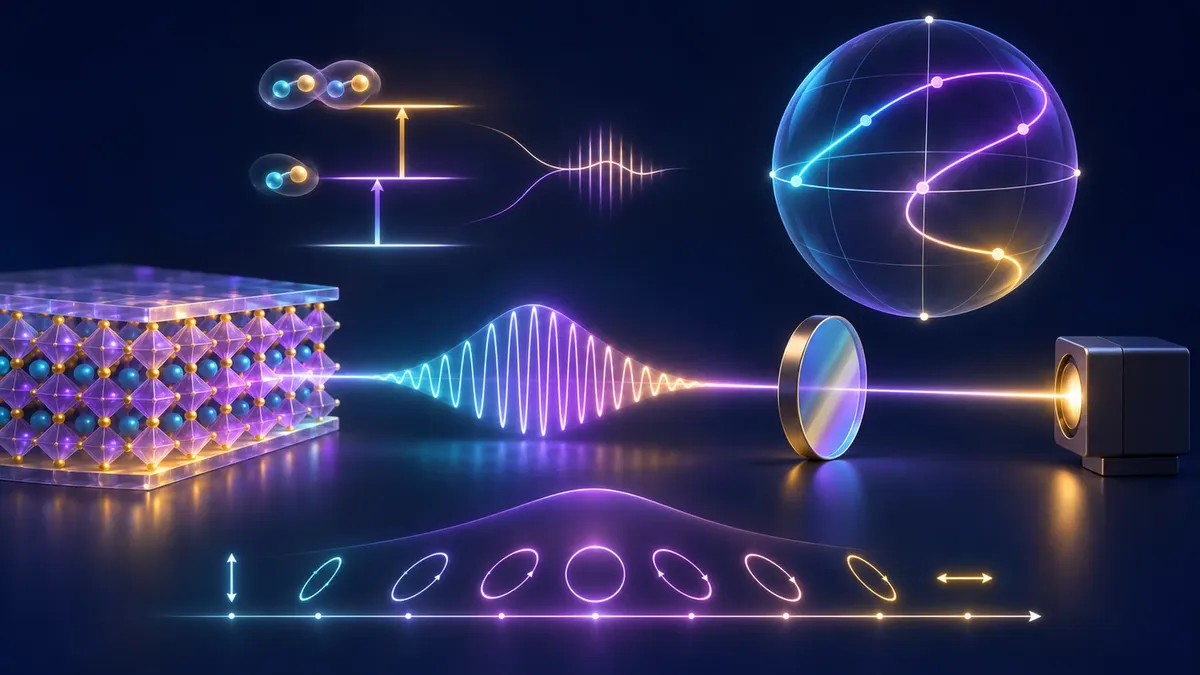
Could a semiconductor’s own spin dynamics help encode information in light? A study of four-wave-mixing signals from a two-dimensional perovskite maps their changing polarization onto the Poincaré sphere, then uses that map to estimate how well a simple communication scheme could distinguish encoded bits.
When a material helps set the message
In many optical communication systems, equipment outside the light source—such as a modulator—sets the light’s polarization. This study explores a different possibility: using the changing spin dynamics inside a semiconductor to produce different polarization states in the emitted light.
The material is a two-dimensional organic–inorganic hybrid perovskite, (PEA)₂PbI₄. The researchers examine four-wave mixing, a nonlinear optical process in which interacting light fields generate a signal. In this system, the signal’s polarization evolves as exciton spins relax. Excitons are bound pairs of electrons and positively charged “holes”; biexcitons are pairs of excitons.
The question is whether those material-driven changes can be described in a way that helps assess their usefulness for encoding information—not just how the light behaves, but how reliably a receiver could tell two encoded states apart.
Mapping polarization onto a sphere
The team used previously reconstructed signal-field amplitudes, derived from polarization-resolved transient-grating measurements. In those measurements, circularly polarized pump pulses and a linearly polarized probe generate the signal; changes in pump–probe delay track the evolving response. The researchers focused their analysis on light in the 535–545 nanometre range associated with an antiparallel-spin biexciton resonance.
They converted the signal’s horizontal and vertical field components into Stokes vectors. These vectors represent polarization as points on the Poincaré sphere: different directions correspond to different polarization states, including linear and elliptical polarization. The researchers traced how the points moved with delay and calculated how a quarter-wave plate would transform them before a polarizer and detector measured horizontal and vertical light.
They then applied this description to a model communication scheme. Bits were represented by signals generated at two pump–probe delays, with a receiver measuring polarization. The analysis estimated how distinguishable the states would be as more photons were detected. This is a model of communication performance, not a demonstration of a complete quantum-key-distribution system.
What the analysis found
The reconstructed signal’s polarization changes as the exciton spins relax: its ellipticity decreases and the state moves toward vertical polarization. The amount of information available to a receiver depends on how the measurement setup projects that changing polarization. In the model, a quarter-wave-plate setting of 0° made the two delay-encoded states easier to distinguish than a setting of 45°, particularly for delays separated by 500 femtoseconds.
For context, the paper reports that an earlier experiment using the 0° setting decoded a 56-bit message with about six detected photons per bit and a bit-error probability of about 1.7%. The present analysis predicts a bit-error probability of about 32% under the same delay pair and photon conditions with the 45° setting. These figures concern the specified experimental arrangement and model; they are not universal performance rates for perovskite sources or communication systems.
A second, microscopic model was used to investigate why the polarization changes and how the material might be tuned. It attributes the accessible polarization states to interference between resonantly enhanced optical transitions, including exciton and biexciton contributions. In calculations that held other model parameters fixed, shifting the antiparallel biexciton resonance energy downward by 0.01–0.05 electronvolts improved the predicted resolution for an appropriately chosen measurement basis. The calculated benefit depended on the quarter-wave-plate angle; it was not an across-the-board improvement.
What remains uncertain
The sphere provides a useful link between reconstructed optical fields and communication metrics, but the analysis does not establish a secure quantum communication protocol. The authors explicitly say it has no security proof. The emitted light is in the weak coherent-state regime, not a source of guaranteed single photons, and the communication results rely on a particular model and measurement scheme.
The proposed resonance shift is a theoretical materials-design suggestion, not a reported experimental intervention. The model also reproduces key polarization contrasts at the selected delays but does not capture every feature of the reconstructed results, including an intermediate maximum in one measurement setting. That limits how confidently it can predict performance outside the tested conditions.
The supplied source is an arXiv preprint, and the evidence available here does not establish whether this version has undergone peer review. Its results are best read as a research framework and a testable materials hypothesis, rather than a ready-to-deploy communication technology.
- two-dimensional perovskites
- polarization encoding
- Poincaré sphere
- four-wave mixing
- exciton spin relaxation
- quantum communication
Reviewed cross-references
These connections were reviewed by a model, not independently fact-checked by a human. Similarity does not imply agreement; consult the original papers and the evidence below.
A metasurface programs polarization states across space and frequency
Shared method: Both studies represent polarization states geometrically on a Poincaré sphere: Gan et al. map perovskite four-wave-mixing fields to Stokes-vector trajectories, while Chen et al. reconstruct classical metasurface fields as normalized Stokes states. This is a shared representation and analysis tool, not evidence that the sources or their communication applications perform comparably.
Model review: · openai-codex/gpt-6-luna
Evidence and provenance
Selected excerpts, not complete papers. PDF extraction can omit figures or damage equations, tables and reading order; sources may be preprints.
2605.28695v3 — Original paper
Excerpt reference:
static/papers/2605.28695v3.md:57-137
Basis: Paper text
Source SHA-256:9171402e48f150c5a1833ed2f0ce2b2d129aa8841a000cf2412353af67bb505d2611.32689v1 — Original paper
Excerpt reference:
static/papers/2611.32689v1.md:150-237
Basis: Paper text
Source SHA-256:e66f1d0594532534baaa02e8ca6d6728440d965355b1ce8333efc1e3d83b3334
Related reading
Automatically matched by shared topic keywords. These links do not imply that the sources agree or establish a consensus.
A sharper filter for correlated photon pairs
Source published
Shared keywords: four wave mixing
Before quantum keys, Sweden’s fiber links need a checkup
Source published
Shared keywords: quantum communication
Quantum proofs could cut the cost of oblivious transfer
Source published
Shared keywords: quantum communication
A quantum switch may carry information through loss
Source published
Shared keywords: quantum communication
Waiting to measure can unlock an unbounded quantum communication advantage
Source published
Shared keywords: quantum communication