TRANSMISSION // 2605.27380v4
How BioELX Links Biomedical Terms Across Languages
Source published
BioELX combines cross-lingual candidate retrieval with mention-focused reranking. Its authors report improved results on four benchmarks, though the evidence available here is abstract-only.
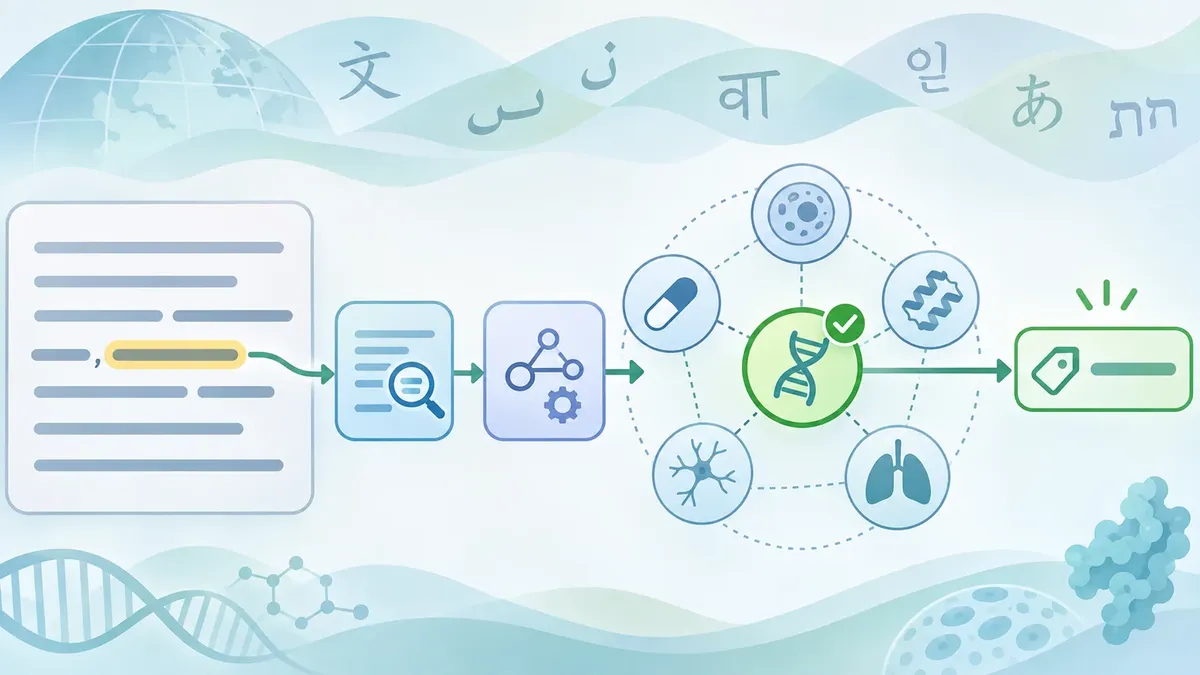
Biomedical entity linking maps a mention in text, in any language, to a unique identifier in a biomedical knowledge base. BioELX aims to improve this task without task-specific entity-linking annotations. Its authors report gains on four benchmarks; the source available for this article is the paper’s abstract, so important details cannot be checked here.
The challenge
Biomedical entity linking connects a text mention to a unique identifier in a knowledge base. In cross-lingual linking, the mention may be in any language. The BioELX authors identify two problems with current systems: training aliases drawn from the UMLS are heavily skewed toward English, and adding context naively to retrievers trained to align aliases can substantially hurt retrieval.
Context can help distinguish what a mention refers to, but using it effectively is not straightforward. BioELX addresses the problem with two stages: retrieval, which finds candidate concepts, and reranking, which scores those candidates in context.
How the system works
For retrieval, the researchers continue training SapBERT_multi using cross-lingual alias supervision derived from Wikidata. They describe the goal as forming shared concept neighborhoods across languages.
For reranking, BioELX adapts pretrained large language model rerankers to entity linking. Its “mention-anchored” prompting marks the target mention in the text, so the reranker scores candidates with respect to that mention rather than other salient words in the context.
The authors say the system uses no task-specific biomedical entity-linking annotations. This does not mean it is trained without supervision: the retrieval stage uses cross-lingual alias supervision, and pretrained rerankers are adapted for the task.
Reported results—and what they do not show
According to the abstract, BioELX achieves new state-of-the-art results on four cross-lingual biomedical entity-linking benchmarks. The authors report Recall@1 gains of 4.9 to 18.2 percentage points over prior best results. These are the authors’ reported benchmark findings; the abstract does not provide the benchmark names, dataset sizes, language coverage, detailed comparisons, or uncertainty estimates needed to assess them independently.
Benchmark performance alone does not establish reliability in clinical workflows or show how consequential errors might be. The abstract also does not provide enough detail to evaluate the method’s behavior across different languages and kinds of text.
Evidence limits
This article is based on the abstract of an arXiv preprint, identified in the source record as version 4. The supplied material does not establish whether the work has undergone peer review. The full paper was not available for this account, so its methods, benchmark setup, and limitations could not be examined. Search excerpts supplied with the source concerned unrelated work and do not verify or challenge BioELX’s results.
The authors link to code and resources in the project repository, which may help others investigate the work. For now, the abstract supports a description of the proposed retrieval-and-reranking approach and the authors’ reported benchmark gains, but not a broader claim about performance in real-world biomedical use.
- biomedical entity linking
- cross-lingual AI
- BioELX
- biomedical NLP
- multilingual retrieval
- knowledge bases
Related reading
Automatically matched by shared topic keywords. These links do not imply that the sources agree or establish a consensus.