TRANSMISSION // 2605.26690v2
SILO explores protein designs with limited evaluations
Source published
SILO combines stochastic search and iterative learning to explore protein sequences in computational tests. Reported gains are encouraging but vary by task.
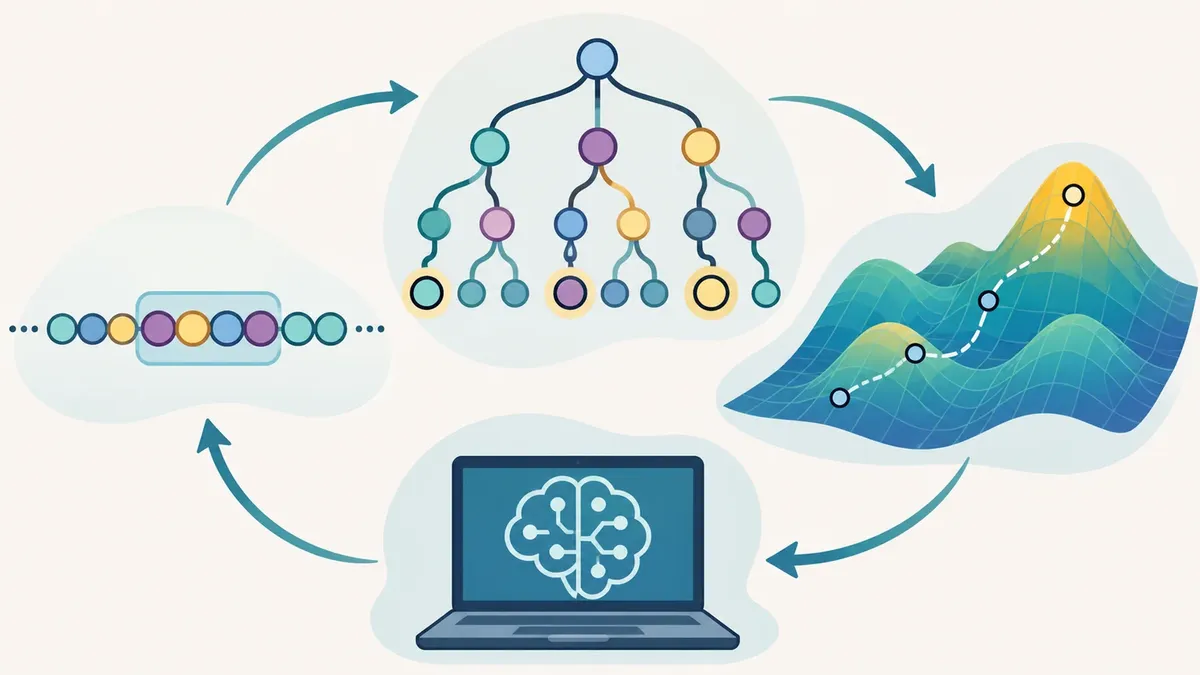
Protein design can involve an enormous number of possible sequence changes, while evaluating candidates may be costly. SILO aims to make a limited number of computational evaluations count by combining guided search with learning from strong results.
Making each evaluation count
A protein sequence is a chain of amino acids, and changes to that chain can affect a protein’s properties. Searching all possible combinations is impractical. In this study, an “oracle” is the system used to score a candidate sequence; the method is designed for settings where calls to that system are limited. Predictive models, called proxies, can help guide the search, but their predictions may be noisy.
In the preprint Oracle-Budgeted Protein Design with Stochastic Search and Iterative Imitation, Ashima Khanna-Reiter and Dominik G. Grimm introduce SILO, short for Self-improvement Imitation Learning Optimization. The question is whether a method can explore sequence changes effectively under a restricted oracle-evaluation budget, while using proxy predictions to help select candidates.
Search, score, learn
SILO combines a hierarchical edit policy with incremental stochastic beam search without replacement, which the authors describe as a way to explore diverse candidate trajectories. A UCB-based proxy ensemble guides candidate selection. The method also uses an alanine-scan-inspired fitness score, derived from the proxy, to guide choices about where to make mutations.
Selected candidates are evaluated by an in-silico oracle. After each round, SILO updates its policy through next-action cross-entropy imitation: the policy learns to imitate editing steps along the round’s best oracle-labeled trajectories. In this way, oracle results inform later proposals.
The authors evaluate SILO on eight in-silico protein fitness landscapes and compare it with five strong baselines from prior work. They report the maximum fitness reached and the mean fitness among the top 100 candidates. These are computational tests, not laboratory experiments.
Encouraging results, with variation
The abstract reports competitive performance within the evaluated oracle budget and often faster early-stage improvement than other reproduced baselines. Two-sided paired t-tests found positive mean differences in SILO’s favor across all eight landscapes for both measures. After Holm correction for multiple comparisons, statistically significant improvements remained on two landscapes for maximum fitness and four for top-100 mean fitness.
A positive average direction across tasks is not the same as strong statistical evidence of improvement in every task. The authors also describe performance under low-labeled-data and noisy-proxy conditions as competitive but task-dependent. Their ablation results identify stochastic beam search as the primary performance driver; AFS guidance and iterative imitation provide additional benefits that vary by task.
What remains uncertain
These results support SILO as a promising approach on the computational landscapes studied. They do not establish how it would perform in real-world protein engineering, where biological context and experimental measurements may differ from in-silico benchmarks. The supplied evidence is the paper’s abstract only, so it does not provide the detail needed to assess the landscapes’ scope, exact evaluation budget, effect sizes, or full limitations.
The work is an arXiv preprint, and the supplied material does not establish peer-review status. The authors report that code is available, but that alone does not verify the results. For now, the abstract’s main message is that SILO combines stochastic search with learning from evaluated candidates, with promising but uneven results across computational tasks.
- protein design
- SILO
- stochastic search
- imitation learning
- computational protein fitness
- oracle budget
Reviewed cross-references
These connections were reviewed by a model, not independently fact-checked by a human. Similarity does not imply agreement; consult the original papers and the evidence below.
ProTEUS puts protein evolution in a prediction-and-test loop
Shared method: Both use feedback from evaluated variants to guide later sequence selection: SILO updates its policy by imitating top oracle-labeled trajectories, while ProTEUS updates fitness predictions and nominations using experimental measurements. SILO’s cited setup specifies an in silico oracle, whereas ProTEUS describes experimental campaigns; the shared feedback-loop structure does not establish equivalent performance. Evidence is limited to selected excerpts, and both works are preprints.
Model review: · openai-codex/gpt-6-luna
Evidence and provenance
Selected excerpts, not complete papers. PDF extraction can omit figures or damage equations, tables and reading order; sources may be preprints.
2605.26690v2 — Original paper
Excerpt reference:
static/papers/2605.26690v2.md:113-174
Basis: Paper text
Source SHA-256:a959811e306fce3a196fe5b782539c2ce341624ca3ce0e398301086f8fbd468e2611.13348v1 — Original paper
Excerpt reference:
static/papers/2611.13348v1.md:380-427
Basis: Paper text
Source SHA-256:51c86a0d15d0b94ca587d12d26be15b3043a202806f19ee00cfd49c3cc013477
Related reading
Automatically matched by shared topic keywords. These links do not imply that the sources agree or establish a consensus.
An AI agent turns peptide-design evidence into testable sequence edits
Source published
Shared keywords: protein design
Can coding agents rebuild biological AI tools?
Source published
Shared keywords: protein design
An Enzyme-Design System That Revises Its Own Research Workflow
Source published
Shared keywords: protein design
DexDICE teaches robots from cautious and fast demonstrations
Source published
Shared keywords: imitation learning
How AXE Selects Driving Paths in Simulation
Source published
Shared keywords: imitation learning