TRANSMISSION // 2605.26179v3
AutoDFT lets calculations change course as they run
Source published
A seven-agent system revises density-functional-theory workflows using results and errors encountered during computation. Tests show gains on a small benchmark, but broader reliability remains unproven.
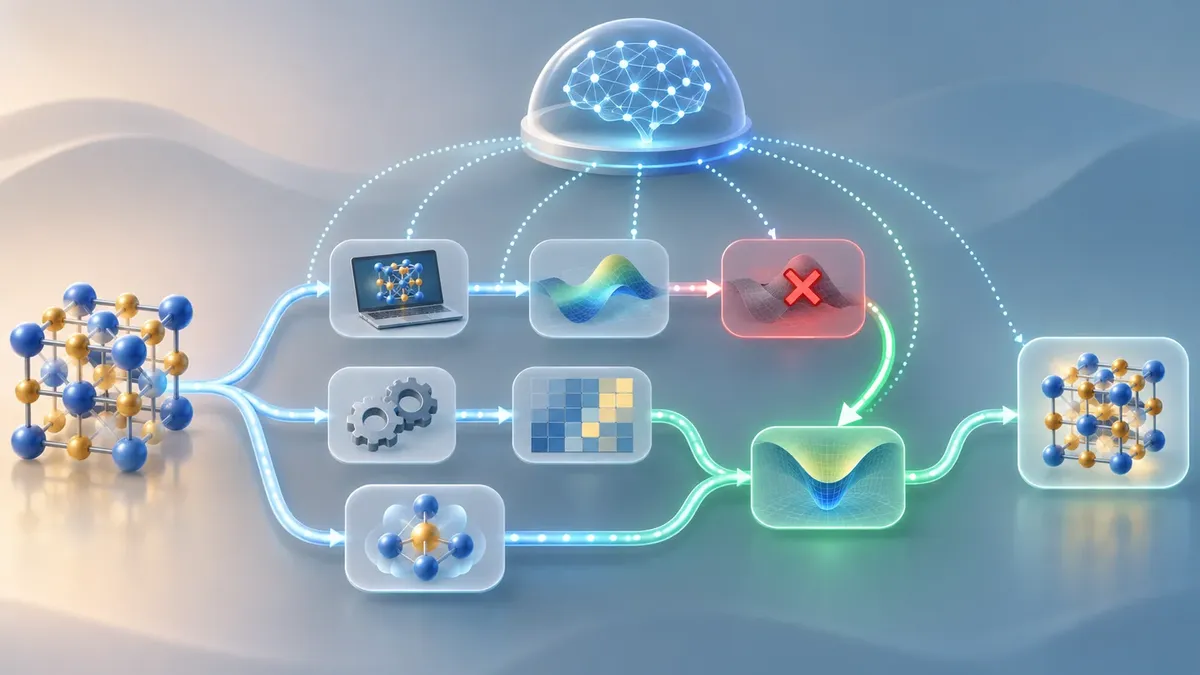
Density functional theory can help researchers estimate material properties, but its calculations often require expert decisions at every stage. AutoDFT is designed to make those workflows adaptive: rather than fixing every step in advance, its agents use intermediate results to adjust parameters, recover from failures and sometimes revise the plan.
Density functional theory (DFT) is a widely used way to calculate properties of materials from quantum-mechanical principles. But running a DFT study is not simply a matter of pressing “go.” Researchers must choose numerical settings, check whether a calculation has converged and decide what to do when results are unexpected. A calculation can even converge numerically while producing a result that is physically questionable.
The paper introduces AutoDFT, a system intended to handle more of those decisions as a calculation unfolds. Its central question is whether a language-model-based workflow can do better when it responds to intermediate results, rather than generating a complete plan before execution begins.
Planning, checking and adapting
AutoDFT is built around seven agents with different jobs. A strategic planner sketches the calculation steps without specifying all their numerical settings. Before each step, a step planner chooses parameters using the results and records from earlier steps. The system then runs the calculation with VASP, a DFT software package.
During execution, a monitor looks for signs of trouble. It combines rule-based checks with selective language-model review. If a step fails, a recovery agent proposes changed settings for another attempt. If it finishes, a step reflector checks whether the result seems physically plausible. It can accept the result, repeat the calculation with tighter settings or revise later steps in the plan. A final rule-based agent extracts properties from the output files.
This design addresses two different problems: a calculation may fail to converge, or it may converge but reveal something that calls for a different scientific workflow. For example, the paper describes a nickel-surface calculation in which the system refined the sampling of reciprocal space before producing a layer-resolved, spin-dependent density of states. This example illustrates the proposed workflow; it does not establish that the system will make sound decisions in every similar case.
What the tests found
The authors tested AutoDFT on VASPBench, a benchmark of 34 tasks covering nine types of DFT calculation. Tasks were drawn from VASP documentation and specified a structure and a calculation goal. With GPT-5.2, the full system completed 32 of 34 tasks, or 94.1%. In the same comparison, an open-loop version using an upfront plan completed 28, while a rule-based baseline completed 23.
The full system also had higher completion rates than the open-loop version with two other tested language models: 29 versus 26 tasks for Claude Sonnet 4.6, and 31 versus 26 for Gemini 3.1 Pro Preview. Cost did not move in the same direction for every model. The authors report that the full system used more VASP computing time than the GPT-5.2 open-loop setup, while it used less than the open-loop setup for the other two models. These results suggest a trade-off, not a universal reduction in cost.
To check whether successful runs produced useful property estimates, the researchers compared calculations on 20 Materials Project materials with database reference values for bandgap, magnetic moment and formation energy. They report errors for completed runs, but the number of completed predictions varied by model and property. Those comparisons therefore describe performance on this selected set, not accuracy across materials in general.
What remains uncertain
The study provides evidence that feedback during execution can help on the tested tasks, but it does not show that every intervention was necessary: the authors explicitly caution that observed interventions do not establish what would have happened without them. Their component tests also do not isolate the contribution of every part of the system.
The benchmark is small and unevenly distributed, with some calculation types represented by only one or two tasks. The authors note that exposure to related documentation during model training cannot be ruled out. Their additional Quantum ESPRESSO test covered only five relatively simple tasks, so it is preliminary evidence of portability, not a broad cross-software validation. A qualitative inspection of 20 reflector decisions found no clear scientific errors, but was not a calibrated, independent test of expert-level judgment.
AutoDFT is described in a preprint whose header identifies the work with KDD ’27. Its reported results should be read as research findings awaiting the scrutiny and replication that broader evaluation can provide. The system may reduce some manual workflow work; the authors also stress that automated outputs still need domain-expert review.
- density functional theory
- materials science
- AI agents
- computational materials
- VASP
- scientific workflow automation
Reviewed cross-references
These connections were reviewed by a model, not independently fact-checked by a human. Similarity does not imply agreement; consult the original papers and the evidence below.
Better tools help AI run some materials simulations—but execution checks still matter
Supporting evidence: Both studies report that more structured or adaptive agent workflows can improve outcomes in evaluated DFT tasks: AutoDFT reports gains over open-loop and rule-based baselines on VASPBench, while DFT-Agent Bench reports scaffold gains in selected lower-scoring Quantum ESPRESSO task cells. This supports only a bounded observation across these separate benchmarks; the codes, tasks and comparisons differ, and the DFT-Agent Bench result compares bundled packages rather than attributing gains to individual components.
Model review: · openai-codex/gpt-6-luna
Evidence and provenance
Selected excerpts, not complete papers. PDF extraction can omit figures or damage equations, tables and reading order; sources may be preprints.
2605.26179v3 — Original paper
Excerpt reference:
static/papers/2605.26179v3.md:462-516
Basis: Paper text
Source SHA-256:a12bbe9df50dfcee11296d7f9869c4fa52b6bd0c28b9af0d202cd159fd500ce82605.26179v3 — Original paper
Excerpt reference:
static/papers/2605.26179v3.md:1255-1306
Basis: Paper text
Source SHA-256:a12bbe9df50dfcee11296d7f9869c4fa52b6bd0c28b9af0d202cd159fd500ce82611.10629v1 — Original paper
Excerpt reference:
static/papers/2611.10629v1.md:279-390
Basis: Paper text
Source SHA-256:61907f63b105a248a8c07cce27ffb17e817b3bc554732a412fec3827ae5d4f11
Related reading
Automatically matched by shared topic keywords. These links do not imply that the sources agree or establish a consensus.
AI agents find a compact chemistry formula—but not a universal winner
Source published
Shared keywords: ai agents, density functional theory
Better tools help AI run some materials simulations—but execution checks still matter
Source published
Shared keywords: ai agents, density functional theory
Magnesium-rich dust could offer another route to formamide in space
Source published
Shared keywords: density functional theory
Why rare training facts may help AI make discoveries
Source published
Shared keywords: materials science
One model, two tasks in catalyst design
Source published
Shared keywords: materials science