TRANSMISSION // 2605.24057v2
Can a model’s future features be spotted early?
Source published
A proposed training-phase indicator aims to track when neural networks develop useful internal structure—and how early feature identities take shape.
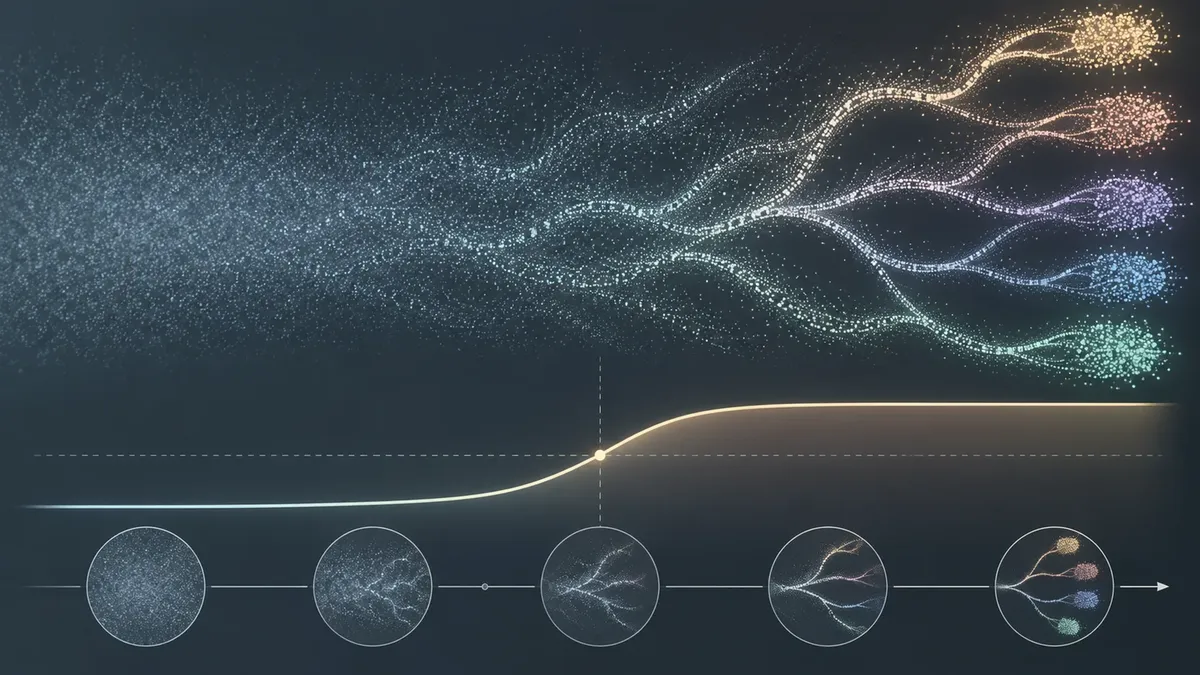
Neural networks can acquire recognizable patterns in their internal representations as training proceeds. But detecting when that happens often relies on measurements made afterward and tied to labeled examples. A new preprint proposes a different approach: use a model’s hidden states to estimate where it is in a sequence of representational transitions, without labels.
Watching representations change
A neural network does not simply improve in a smooth, uniform way. Its internal representations—the patterns of activity in its hidden layers—can develop structure during training. Researchers would like to know when useful structure appears, when individual features become established, and when a model’s representations may be starting to collapse.
The paper Feature Lottery? A Bifurcation Theory of Concept Emergence proposes a way to monitor these changes as training happens. Its central idea is to treat representation learning as a kind of phase transition: a system can shift from a relatively unstructured state into one where patterns become distinct. The authors use mathematical ideas from bifurcation theory, which studies how a system’s behavior changes when its conditions cross a threshold.
A label-free phase coordinate
The method analyzes hidden states from an evolving neural-network encoder using what the abstract calls a “passive GMM probe.” It compares a quantity representing the network’s current state, β(t), with a theoretically predicted threshold, βc(t). Their ratio, β(t)/βc(t), is proposed as a phase coordinate: a single value intended to indicate where the network is in its representation dynamics.
The authors say this measure can be computed from hidden states alone, without labels. In their theoretical account, the emergence of structure corresponds to a supercritical pitchfork bifurcation driven by the loss Hessian. Put more intuitively, once conditions cross a critical point, small differences can grow into distinct, organized patterns. The abstract also describes four transition regimes predicted by the proposed coordinate, though the abstract-only source available for this article does not specify their details.
The researchers report testing the idea in several settings: sparse autoencoders trained on the Pythia language models, self-supervised learning on CIFAR, and grokking on modular arithmetic. Grokking is a pattern in which a model may take a long time to generalize after first learning its training examples. The authors say that finite dissipation can make large-scale symmetry breaking lag far behind the initial threshold crossing, offering a dynamical explanation for delayed generalization in grokking. This is an explanation proposed by the paper, not evidence that one mechanism accounts for every instance of delayed generalization.
The “feature lottery” claim
In sparse-autoencoder training, the paper describes a “feature lottery”: features that become interpretable may be determined early, rather than selected only near the end of training. The abstract reports that, at 5% of training, atoms in the top 10% by early purity later reach a final part-of-speech (POS) purity of 0.82. The bottom 10% reach 0.47, compared with 0.22 for chance.
These figures suggest that early purity is associated with later purity in the reported experiment. They do not, by themselves, show that early purity causes a feature’s eventual quality, or that the same relationship will hold for other models, datasets, or definitions of interpretability. The abstract does not give enough methodological detail to assess how purity and chance were calculated or how variability across runs was handled.
The paper further presents β/βc as a possible early-warning indicator of training health, including the onset of usable structure, feature identity formation, and representation collapse. These are proposed applications; the abstract does not provide enough detail to judge how reliably the indicator detects each event or how it compares with existing monitoring measures.
What remains uncertain
The evidence summarized here comes from the paper’s abstract, not a full examination of its methods, results, or limitations. That means important questions remain open: how the probe is implemented, what assumptions support the theoretical threshold, how the four regimes are validated, and how performance varies across training runs. The reported examples span several settings, but an abstract cannot establish how broadly the method generalizes.
The work is an arXiv preprint, so it should be read as research that has been shared publicly rather than as a settled result. Its proposal is an intriguing way to think about training as a sequence of transitions, and the early-purity numbers are a specific reported association. Independent scrutiny and fuller methodological evidence are needed before treating the phase coordinate as a dependable general-purpose diagnostic.
- neural networks
- representation learning
- bifurcation theory
- sparse autoencoders
- grokking
- machine learning
Reviewed cross-references
These connections were reviewed by a model, not independently fact-checked by a human. Similarity does not imply agreement; consult the original papers and the evidence below.
Can neural networks have representational atoms?
Shared method: Both studies use sparse autoencoders to analyze model representations. Yang studies whether early atom purity in SAEs trained on frozen Pythia activations predicts final POS purity; Hu et al. evaluate threshold-activated SAEs as a way to identify representational atoms using fidelity and stability. The SAE setups and evaluation criteria differ, so this is a methodological connection, not evidence that the findings validate each other.
Model review: · openai-codex/gpt-6-luna
Evidence and provenance
Selected excerpts, not complete papers. PDF extraction can omit figures or damage equations, tables and reading order; sources may be preprints.
2605.24057v2 — Original paper
Excerpt reference:
static/papers/2605.24057v2.md:49-103
Basis: Paper text
Source SHA-256:c3f26b45cbf2b86ea7dd0e68392a725a174266c8972bf887d831a0e41a1147892611.14168v1 — Original paper
Excerpt reference:
static/papers/2611.14168v1.md:60-99
Basis: Paper text
Source SHA-256:29a97a251154652c5ee4598b2ea8c06e0ef898b5ab7b9dd4cb351ced390b1449
Related reading
Automatically matched by shared topic keywords. These links do not imply that the sources agree or establish a consensus.
Grokking as a Search for the Right Internal Representation
Source published
Shared keywords: machine learning, neural networks, representation learning
Can neural networks have representational atoms?
Source published
Shared keywords: machine learning, neural networks, sparse autoencoders
Why sparse autoencoders hit different limits in different layers
Source published
Shared keywords: representation learning, sparse autoencoders
A Mathematical Case for Neural Flow Matching
Source published
Shared keywords: neural networks
How a tiny particle exposed a flaw in a physics AI
Source published
Shared keywords: machine learning, sparse autoencoders