TRANSMISSION // 2605.23557v2
Reading turbulence in blocks may help underwater quantum links
Source published
A theoretical study combines virtual photon subtraction at the sender with receivers that process underwater quantum signals in different ways. In its simulations, joint detection across blocks of observations produced the lowest accepted-only bit-error rates among the three designs tested. The result is a modeled performance comparison—not a demonstration of a working secure underwater link.
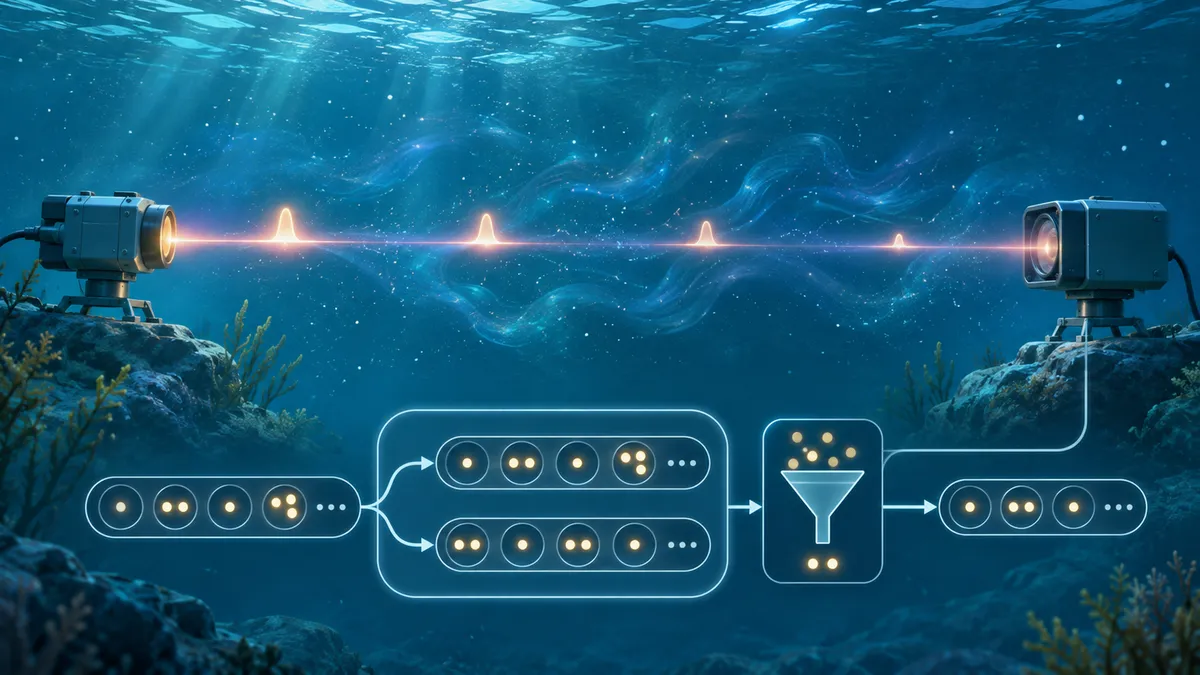
Water absorbs and scatters light, while turbulence can make the received signal fluctuate. Those effects complicate quantum key distribution, which uses quantum states to help two parties establish a shared key. A new theoretical study asks whether filtering the sender’s signals and analyzing groups of receiver observations together can make underwater continuous-variable QKD more tolerant of turbulence.
The challenge of sending quantum signals through water
Underwater optical links promise faster communication than acoustic links in some settings, but light does not travel through water unchanged. Absorption and scattering reduce the signal, and turbulence causes additional fluctuations. A receiver may also face thermal noise. Together, these effects can make it harder to distinguish the signals associated with different bits.
The study by Nour Rizk and colleagues examines continuous-variable quantum key distribution, or CV-QKD. In this approach, information is carried in properties of an optical field, rather than only in discrete choices such as a photon’s polarization. The authors focus on a design that pairs virtual photon subtraction at the sender with different detection methods at the receiver.
The word “virtual” matters: the proposed method does not physically remove photons using a detector. Instead, the sender, Alice, post-selects her measurement results—keeping some and discarding others according to a filter. This reshapes the distribution of the signals that remain. It avoids the dedicated hardware needed for physical photon subtraction, but it also means not every transmission attempt is accepted.
Comparing three receiver strategies
At the other end of the link, Bob’s receiver is modeled in three ways. Homodyne detection (HD) measures a field quadrature. Quantum maximum-likelihood detection (QMLD) uses photon counts to choose the most likely bit for each observation separately. Quantum multiple-symbol detection (QMSD) also uses photon counts, but makes decisions about a block of observations together.
That block-level approach is intended to use correlations in turbulence across consecutive channel uses. The receiver is treated as not knowing the channel’s instantaneous state—often called channel state information, or CSI. Instead, its likelihood calculations average over a statistical model of the fading.
The researchers derive analytical and semi-closed-form expressions for the accepted-only quantum bit error rate (QBER): the error fraction among signals retained after Alice’s filter. They model underwater turbulence with an Erlang distribution, an approximation used in the analysis for the positive-valued intensity fluctuations. They then compare predictions with Monte Carlo simulations across modeled water types and system settings.
What the model finds
Across the cases investigated, VPS-QMSD has the lowest accepted-only QBER, followed by VPS-QMLD and VPS-HD. The paper reports close agreement between its analytical calculations and simulation results. In the modeled scenarios, errors rise with distance and receiver thermal noise; clear-water cases perform better than coastal-water cases. The study also reports lower QBER when it increases the virtual-subtraction order or, for QMSD, the number of observations processed together.
The proposed combination has two distinct ingredients. Post-selection reshapes the source ensemble, while QMSD uses a sequence of receiver observations to make a joint decision. The comparison suggests that, under the paper’s assumptions, exploiting block-level information can outperform deciding on each photon-count observation alone. It does not establish that every real underwater channel will have the modeled correlations or that longer processing blocks are always practical.
What remains uncertain
These are model-based performance results, not an experimental demonstration of the proposed system. The turbulence is represented statistically, including through an Erlang approximation to a log-normal model, and the performance metric is QBER among accepted signals. The reported ranking does not by itself tell us the overall rate of usable secret key: post-selection discards attempts, and a QBER comparison alone is not a complete security proof. The numerical evaluation also assumes ideal detectors with unit detection efficiency, so it does not capture every practical receiver limitation.
The article is an arXiv preprint. A preprint is a publicly shared research manuscript and may not yet have undergone peer review; the source record here does not establish its publication status. The results should therefore be read as a theoretical proposal and comparison within a specified model, not as evidence that secure quantum communication has been achieved over an operational underwater link. Experimental tests and a fuller assessment of key generation and implementation security would be needed to judge practical performance.
- underwater quantum communication
- continuous-variable QKD
- virtual photon subtraction
- quantum multiple-symbol detection
- turbulence modeling