TRANSMISSION // 2605.22603v3
How quantum magic can return after noise
Source published
A theoretical study finds that amplitude damping can erase and later restore quantum magic, even as entanglement and coherence follow different paths.
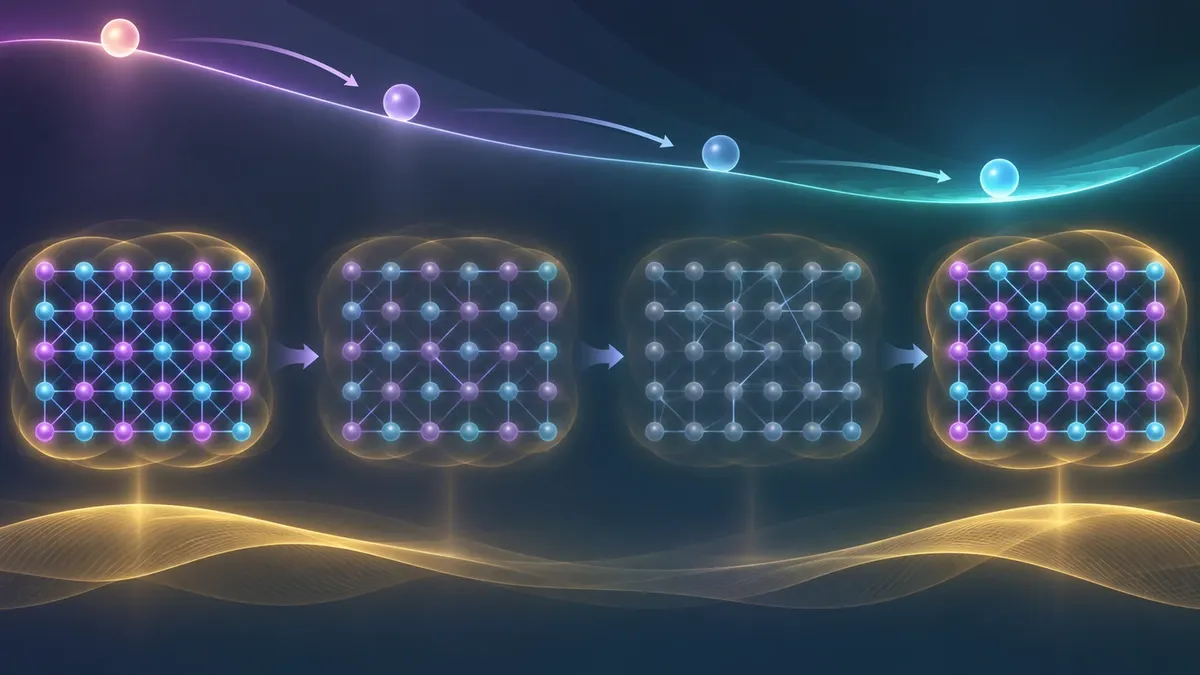
Noise is often treated as a one-way destroyer of quantum resources. But entanglement and “quantum magic”—a distinct property associated with quantum computation—need not respond alike. An arXiv preprint examines how magic can disappear and return under dissipation.
Noise can rob a quantum system of useful properties. Yet a theoretical study by Chenfeng Cao describes a counterintuitive possibility: under a steady process of energy loss, a quantum state can lose “magic” and later regain it, without its lost coherence returning.
The work, titled “Sudden death of entanglement, rebirth of magic,” is available as an arXiv preprint. Its abstract reports theoretical results for specific noise models, not an experimental observation. These findings concern states and measures with precise technical definitions; they do not show that noise generally improves quantum computers.
Two resources, two different fates
Entanglement describes quantum correlations between parts of a system. Quantum magic, also called non-stabilizerness, is a different resource: it distinguishes states outside the stabilizer polytope, the set of mixtures of stabilizer states. Stabilizer methods are important because circuits restricted to certain stabilizer-state preparations, Clifford operations and Pauli measurements can be simulated efficiently on classical computers. Magic is studied as a resource for going beyond those restricted methods, but its presence alone does not guarantee a computational advantage.
Because entanglement and magic are distinct, losing one does not necessarily mean losing the other. The paper investigates this distinction under local Markovian noise—a model in which parts of a system interact with their environments through memoryless processes.
What the analysis examines
For its central example, the study considers an n-qubit state of the form α|0ⁿ⟩ + β|1ⁿ⟩, with the ground-state amplitude smaller than the fully excited-state amplitude. Each qubit undergoes independent amplitude damping, a process that transfers excitation toward the lower-energy state.
The authors track how entanglement and magic change as damping proceeds. They also consider the coherence between the all-ground and all-excited configurations and the populations of those configurations. The abstract reports additional results about smaller subsets of qubits and the reservoirs. It also describes a separate case involving thermal relaxation and dephasing, but does not provide enough detail to reconstruct that model fully.
Magic disappears, then returns
In the amplitude-damping example, the state’s magic vanishes for a finite interval of damping and later reappears. Meanwhile, coherence between the two extreme configurations keeps decreasing. Its recovery is therefore not what the abstract identifies as the trigger for magic’s return. Instead, magic returns when the population of the fully excited configuration falls below that coherence.
The study reports that the damping probabilities associated with entanglement death and magic rebirth sum to one for every n ≥ 2. This relationship applies to the model analyzed; it is not a general law for noisy quantum systems. The abstract also reports that magic returns to the register just as the reservoirs become entangled. For a sufficiently small ground-state amplitude, the register is already fully separable at rebirth. These results illustrate that the behavior of entanglement and magic need not track together.
There is a further twist in how the returning resource is distributed. Every proper subset of the qubits is a stabilizer mixture throughout, according to the abstract, even though a joint parity measurement followed by Clifford decoding can concentrate the reborn magic onto one qubit. Thus the reported magic is not evident in any proper subset considered on its own, but can be accessed through a joint operation.
For thermal relaxation combined with dephasing, the abstract reports a range in which magic loss is permanent for every isolated qubit, while two qubits exposed to the same noise can regain magic. The abstract does not specify the range or detailed parameter conditions, so the result should not be extended beyond the stated setting.
What remains uncertain
These are theoretical findings reported in the abstract, not demonstrations in a laboratory. The available source material does not provide the full derivations, detailed definitions, parameter ranges or supporting figures. Those details are important for evaluating the scope of the results and how they might be tested. An arXiv preprint may not have undergone peer review; its listing alone does not establish independent validation.
The narrower lesson is that, in particular models of dissipation, different quantum resources can change in different ways. Entanglement may disappear while magic later returns, even as coherence continues to fade. That distinction can help researchers describe noisy quantum states more carefully, but it does not mean that noise is generally beneficial.
- quantum magic
- quantum entanglement
- amplitude damping
- quantum noise
- quantum information
Reviewed cross-references
These connections were reviewed by a model, not independently fact-checked by a human. Similarity does not imply agreement; consult the original papers and the evidence below.
Why measuring quantum resources can take so many samples
Supporting evidence: Cao’s amplitude-damping analysis predicts a small reborn-magic signal and notes that resolving it requires calibrated measurements and uncertainty estimates; Barch and García-Pintos derive general sampling lower bounds for estimating resource robustness and for tracking its change along a trajectory. This supports the bounded point that measuring a magic-rebirth trajectory can face statistical hurdles, but the latter results are general and do not establish the sample cost for Cao’s specific system.
Model review: · openai-codex/gpt-6-luna
Evidence and provenance
Selected excerpts, not complete papers. PDF extraction can omit figures or damage equations, tables and reading order; sources may be preprints.
2605.22603v3 — Original paper
Excerpt reference:
static/papers/2605.22603v3.md:1114-1172
Basis: Paper text
Source SHA-256:3567405c171a8a1cdf95762b9363616b87343fa5697843d4f5a5f61e3d45809e2611.19017v2 — Original paper
Excerpt reference:
static/papers/2611.19017v2.md:12-65
Basis: Paper text
Source SHA-256:2fa9e33ae79a134fd6eba85041118b06d65b542900567631a4b19ac675af29cf
Related reading
Automatically matched by shared topic keywords. These links do not imply that the sources agree or establish a consensus.
How topology makes quantum magic visible as entanglement
Source published
Shared keywords: quantum entanglement, quantum information, quantum magic
When quantum noise helps a forecasting model
Source published
Shared keywords: quantum noise
When quantum magic cannot be distilled
Source published
Shared keywords: quantum information, quantum magic
A random-access test for quantum “magic”
Source published
Shared keywords: quantum information, quantum magic
Why measuring quantum resources can take so many samples
Source published
Shared keywords: quantum information, quantum magic