TRANSMISSION // 2605.19182v3
Bound entanglement can help reconstruct quantum processes
Source published
A theoretical study finds that some bound-entangled states can serve as probes for quantum process tomography, with a four-by-four example offering better mathematical conditioning than any separable probe in the same dimensions.
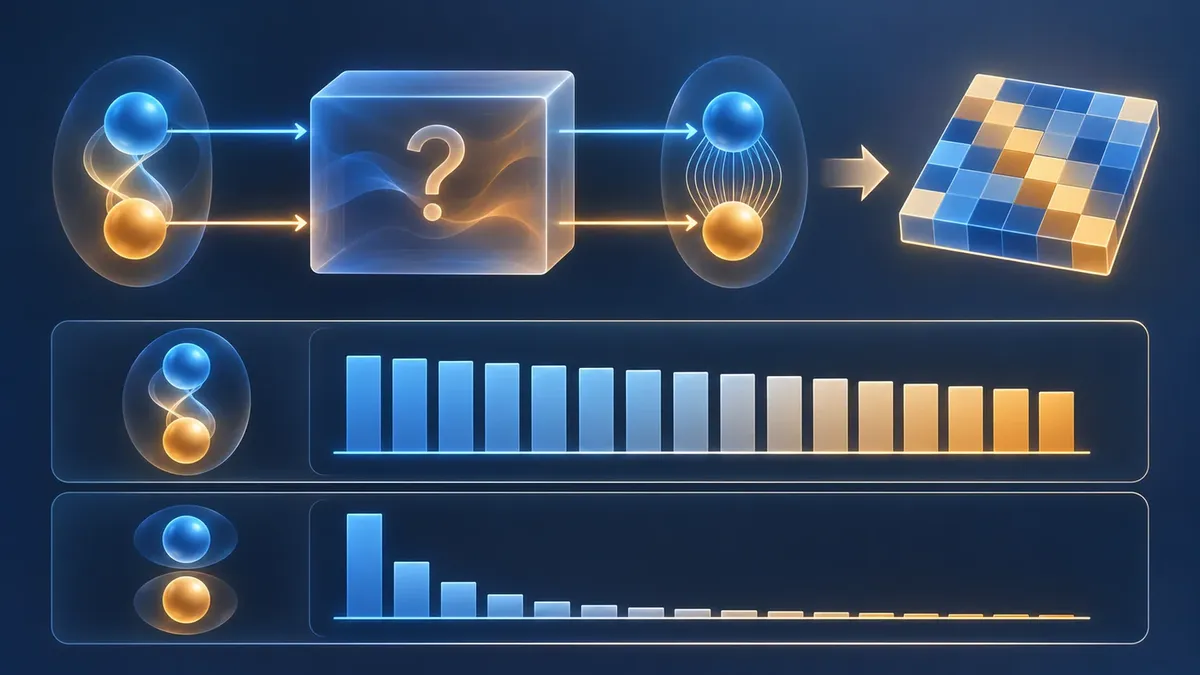
Quantum process tomography aims to reconstruct how an unknown quantum system changes its inputs. A theoretical study shows that certain bound-entangled states can help with this task. Not every such state works: a probe must meet a mathematical condition for complete reconstruction, and whether reconstruction is possible is distinct from how stable it is to errors.
A probe for an unknown quantum process
Quantum devices transform states: a photon may pass through an optical component, or a qubit may undergo a gate. Quantum process tomography (QPT) infers the transformation, or channel, by preparing inputs and measuring outputs. In ancilla-assisted QPT, the system is prepared jointly with a second system, called an ancilla. The unknown channel acts on the first part while the ancilla is left untouched. Correlations in the joint output can encode information about the channel.
A familiar probe is a maximally entangled state, but other states can work. In this approach, a probe supports complete reconstruction when its realigned matrix is invertible, a property the paper calls faithfulness. The question is whether bound-entangled states can satisfy this condition and how well they perform as probes.
Bound-entangled states are entangled, yet their entanglement cannot be distilled into maximally entangled pairs using local operations and classical communication, even in the asymptotic limit. The states studied here are positive under partial transpose (PPT); for entangled states, this property implies nondistillability.
What the researcher did
The paper gives mathematical constructions of PPT-entangled probes and checks whether their realigned matrices have full rank. It presents a general family in dimensions d ⊗ d, with d at least four, and discusses explicit examples in three-by-three and four-by-four dimensions, including a four-by-four state labelled ρCCNR.
The study also examines local filtering: operations on the two parts of a probe, with selected outcomes retained. To assess reconstruction quality, it considers the singular values of the realigned matrix. If the smallest singular value is close to zero, inverting the matrix can amplify errors. The author therefore compares the smallest singular value and the condition number, a measure of sensitivity to errors, and derives bounds for separable probes.
What the results show
The constructed bound-entangled states can be faithful, meaning they can, in principle, encode enough information for complete channel reconstruction. For the four-by-four ρCCNR example, the paper reports a smallest singular value of 1/12 and a condition number of 3. It proves that any separable probe in the same dimensions has a smallest singular value no greater than 1/20 and a condition number no smaller than 5. By these mathematical measures, this example is better conditioned than any separable probe in that setting.
This does not make it better than every entangled probe. The paper identifies the maximally entangled probe as optimal, and says the bound-entangled example has the same conditioning as an antisymmetric Werner state that is distillably entangled. The result is more specific: nondistillable entanglement can still be useful for this reconstruction task.
The filtering analysis highlights why entanglement measures alone do not determine tomography performance. The computable cross norm and realignment (CCNR) quantity can detect entanglement, but increasing it does not necessarily improve reconstruction. A rank-deficient local filter can destroy faithfulness, making complete reconstruction impossible. An invertible filter preserves faithfulness, though it may change conditioning. Local filtering cannot turn an unfaithful state into a faithful one, the paper shows.
What remains uncertain
These results concern mathematical conditioning, not a laboratory demonstration of more accurate channel reconstruction. The paper calls for experimental studies; its bounds do not establish how a probe would perform amid practical preparation and measurement errors.
The author also leaves open whether PPT-entangled states with maximal CCNR violation must always have maximal operator Schmidt rank, the rank condition associated with faithfulness. The paper says this relationship needs further investigation, particularly in higher dimensions.
The source is an arXiv preprint, and the supplied material does not establish its peer-review status. Its conclusions should be understood within the stated tomography framework, not as evidence that bound-entangled probes are universally practical or superior.
- quantum process tomography
- bound entanglement
- quantum channels
- ancilla-assisted tomography
- PPT entangled states
- quantum information
Related reading
Automatically matched by shared topic keywords. These links do not imply that the sources agree or establish a consensus.
When quantum magic cannot be distilled
Source published
Shared keywords: quantum information
How quantum systems behave over the long run
Source published
Shared keywords: quantum channels, quantum information
A probability table may reveal what a quantum channel does—and what the lab is doing
Source published
Shared keywords: quantum channels, quantum information
New bounds map uncertainty across quantum channels
Source published
Shared keywords: quantum channels, quantum information
Why finite quantum circuits cannot reproduce the quantum switch
Source published
Shared keywords: quantum channels, quantum information