TRANSMISSION // 2605.18959v2
Hyrax aims to make astronomical machine learning easier to explore
Source published
An open-source framework brings data handling, model experiments and visual exploration together, with five demonstrations using astronomy survey data.
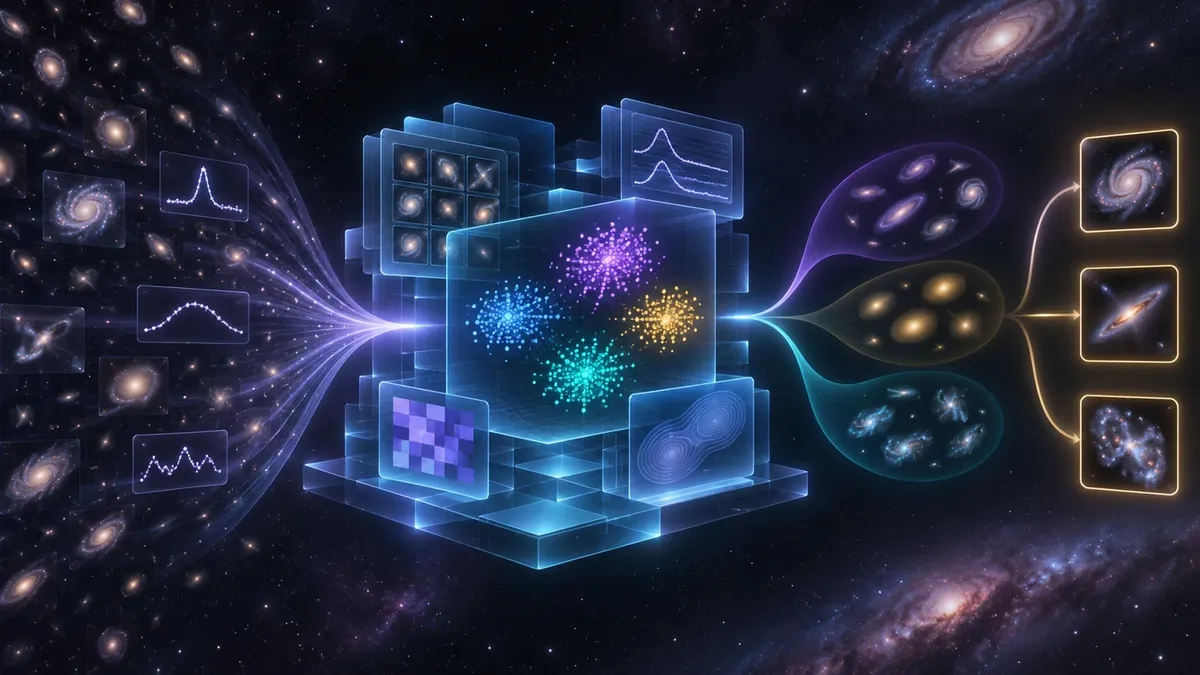
As new telescopes generate enormous collections of images and other measurements, astronomers need more than clever models: they need tools to manage and compare machine-learning experiments. Hyrax is a Python framework designed to support that work, and its authors illustrate it with five applications using survey data.
The challenge: data at survey scale
The Vera C. Rubin Observatory, the Roman Space Telescope and Euclid are expected to produce vast amounts of astronomical data, including images and time-varying observations. In this setting, a project’s bottleneck may be the infrastructure needed to obtain, organize and analyze data—not just the design of a machine-learning model.
Hyrax, an open-source, modular Python framework, is intended to support several parts of that process in one system. The authors describe capabilities for data acquisition, model training, inference and experiment comparison. Its features include GPU support, multimodal datasets, vector databases for similarity search, and interactive exploration of learned latent spaces in two or three dimensions.
Five demonstrations
The paper’s abstract describes five applications using real survey data. In one, the team applied unsupervised representation learning to roughly 400,000 galaxies in Rubin Legacy Survey of Space and Time Data Preview 1. The framework surfaced candidate mergers and low-surface-brightness galaxies missing from reference Euclid and Dark Energy Survey catalogs. It also isolated imaging artifacts. The authors report that this discovery exercise used no labeled training data.
A second demonstration used a hybrid density-based clustering approach to identify candidates for cluster-scale gravitational lenses.
The other examples cover a range of tasks: classifying early-time transient events in the Zwicky Transient Facility using light curves, spectra, images and metadata; filtering false positives in shift-and-stack searches for distant Solar System objects in the Dark Energy Camera Ecliptic Exploration Project survey; and detecting semi-resolved dwarf galaxies in Hyper Suprime-Cam and LSST-like images using synthetic source injection.
Together, the examples show Hyrax being used with different kinds of astronomical data and machine-learning tasks. They are demonstrations of versatility, not evidence that one method or workflow is best for every survey or science question.
What the evidence can—and cannot—show
The source available for this article is the paper’s abstract, not its full methods, results tables or technical appendices. It does not provide enough detail to assess how candidate objects were verified, how performance was measured, or how the approaches compare with alternatives. “Surfacing” candidates does not by itself establish that each is a confirmed discovery. The abstract also does not show that Hyrax produced better scientific results than other infrastructure would have.
The work presents a framework and example applications rather than a single controlled evaluation of overall framework performance. The examples suggest that Hyrax can support varied workflows, but they do not settle questions about generalization to new data, computational costs, or performance in uses beyond the cases described.
Hyrax’s broader promise is organizational: bringing data, modeling and experiment-exploration tools together may make it easier for astronomers to try and compare methods as surveys grow. Whether that translates into reliable discoveries depends on validation of individual results and on how the framework performs in wider use.
This account is based on the abstract of an arXiv preprint, version 2, posted May 18, 2026. A preprint is a research manuscript shared publicly; its presence on arXiv does not by itself establish peer review or publication. Because the abstract is limited, technical details beyond its summary cannot be independently assessed here.
- Hyrax
- astronomical machine learning
- Rubin Observatory
- galaxy candidates
- survey data
- unsupervised learning
Related reading
Automatically matched by shared topic keywords. These links do not imply that the sources agree or establish a consensus.
Webb imaging identifies 14 extremely metal-poor galaxy candidates
Source published
Shared keywords: galaxy candidates
Turning anomaly intent into testable time-series detectors
Source published
Shared keywords: unsupervised learning
A clustering algorithm that filters first, then fills in the gaps
Source published
Shared keywords: unsupervised learning
CARROT Lets Graph Clusters Find Their Own Size
Source published
Shared keywords: unsupervised learning
GPS signals offer Rubin Observatory a way to track atmospheric water
Source published
Shared keywords: rubin observatory