TRANSMISSION // 2605.16381v2
Teaching Video AI When to Speak
Source published
StreamPro trains video models to decide whether, when and what to say as a stream unfolds. Its authors report better benchmark scores, but real-world usefulness remains unproven.
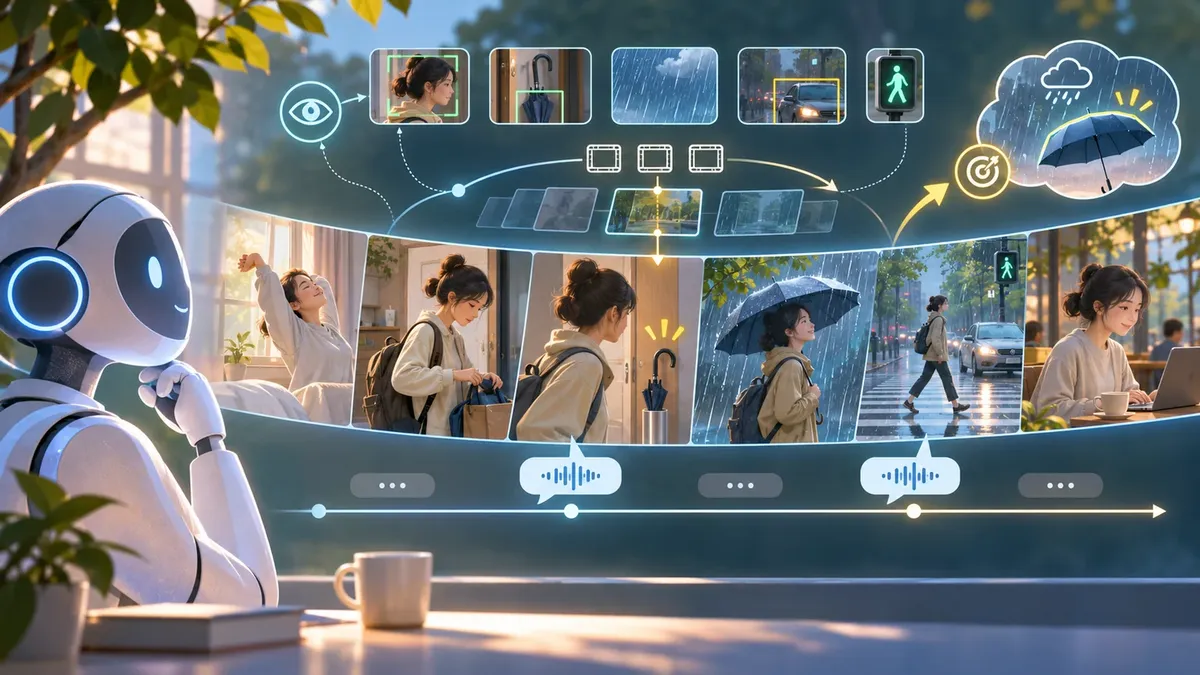
A video assistant can fail by staying quiet when help is needed—or by interrupting too often. StreamPro is a two-stage training approach designed to improve that balance, with tests covering perception, timing and anticipatory assistance.
A video assistant that answers questions after a clip has ended faces a different challenge from one that watches events unfold. A proactive system must keep track of what is happening, decide whether a response is needed, and choose the right moment to speak. It must also avoid unnecessary interruptions. The StreamPro paper asks whether training methods that reward both individual answers and the quality of a whole response sequence can improve those decisions.
Training for silence and response
The authors identify two training problems. In supervised fine-tuning (SFT), many moments call for silence and relatively few require a response. The researchers argue that this imbalance can teach a model to remain silent too often. In reinforcement learning (RL), feedback can be sparse: a response may receive little credit if its wording is partly right but its timing is off. Scoring each response alone also misses problems across a sequence, such as repetition or omissions.
StreamPro addresses these issues in two stages. First, its CB-Stream Loss reweights the training signals for silence and response, aiming to prevent the more common silence examples from dominating. Then it uses Group Relative Policy Optimization (GRPO), an RL method, with complementary rewards. A Response-Matching reward gives feedback on the timing and semantic correctness of individual responses. The Sequence-Quality reward uses a rubric to assess the sequence as a whole, including whether responses are appropriately detailed, in chronological order and sufficiently complete.
The researchers also created training sets for the two stages: StreamPro-SFT-63K and StreamPro-RL-3K. They say the evaluation data were kept separate from training data. Their new benchmark, StreamPro-Bench, includes 577 videos and 1,285 question-answer pairs across seven tasks. These are grouped into Perceptual Understanding, Temporal Reasoning and Anticipatory Assistance. Examples include tracking an event, identifying when it ends, offering guidance during a procedure, and warning about a potential navigation risk.
What the tests found
The authors introduce StreamPro-F1, a score designed to combine response correctness and timing while penalizing both missed and excessive responses. Its timing rules vary by task. For example, recognizing an event and warning about a possible hazard do not have the same ideal response time.
On StreamPro-Bench, the trained 4-billion-parameter model scored 32.8 on average after the RL stage, compared with 9.2 for the strongest previous proactive model in the paper’s comparison. The SFT version scored 19.8. The result suggests that both stages—and especially the further RL training—helped on this benchmark. The authors also report a score of 79.8 on the Real-Time Visual Understanding portion of StreamingBench, alongside competitive results on offline video tests.
Ablation tests offer clues about which parts mattered. Reweighting the SFT loss improved the benchmark score over standard cross-entropy training. In RL tests, the sequence-quality reward improved results over a setup without it. The authors also varied how much timing error the response-matching reward tolerated; a wider tolerance performed better in the reported comparison. These tests support the design choices in this setup, but do not establish that the same choices will work equally well on other data or tasks.
What the scores do—and don’t—show
StreamPro-F1 is not a direct measure of whether people would find an assistant helpful. For most tasks, semantic correctness is judged by another language model; temporal grounding uses an overlap measure instead. The paper reports similar benchmark averages using three different language-model judges, and describes a human preference exercise. Such checks add evidence, but they do not make an automated benchmark equivalent to real-world user evaluation.
The benchmark also has specific boundaries. Risk-forecasting examples were manually reviewed, but the authors say risk forecasting was not included in either training set because reliable examples were difficult to construct. Some other benchmark and training data were generated or refined with language models; training data did not receive the same human-review step as the benchmark. The tests therefore do not show that the model can reliably anticipate hazards in everyday settings. Nor do benchmark scores alone establish practical safety, usefulness or performance across different environments.
StreamPro is presented in an arXiv preprint, a research manuscript that may not have undergone peer review. The evidence described here comes from that paper, and its comparisons depend on the authors’ benchmarks, evaluation procedures and selected baselines. The results are promising for training systems to manage the timing and frequency of responses, but broader independent testing would be needed to determine how well that ability transfers beyond the reported experiments.
- video AI
- proactive video understanding
- reinforcement learning
- StreamPro
- video benchmarks
- AI assistants
Related reading
Automatically matched by shared topic keywords. These links do not imply that the sources agree or establish a consensus.
Teaching AI What to Remember From Video
Source published
Shared keywords: reinforcement learning
How PhyMotion scores AI-generated human movement
Source published
Shared keywords: reinforcement learning
Why Video AI Misses Brief, Crucial Moments
Source published
Shared keywords: video ai
EvoWorld tests whether AI-generated worlds can change while the camera looks away
Source published
Shared keywords: video benchmarks
When AI reviews violent video, simpler evidence can work better
Source published
Shared keywords: video ai