TRANSMISSION // 2605.14269v2
How PhyMotion scores AI-generated human movement
Source published
PhyMotion reconstructs 3D body motion and uses a physics simulator to score it. Researchers tested the scores as video-model rewards, while noting important limits.
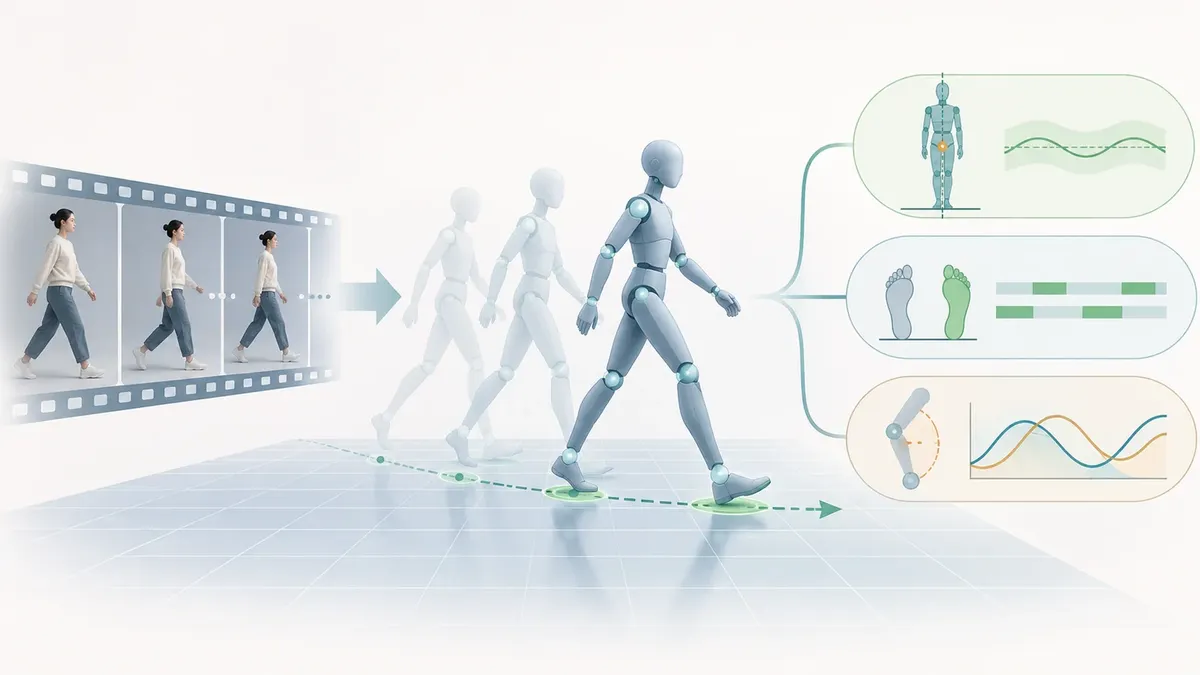
A generated clip can look convincing yet show a person floating, slipping, or moving implausibly. PhyMotion tries to spot these problems by estimating a person’s 3D movement and evaluating it with a physics simulator.
A person in an AI-generated clip may appear to perform a convincing kick or dance, but a foot might slide across the floor or a limb pass through the body. The authors of PhyMotion argue that some video evaluators they tested can miss such problems because they rely on visual and semantic cues rather than explicitly checking an articulated body’s movement and physical feasibility. Their question: can a score based on reconstructed 3D motion and physics better match people’s judgments—and help improve video generators?
PhyMotion is described in an arXiv preprint. Although the paper labels itself a NeurIPS 2026 contribution, the supplied source does not independently establish its publication or acceptance status. The results below are the authors’ reported findings, not independent confirmation.
From video to a physics-based score
The system processes a generated video with GVHMR to recover a sequence of 3D human poses using the SMPL-X body model. It retargets that motion onto a humanoid in MuJoCo, a physics simulator, and estimates quantities including joint motion, ground contact, balance, forces, and torques.
Those estimates feed three scores. Kinematic feasibility checks for issues such as abrupt joint movement, joint-limit violations, and body parts intersecting. Contact and balance feasibility looks for foot sliding, ground penetration, floating, and unstable support. Dynamic feasibility estimates whether the movement could be produced without forces, torques, or effort that exceed the system’s chosen thresholds. Higher scores indicate fewer violations under these definitions; they are not a universal verdict on whether a movement is physically correct.
The team first tested whether the scores aligned with human preferences. They selected 1,200 video-pair comparisons for annotation. The videos came from six baseline generators and were paired under the same prompt; six annotators judged body structure, balance, and motion naturalness. In this specific study, the combined PhyMotion score had an aggregate Spearman correlation of 0.376 with the judgments. The authors report that this exceeded the correlations of the tested comparison metrics. Correlation describes how similarly two sets of scores rank examples; it does not mean the system judges movement as a person would. Nor does this selected study establish performance across all video models or kinds of motion.
Using the scores to train generators
The researchers also used PhyMotion as a reinforcement-learning reward to fine-tune two video generators: one autoregressive and one bidirectional. In this approach, a model’s generated clips are scored and training adjusts the model to favor higher-scoring outputs. The authors combined the three feasibility scores and used a constraint intended to keep the fine-tuned model close to its starting behavior.
The post-training human-preference evaluation was separate from the 1,200-comparison metric-validation study. It used 1,487 sampled video pairs. The paper reports an overall Elo rating of 1621 for the PhyMotion-trained model and 1604 for the Wan 2.2 14B reference model. Elo summarizes results from pairwise preferences; it is not a direct measure of physical accuracy. The authors also report gains on several automatic evaluations and comparable results on general video benchmarks. In ablations—experiments that remove or isolate parts of the method—each score component primarily improved its corresponding dimension, while the combined reward performed best overall in their tested setup.
What the results do—and do not—show
The approach depends on estimates of the 3D body from video and on how the simulated human and scoring rules represent movement. That dependence is a reason to interpret the scores as model-based estimates, not ground truth. The paper explicitly identifies several limitations: reward optimization can be hacked; some examples suppress or simplify challenging actions; human–object interaction is not explicitly modeled; and the main post-training focuses on flat surfaces. The authors also note that biases in the underlying video generators and body-reconstruction tools may affect results across appearances, body shapes, clothing, viewpoints, or activities.
The findings support PhyMotion as a promising evaluation and training tool within the authors’ tested prompts, models, and procedures. They do not establish that it reliably handles every body, action, or environment. As an editorial recommendation, further independent replication and broader testing—including across diverse bodies and settings—would help clarify how well the results transfer. The preprint’s reported experiments are useful evidence, but should not be treated as the last word.
- AI video generation
- human motion
- 3D pose estimation
- physics simulation
- reinforcement learning
Related reading
Automatically matched by shared topic keywords. These links do not imply that the sources agree or establish a consensus.
Learning chemotherapy schedules from patient records: a small study with major limits
Source published
Shared keywords: reinforcement learning
A moving anchor for steadier language-model reinforcement learning
Source published
Shared keywords: reinforcement learning
Teaching AI to judge the safety of a whole maneuver
Source published
Shared keywords: reinforcement learning
How many samples does regularized reinforcement learning need?
Source published
Shared keywords: reinforcement learning
When a Learning Agent Becomes the Wrong Kind of Firm
Source published
Shared keywords: reinforcement learning