TRANSMISSION // 2605.14042v3
A smarter schedule for fault-tolerant quantum circuits
Source published
Qomet exploits commuting quantum gates and models routing in detail to improve simulated circuit schedules. Its gains vary with the workload and resource assumptions.
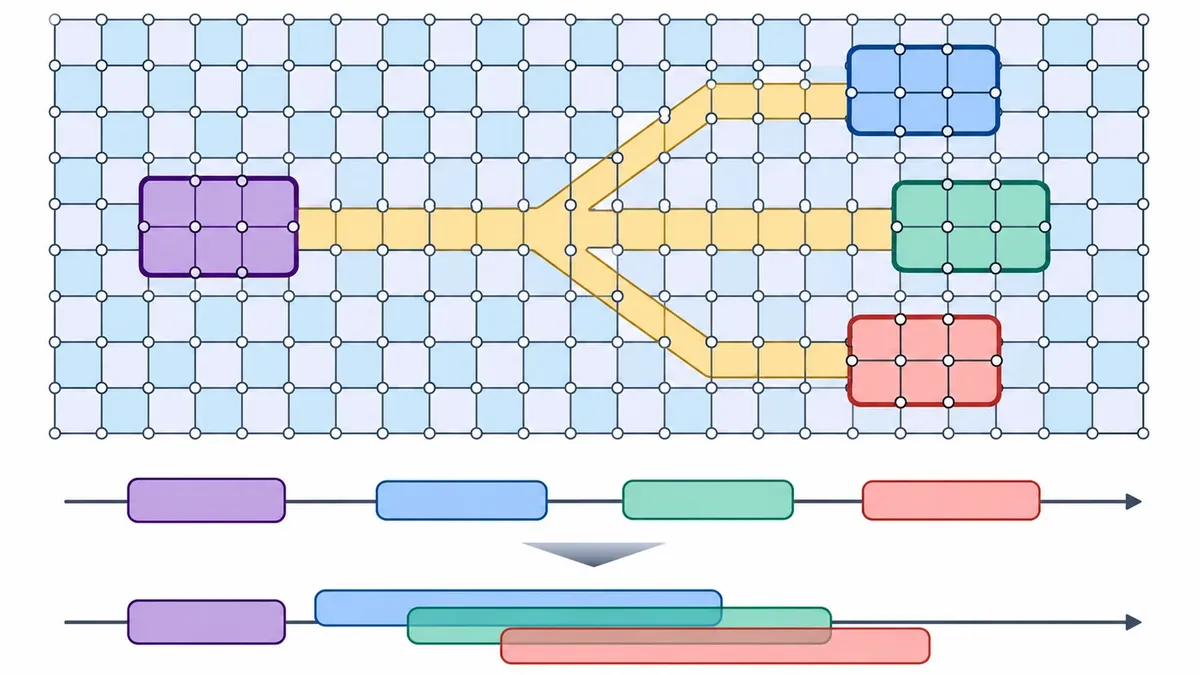
Fault-tolerant quantum computers use error correction to protect information, but that protection makes operations costly in space and time. A new compiler study asks whether better scheduling can reduce that overhead by exposing parallel work hidden in circuits.
A quantum circuit can look sequential even when some operations could happen at the same time. In a fault-tolerant computer, missed opportunities for parallel work matter: logical operations use patches of physical qubits, and coordinating those patches takes time and space. A paper introducing a compiler called Qomet asks whether recognizing more structure in a program can produce more efficient schedules for lattice surgery, a method for operating on error-corrected qubits.
In lattice surgery, information is stored in regions, or patches, of a surface code. Logical operations are carried out by joining and separating patches through measurements. Operations that look simple in a circuit diagram can involve routing, waiting and occupying auxiliary patches. A schedule that advances the processor in fixed time slices may leave resources idle while one slow operation holds up the next slice.
The researchers focus on controlled-phase, or C-Phase, gates. These gates are diagonal in the computational basis and commute with one another, so their order can be changed without changing the computation. The authors’ key observation is that a sequence of such gates can sometimes be reorganized as one interaction between a control patch and several target patches. Lattice surgery can implement this pattern as a multi-target operation, potentially replacing separately scheduled interactions with a more parallel arrangement.
Qomet combines this circuit-level reordering with a detailed scheduler. Rather than assigning every operation to a uniform slice, it models events cycle by cycle, accounting for patch positions, routes, rotations and different operation durations. It also tries to pack compatible operations into available routing space. The evaluation compares modeled schedules for surface-code layouts with two compilation approaches, DASCOT and PureMagic. The authors test different workloads, layouts and assumptions about how non-Clifford operations are supplied, including magic-state distillation, cultivation and STAR injection.
For QFT and QAOA benchmarks across four layouts in the STAR regime, Qomet’s execution-time reduction reaches up to 24.5 times over DASCOT, with a geometric mean of 4.99 times. In the same benchmark scope—QFT and QAOA across four layouts—the magic-state cultivation results show a maximum reduction of 23.9 times over DASCOT and a geometric mean of 6.22 times. These are comparisons of modeled execution times under the paper’s assumptions, not measured speedups on a working quantum computer.
The analysis also has an important resource caveat: the magic-state factories’ output rate is not modeled, and factory area is excluded from the space-time volume calculation. Thus, the reported comparisons do not capture every potential cost of supplying those resources in a real system.
The pattern of results is not universal. Under magic-state distillation, where states must be routed from factories, congestion and limited supply constrain the advantage; in some tested settings Qomet is close to a baseline, and one reported case uses slightly more space-time volume. On circuits with few C-Phase gates, gains are smaller and are attributed mainly to pipelined scheduling rather than gate grouping. The authors also estimate lower program-failure probabilities in a particular model: they assume identical per-cycle logical error rates for patches and calculate failure from the schedule’s space-time volume. This is a model-based estimate, not an observed improvement in device reliability.
The study supports a narrower conclusion than “quantum computers will run this much faster.” It suggests that combining circuit-structure knowledge with routing- and timing-aware scheduling can improve modeled execution costs, especially for circuits rich in commuting phase operations. The benefit depends on the circuit, layout, resource-supply assumptions and comparison compiler. The work evaluates schedules and resource models, not an end-to-end run on fault-tolerant hardware. The source is an arXiv preprint; the supplied material does not establish its peer-review status.
- quantum computing
- fault-tolerant quantum computing
- quantum compiler
- lattice surgery
- quantum error correction
- Qomet
Related reading
Automatically matched by shared topic keywords. These links do not imply that the sources agree or establish a consensus.
A quantum compiler that keeps error correction in view
Source published
Shared keywords: fault tolerant quantum computing, quantum error correction
Why some simple gate patterns cannot control every logical qudit
Source published
Shared keywords: fault tolerant quantum computing, quantum error correction
TopoLS explores new layouts for lattice surgery
Source published
Shared keywords: lattice surgery, quantum computing, quantum error correction
GeneCS Targets Leaner Quantum Code Surgery
Source published
Shared keywords: fault tolerant quantum computing, quantum error correction
Froq tests quantum-side speculation in simulation
Source published
Shared keywords: fault tolerant quantum computing, quantum error correction