TRANSMISSION // 2605.13738v3
Can LISA spot black hole mergers before they happen?
Source published
Two search methods recovered simulated massive black hole binaries before merger. Inpainting also worked with tested data gaps, though real LISA data will pose further challenges.
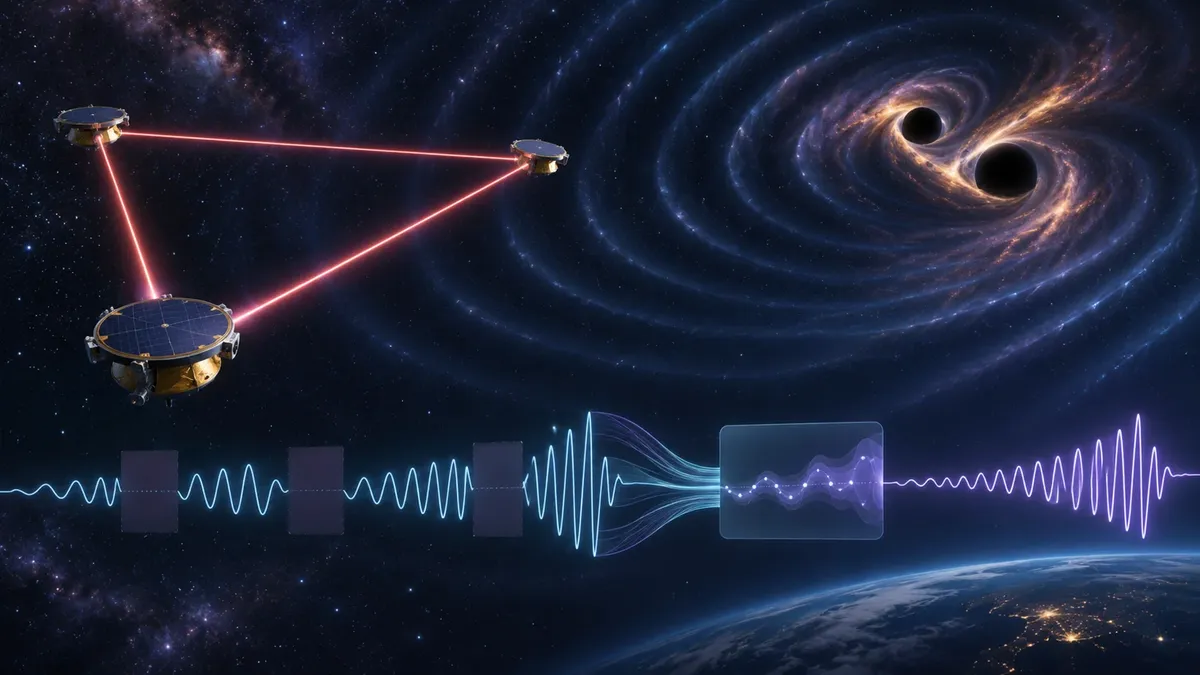
A warning before two massive black holes merge could give other observatories time to look for a matching event. Researchers tested two ways to find such binaries in simulated LISA data, including a method designed to cope with missing measurements.
Why search before a merger?
The planned Laser Interferometer Space Antenna (LISA) will observe gravitational waves from massive black hole binaries. Finding a binary before it merges could give astronomers time to point other observatories toward the source and prepare for a possible joint observation of gravitational waves and light. It may also help researchers estimate where in the sky the merger will occur.
The challenge is to search as data arrive, amid other sources and possible interruptions. Gareth Cabourn Davies and Ian Harry tested two approaches on simulated LISA data: a zero-latency filter and an “inpainting” method.
Two ways to search the data
The researchers used the training dataset from the LISA Data Challenge known as Sangria-HM. It represents a year of data containing simulated instrumental noise, a foreground of Galactic binaries, and massive black hole binary signals. The Galactic binaries matter because their combined signal can add confusion in the same frequency range as some merger signals.
Both methods use matched filtering: they compare data with model waveforms, or templates, to look for a pattern consistent with a binary. The zero-latency method is designed to analyze incoming data without waiting for additional measurements needed by a conventional whitening procedure. In this test, it searched at five specified times before merger: 0.5, 1, 4, 7 and 14 days.
Inpainting addresses missing or unusable data. Rather than treating a gap as an ordinary stretch of zeros, the method adjusts values within the gap so that data processing does not allow surrounding measurements to spill into it and distort the filter. The researchers adapted this approach to search across a range of possible times before merger, rather than only at a short list of fixed times.
What the tests found
The paper reports that both methods recovered 14 of the 15 simulated binaries at least half a day before merger. The one not recovered at that point was too quiet for the search at that stage. The results were broadly consistent with estimates of how much signal strength each binary should contribute before merging.
The inpainting search also recovered a signal after the researchers added three separate, day-long gaps within the 14 days before its merger. The recovered signal was weaker, as expected when some data are missing, but the method continued to accumulate evidence from available measurements. This is a demonstration on one simulated signal and a particular arrangement of gaps, not a guarantee for every outage or source.
The researchers also examined four binaries whose mergers fell within a 10-day period. Their signals interfered with one another in the search. Removing confidently identified signals helped reveal quieter ones, but did not make every signal straightforward to separate. In this focused test, some removal times were chosen by the researchers, and the paper notes that waveform subtraction was imperfect in one case because a bug left a residual. Real-time identification and removal would need further development.
What remains uncertain
These results come from a simulated challenge dataset, not LISA observations. The authors note that the study does not cover all possible binary parameters and that the dataset does not include every difficulty expected in real data. They identify correlated noise, non-Gaussian disturbances and irregular data arrival as issues for future work. The gap test also does not establish performance across a broad range of gap patterns.
The source is an arXiv preprint. The authors make code and results available for reproduction, but successful recovery in this simulation does not by itself show how often real searches will identify mergers early or localize them well enough for follow-up. The study presents a proof of concept: inpainting can preserve a premerger search through the tested gaps, while overlapping signals and more realistic data remain important challenges.
- LISA
- gravitational waves
- massive black hole binaries
- premerger detection
- inpainting
- astronomy
Related reading
Automatically matched by shared topic keywords. These links do not imply that the sources agree or establish a consensus.
Separating black hole signals from glitches in simulated LISA data
Source published
Shared keywords: gravitational waves, massive black hole binaries
Phentax adapts black hole waveform calculations for LISA’s crowded signals
Source published
Shared keywords: gravitational waves
Teaching LISA’s data models to expect the unexpected
Source published
Shared keywords: gravitational waves
Two cosmic signals could reveal how massive black holes grow
Source published
Shared keywords: gravitational waves
The Milky Way’s leftover signals could blur LISA’s search for a gravitational-wave background
Source published
Shared keywords: gravitational waves