TRANSMISSION // 2605.13542v2
Testing whether AI can follow a changing ICU patient
Source published
RealICU tests whether language-model agents can track evolving ICU records, recommend care and avoid risky actions. Structured memory helped some tasks, but safety problems remained.
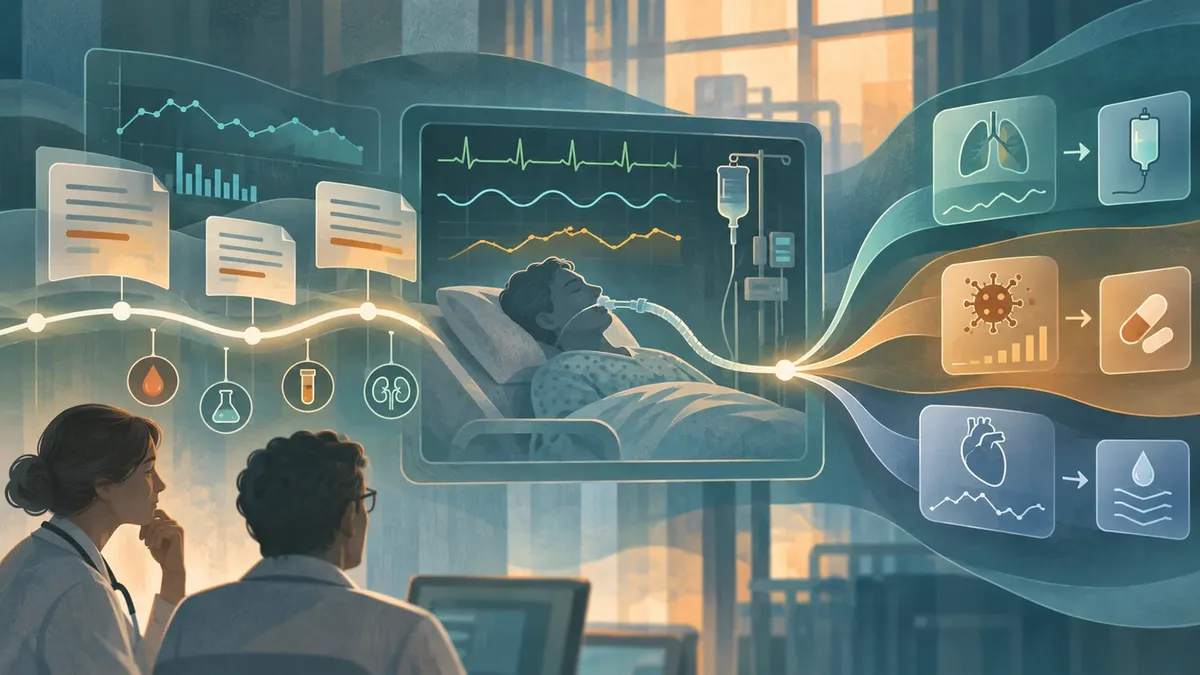
An ICU patient’s condition can change quickly, while the record grows hour by hour. RealICU is a benchmark designed to test whether AI agents can make sense of that evolving history—not merely copy actions clinicians previously took.
Why test AI on an entire ICU stay?
Intensive care generates a dense stream of measurements, test results, medications and clinical notes. A decision-support system would need to track what is changing, identify urgent problems and avoid suggestions that could be harmful for a particular patient. A model that performs well on a short medical quiz may not be able to do all of that over a long, changing record.
There is also a problem with how some benchmarks judge recommendations: they treat what clinicians did in the past as the correct answer. But a recorded decision reflects what was known at the time, and may not be the best action in retrospect. The RealICU researchers argue that this can reward AI for imitating historical behavior rather than assessing whether its answers fit the patient’s clinical course.
Building a hindsight-based benchmark
The team created RealICU from records in MIMIC-IV. They selected 94 ICU stays and organized patient information into 30-minute windows, with evaluation checkpoints sampled at two-hour intervals. For a given checkpoint, an AI system sees only information available up to that point. Reference labels, however, are made with knowledge of the full trajectory—a hindsight review of how the patient’s condition unfolded.
The benchmark asks systems to assess four things: whether the patient is improving, stable or deteriorating; what acute problems need attention; what actions could benefit the patient within the next hour; and what actions should be avoided because they could be harmful. Clinicians advised on these tasks. For RealICU-Gold, the team sampled roughly 10 windows per stay; at least two senior physicians labeled each sampled window, and windows without agreement were excluded.
RealICU-Gold contains 930 physician-labeled windows. To cover more checkpoints, the researchers also used Oracle, an LLM-based labeler, to create RealICU-Scale’s 11,862 labels. Oracle was validated by comparing its labels with physician consensus on the Gold set, not by having physicians review every Scale window. The authors report Oracle F1 scores of at least 0.895 across the four tasks on that comparison. This indicates agreement on the validation sample; it does not establish independent reliability across all windows or make generated labels equivalent to physician review.
The study tested three language-model backbones: Gemini-3.1-pro, GPT-5.4 and Qwen3-235B-A22B. Systems used different context approaches, including the current window, retrieval of earlier windows and ICU-Evo’s structured memory. ICU-Evo separates recent observations, measurement trends, critical events, a compressed account of the stay and patient-specific hypotheses. Full-history results on RealICU-Scale were omitted for Gemini and GPT because of inference costs, so not every context approach was compared for every backbone on that dataset.
The researchers scored status classification, matching predicted problems and recommendations to reference labels, and the share of recommendations overlapping with actions marked as red flags. These are benchmark measures, not direct measures of patient outcomes.
Better recall did not guarantee safer advice
The tested systems struggled with the benchmark overall. For example, Gemini-3.1-pro with ICU-Evo reached 0.459 accuracy on patient status in RealICU-Gold and 0.534 Recall@5 for recommended actions. Recall@5 measures how much of the reference set appears among the system’s five suggestions; it does not, by itself, measure whether those suggestions are safe.
Structured memory generally improved coverage of acute problems and recommended actions, but that improvement could come with more harmful suggestions. In one comparison using GPT-5.4, ICU-Evo’s action Hit@5 was higher than the retrieval-based system’s, while its harmful recommendation rate rose from 0.234 to 0.473. This rate reflects overlap with the benchmark’s red-flag labels under the study’s method—not observed harm to real patients.
The authors describe two recurring problems. Systems could suggest more relevant actions while also proposing more actions flagged as potentially harmful, sometimes before contraindications had been ruled out. They could also anchor on an early interpretation and fail to adjust when later evidence pointed elsewhere. In some tests, patient-specific hypothesis memory contributed to misleading recommendations; removing it improved a recommendation metric for one model.
So the result is qualified: organizing records into different kinds of memory can help models use long histories, but memory alone did not make recommendations reliably safe. The benchmark does not show that these systems improve patient outcomes or are ready for clinical use.
What remains uncertain
RealICU uses only 94 ICU stays from one database, so its patient mix and documentation practices may not represent other hospitals or countries. It focuses on text and text-readable measurements, not raw imaging or signal data. The researchers ran a single experiment per model configuration, leaving variation in results uncertain. RealICU-Gold is a sparse sample, and most RealICU-Scale labels come from an LLM labeler validated against that sample. Disagreement and judgment calls remain possible.
The manuscript identifies itself as a NeurIPS 2026 evaluation-and-datasets submission and is available as an arXiv preprint. A preprint can change and should not be treated as proof of clinical effectiveness. RealICU is a constructed and evaluated benchmark, not just a proposal. Its findings highlight a challenge for high-stakes AI: retaining more history may help, but does not by itself solve safe decision-making under uncertainty.
- clinical AI
- intensive care
- large language models
- medical benchmarks
- AI safety
- long-context reasoning
Reviewed cross-references
These connections were reviewed by a model, not independently fact-checked by a human. Similarity does not imply agreement; consult the original papers and the evidence below.
When Clinician Edits Help—and When They Could Teach AI to Make Things Up
Supporting evidence: Both papers caution against treating clinician-produced records as unquestioned supervision: RealICU argues recorded ICU actions may reflect incomplete information, while Jeong et al. report that over 45% of reviewed edited outputs included information unsupported by model inputs and that training on raw edits increased ungrounded content in their semi-synthetic discharge-summary study. The settings and risks differ, so this supports only the bounded point that clinician-derived data may need qualification before use—not that either paper validates the other's method.
Model review: · openai-codex/gpt-6-luna
Evidence and provenance
Selected excerpts, not complete papers. PDF extraction can omit figures or damage equations, tables and reading order; sources may be preprints.
2605.13542v2 — Original paper
Excerpt reference:
static/papers/2605.13542v2.md:118-170
Basis: Paper text
Source SHA-256:49cdf5c2fbac2444903b8acbeae98a0356d034430c886c3e9dcce780d9de7d8d2611.12904v1 — Original paper
Excerpt reference:
static/papers/2611.12904v1.md:13-88
Basis: Paper text
Source SHA-256:00cc0497d77b9a6360f587cd4fb95ef3e6ee997fdcc094bdbf6ebc282c821a762611.12904v1 — Original paper
Excerpt reference:
static/papers/2611.12904v1.md:189-237
Basis: Paper text
Source SHA-256:00cc0497d77b9a6360f587cd4fb95ef3e6ee997fdcc094bdbf6ebc282c821a76
Related reading
Automatically matched by shared topic keywords. These links do not imply that the sources agree or establish a consensus.
WARD Finds Gaps in Clinical AI’s Decisions
Source published
Shared keywords: ai safety, clinical ai, large language models
Can AI Judges Spot Unsafe Clinical Actions?
Source published
Shared keywords: ai safety, clinical ai
A model that tracks changing ICU physiology
Source published
Shared keywords: clinical ai
Can Small Medical AI Learn Swedish?
Source published
Shared keywords: medical benchmarks
When AI Judges Start Shaping Clinical AI
Source published
Shared keywords: clinical ai, large language models