TRANSMISSION // 2605.11565v2
How a superconducting circuit could mimic black-hole ringdown
Source published
A theoretical model finds no growing probe modes in a dispersionless circuit analogue and predicts a damped response whose observability remains uncertain.
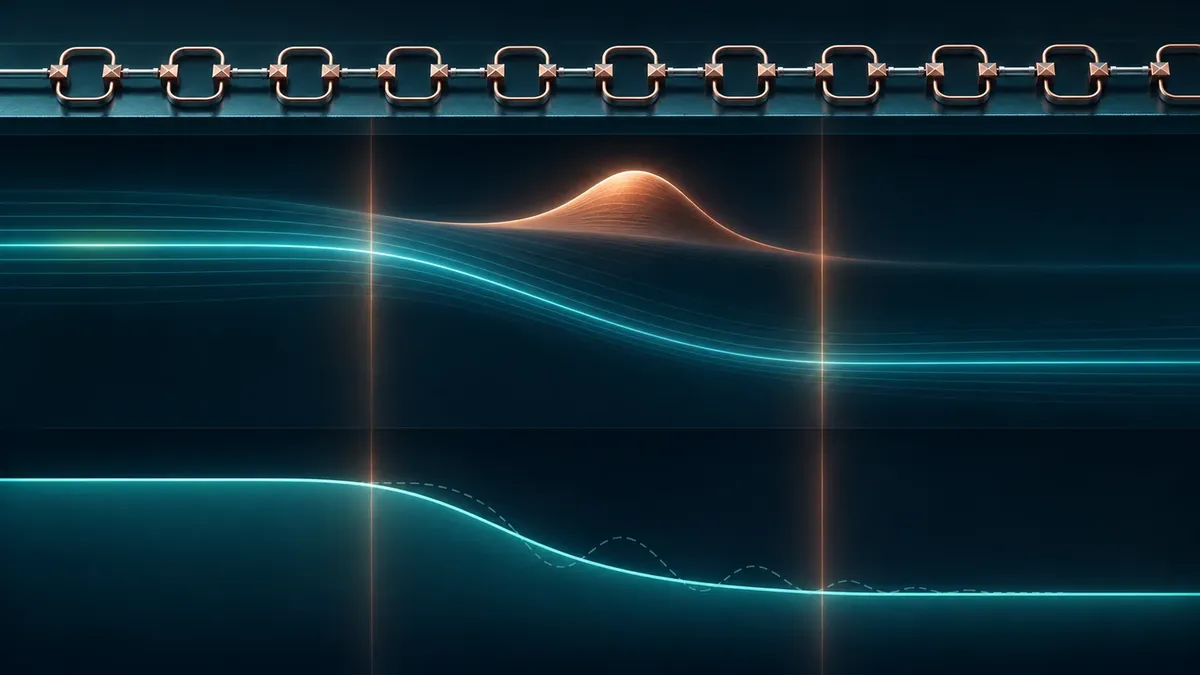
A moving pulse in a superconducting circuit can change how a weaker signal travels, creating effective black- and white-hole horizons. Researchers modeled whether small disturbances grow or decay—and what kind of ringdown the circuit might produce.
Black holes are expected to settle after a disturbance through a fading signal known as ringdown. Laboratory systems cannot reproduce real black holes, but some can mimic aspects of how waves move in curved spacetime. These “analogue” systems let researchers investigate related wave behavior in a controlled setting.
Daisuke Yamauchi, Haruna Katayama and Norihiro Tanahashi studied a proposed analogue built from a superconducting traveling-wave parametric amplifier, or TWPA. Its circuit contains SNAILs—nonlinear circuit elements whose response can be tuned using magnetic flux. The researchers asked whether a moving pulse can create effective black- and white-hole horizons for a weaker probe signal, whether that setup is stable against certain disturbances, and whether its response could show a characteristic decay.
How the circuit creates horizons
The model’s background pulse is a soliton: a localized wave that can travel while largely retaining its shape. The researchers considered a weak probe signal moving through this pulse. Because the soliton changes the probe’s effective propagation speed, the model can contain locations where that speed matches the soliton’s speed. These act as analogue horizons: in the soliton’s moving frame, they shape which directions the probe can travel.
The team derived an equation for the probe field and recast it, under simplifying assumptions, as a wave equation in an effective spacetime. They also expressed it in a Schrödinger-like form, where a mathematical potential represents the effect of the soliton on the probe. The analysis focuses on the dispersionless effective theory: it neglects nonlinear-dispersion terms that become important in some regimes.
To assess stability, the researchers used a technique from supersymmetric quantum mechanics. The effective potential has a region below zero, so its shape alone does not establish stability. Instead, the authors show that, under their boundary conditions and within the dispersionless theory, there are no normalizable negative modes. In this analysis, that rules out a particular kind of exponentially growing disturbance. It does not establish stability for every possible disturbance or for a real circuit with all effects included.
What the mode calculations show
The researchers also calculated quasi-normal modes: characteristic responses that satisfy outgoing-wave conditions at the horizons. They used a numerical “shooting” method, integrating the wave equation from near the horizons and searching for frequencies that meet the conditions at both ends. They compared these results with estimates from the Wentzel–Kramers–Brillouin (WKB) approximation, an analytical approach used to estimate wave behavior around a potential barrier.
For the cases studied, the numerical calculation finds a purely imaginary fundamental-mode frequency. Such a mode decays without oscillating; it is not a repeating tone. Some WKB estimates instead have nonzero real parts, which would imply an oscillatory component. The authors judge the shooting results more reliable because the WKB correction terms are not well controlled in this system, while noting that the methods produce frequencies of similar overall magnitude. The disagreement leaves the detailed mode structure uncertain.
The paper suggests that a few quasi-normal-mode timescales might be accessible before nonlinear dispersion becomes important. This should not be read as a prediction of several visible oscillations: the numerical fundamental mode is non-oscillatory. Rather, the suggestion concerns observing the mode’s characteristic decay over a limited interval. The authors also find that nonlinear dispersion cannot be neglected near the horizons, so the simplified description has limits precisely in those regions.
A theoretical proposal, not a detection
This work develops a theoretical model; it does not report an experiment observing ringdown. Its stability result applies to the specified effective theory, with nonlinear dispersion neglected. The authors further note that realistic circuit parameters may require smaller soliton relative velocities than some values used in their numerical analysis. More precise frequency calculations are also needed, and the paper cautions against relying on WKB results alone.
The source is an arXiv preprint. Journal-style formatting in the supplied paper text does not by itself establish peer review, and the available source does not confirm that the work has been accepted or published. The results are best understood as a theoretical analysis and a proposal for future investigation, with experimental observation still to be demonstrated.
- analogue black holes
- superconducting circuits
- SNAIL
- traveling-wave parametric amplifiers
- solitons
- quasi-normal modes
- ringdown
Related reading
Automatically matched by shared topic keywords. These links do not imply that the sources agree or establish a consensus.
Simplifying noise models for superconducting circuits
Source published
Shared keywords: superconducting circuits
Teleporting a logical qubit by joining code patches
Source published
Shared keywords: superconducting circuits
A titanium seed helps tantalum grow at room temperature
Source published
Shared keywords: superconducting circuits
A quieter route to tunable light–matter interactions
Source published
Shared keywords: superconducting circuits
A second transmon could speed up qubit readout
Source published
Shared keywords: superconducting circuits