TRANSMISSION // 2605.11007v5
A geometric story for how Transformers update tokens
Source published
A preprint models Transformer attention as estimating a rotating direction from noisy token readings, then derives a modified attention block. The theory offers an interpretation and a design proposal, not evidence of better language-model performance.
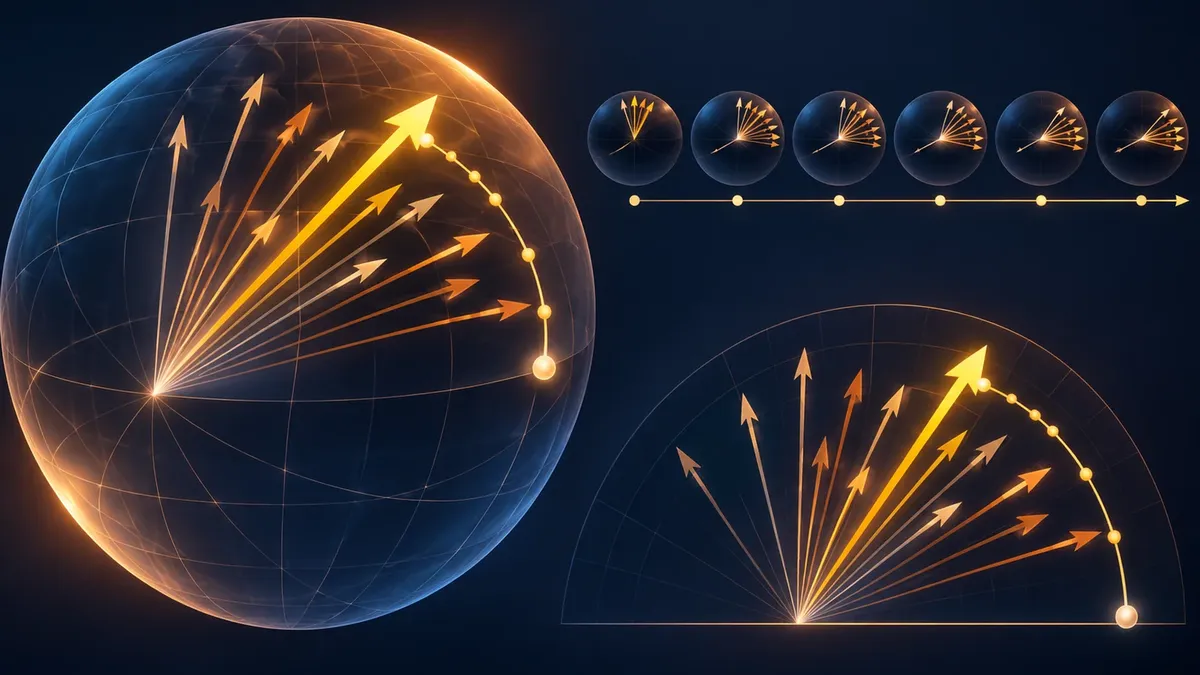
Could attention, normalization and rotary position encodings be parts of one estimation problem? Peter Racioppo’s preprint explores this idea by treating tokens as noisy readings of a shared direction that rotates across a sequence. The framework offers a way to interpret familiar Transformer operations and suggests a modified block, but its practical value remains to be tested.
Transformer attention, normalization, rotary positional encodings and residual connections are usually described as separate parts of a neural-network block. In “The Transformer as a Polar State Estimator,” Peter Racioppo asks whether they can instead be understood as pieces of one problem: estimating a changing hidden direction from noisy observations.
The proposal is a mathematical interpretation of Transformer design, not a claim that a new model has performed better on language tasks. Its central picture is geometric: each token is a reading of a shared direction, but the reading has its own length, or magnitude. The shared direction rotates as the sequence advances. A token’s magnitude may provide information about confidence, depending on assumptions about how magnitudes and noise relate.
From token readings to an estimate
Imagine several instruments measuring a direction that changes over time. Their readings may differ because of noise, and the model must combine them to estimate the direction at a particular position. The paper describes this on a hypersphere—the surface of a high-dimensional ball—because the shared quantity is a direction rather than an unrestricted vector.
In the proposed model, a token’s observed direction follows a von Mises–Fisher distribution, a probability distribution for directions on a sphere. Its concentration describes how tightly readings cluster around the underlying direction. The paper then connects this estimation setup to Transformer components.
Rotational dynamics for the hidden direction correspond to rotary positional encodings, or RoPE, which rotate representations according to position. Normalization places query and key directions on a common radius for comparison, while the model measures their magnitudes separately. Attention becomes a robust, weighted estimate: using a particular bounded penalty, the method reduces the weight of readings that disagree with the current estimate. This is a feature of the paper’s specified weighting rule, not a general guarantee about attention mechanisms. The residual connection becomes a step from the current state toward the estimate.
This account also addresses a familiar design split: queries and keys are often normalized, while values are not. In the paper’s framework, these choices reflect different assumptions about magnitudes. If key magnitudes vary independently, the model compares directions and can use magnitude as a confidence signal, with confidence determined by the assumed noise. If value magnitudes share a common scale, combining unnormalized values can represent the estimated state. This is a proposed reconciliation of the design choices, not evidence that these assumptions always describe representations in trained networks.
A proposed change to the standard block
From the estimator, Racioppo derives a “Polar Transformer.” The proposal makes three main changes to standard attention: it rotates values to the current position and counter-rotates the resulting estimate; it uses key magnitudes in assessing confidence; and it updates the residual state by stepping toward an estimate rather than adding the full attention output.
The distinction is more specific than simply changing the size of an update. In the paper’s formulation, the step depends on the available evidence and on parameters representing prior strength. The author argues that this treats the state’s direction and magnitude differently from a standard residual addition. The paper also describes an implementation that can use a standard fused-attention kernel for one choice of robust weighting; other choices require a modified computation.
These are derivations and design proposals. The supplied paper text reports no performance benchmarks or empirical evaluation establishing that the Polar Transformer improves accuracy, training stability, efficiency or generalization. The paper leaves open whether more flexible assumptions about key and value magnitudes would help. Its main derivation also does not cover the feedforward sublayer, which it treats separately as a learned nonlinear transition.
What the result does—and does not—establish
The main contribution is a unifying model: under specified assumptions about noise, magnitudes and rotational dynamics, several recognizable Transformer operations can be derived as parts of a state-estimation procedure. This offers researchers a way to reason about how those operations might fit together and to develop testable architectural ideas.
The interpretation depends on the assumptions. The paper focuses on deterministic rotational dynamics and a particular noisy-observation model; it leaves stochastic or time-varying dynamics for future work. It also assigns different magnitude assumptions to keys and values. These may be useful abstractions, but the derivation alone does not show that they accurately describe real models or explain why existing systems succeed.
This is an arXiv preprint, and the paper labels itself a preprint. The source text supports a theoretical account and an implementation proposal, not a demonstrated performance advantage. The careful takeaway is therefore not that Transformers have been shown to work this way in practice, or that the new block is better. It is that the paper offers a geometric lens and a candidate design whose practical consequences remain an empirical question.
- Transformer architecture
- attention mechanisms
- rotary positional embeddings
- state estimation
- machine learning
Reviewed cross-references
These connections were reviewed by a model, not independently fact-checked by a human. Similarity does not imply agreement; consult the original papers and the evidence below.
EntNet learns entanglement signatures from spin correlations
Shared method: Both papers use rotary positional embeddings: the Polar Filter paper interprets RoPE rotations as dynamics for transporting observations, while EntNet uses RoPE in a Transformer to learn spatial patterns in spin-correlation features. This is a shared architectural method, not evidence that EntNet uses or validates the Polar Filter; the papers address different tasks and settings.
Model review: · openai-codex/gpt-6-luna
Evidence and provenance
Selected excerpts, not complete papers. PDF extraction can omit figures or damage equations, tables and reading order; sources may be preprints.
2605.11007v5 — Original paper
Excerpt reference:
static/papers/2605.11007v5.md:121-185
Basis: Paper text
Source SHA-256:7e292129852571ac08c5a3156898f14461631dfd365c095e5a6b8f3c4d495af72611.11935v1 — Original paper
Excerpt reference:
static/papers/2611.11935v1.md:12-59
Basis: Paper text
Source SHA-256:a030a441010229569e9009c5dd927f268310cc531a9df16c7b46ec007e9caab1
Related reading
Automatically matched by shared topic keywords. These links do not imply that the sources agree or establish a consensus.
EntNet learns entanglement signatures from spin correlations
Source published
Shared keywords: machine learning
A Transformer-style model designed for tiny AI chips
Source published
Shared keywords: transformer architecture
How an AI Decision Model Follows Option Names
Source published
Shared keywords: attention mechanisms, machine learning
When long-context AI gains vanish after calibration
Source published
Shared keywords: attention mechanisms
How HiGLR Makes Image Restoration More Efficient
Source published
Shared keywords: attention mechanisms