TRANSMISSION // 2605.09906v2
Why an AI should keep audio and vision separate—at first
Source published
Separate First, Fuse Later keeps audio and visual reasoning apart until evidence is combined for an answer, aiming to reduce cross-modal hallucinations.
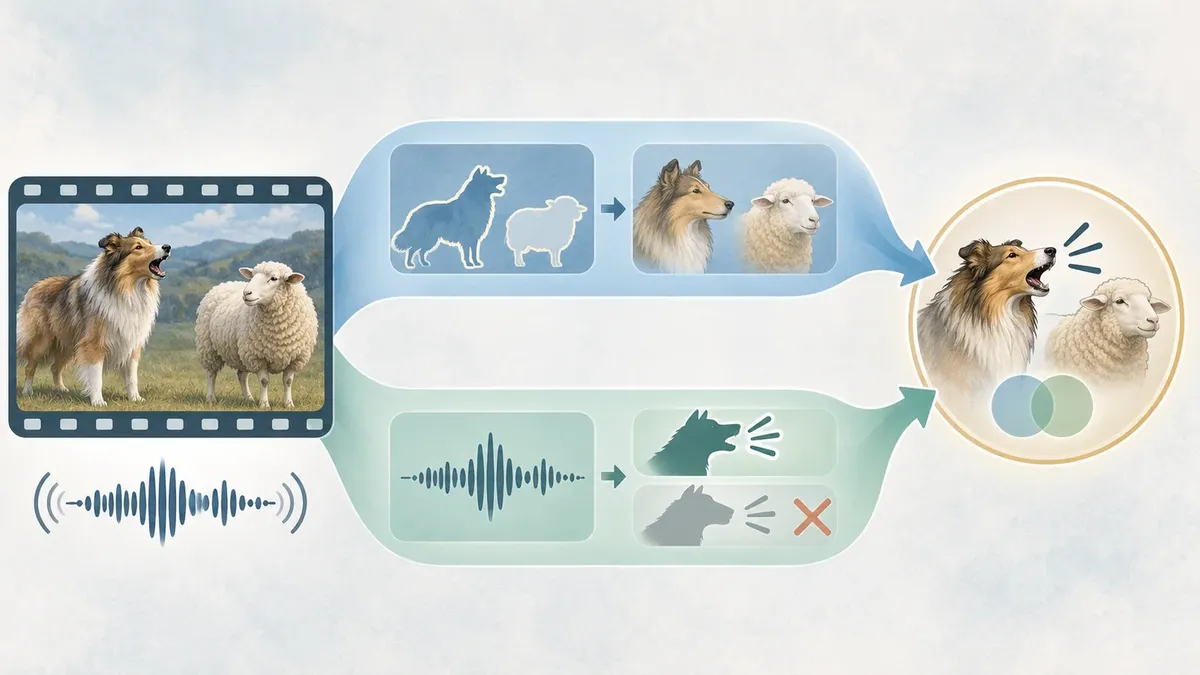
Audio and video can offer different clues about a scene. But a model that considers them together too early may let what it sees bias what it thinks it hears. A proposed framework, Separate First, Fuse Later, aims to keep the two interpretations apart during reasoning and combine them when answering.
The problem: when one signal colours another
Audio and video can provide complementary evidence, but a model can also let one signal distort its interpretation of the other. The paper’s example shows a collie and a sheep in a video while the audio contains barking. The intended answer is that the collie is vocalizing. A model reasoning jointly might instead attribute a bleat to the sheep, despite no audio evidence for that sound.
Xuanchen Li and colleagues propose Separate First, Fuse Later (SFFL), a framework for audio-visual question answering (AVQA). Its central idea is to reason about audio and video separately, then combine the evidence when forming an answer.
How the framework works
The method first estimates which evidence source a question needs. To create “Preferred Evidence Modality” (PEM) labels, the researchers tested questions with audio alone, video alone, and both together. They labelled audio as preferred when audio and combined input could solve a question but video alone could not; they used an analogous rule for visual evidence. Questions requiring both modalities received an audio-visual label when neither alone could solve them. Ambiguous, contradictory, or trivially solvable cases were excluded. The resulting training set contained about 14,000 labelled examples.
For this annotation pipeline, Qwen3-Omni-Instruct generated candidate answers and reasoning traces under the different input settings. The researchers used answer correctness and consistency across those samples to decide whether an input setting could solve each question. This is separate from the models later evaluated: the paper reports its main experiments using Qwen3-Omni-30B-A3B-Instruct, and also tests a Qwen2.5-Omni-7B model.
During answer generation, SFFL produces separate reasoning traces for visual and audio evidence, followed by a summary that combines them and a final answer. A Modality Asymmetric Attention Mask limits information leakage between stages: visual reasoning cannot attend to audio input, while audio reasoning cannot attend to video input or the visual reasoning trace. The later fusion stage can draw on both modalities.
Training uses two stages of reinforcement learning. One reward checks whether the model chooses the labelled preferred modality and follows the required structure; another checks answer correctness. The researchers evaluate models on general AVQA benchmarks and AVHBench, which includes tasks designed to assess cross-modal hallucinations.
What the study reports
The abstract reports average relative gains of 5.16% on general AVQA benchmarks and 11.17% on a cross-modal hallucination benchmark. These are the authors’ reported relative gains against comparison results in their experiments—not percentage-point increases or evidence of gains across all models and settings. The abstract does not specify the precise aggregation or denominator behind those averages, so they should be read as summary figures rather than universal estimates.
For the SFFL model based on Qwen3-Omni-30B-A3B-Instruct, the paper reports an average of 81.29 across AVHBench’s three task types: video-driven audio hallucination (VAH), audio-driven video hallucination (AVH), and audio-visual matching (MIS). On three general question-answering benchmarks, that model scores 92.31 on AVQA, 77.43 on Valor32k-AVQA v2.0, and 69.93 on MUSIC-AVQA.
Component tests suggest that separation alone is not enough. The authors report that the attention mask produced more consistent gains across several measures, while separated reasoning particularly improved audio-visual matching. The results therefore support the tested combination of controlled information flow, modality preference, and training—not simply an instruction to think about each modality separately.
What remains uncertain
The findings come from selected benchmarks and particular model backbones. They do not establish that SFFL will improve every audio-visual system or perform similarly in everyday use. The PEM labels depend on an automated annotation process, including Qwen3-Omni-Instruct’s candidate answers and consistency checks. The paper also reports uneven effects from separated reasoning without the attention mask, underscoring that individual components do not always help uniformly.
This article is based on the supplied text of an arXiv preprint. Although the text includes an AAAI copyright notice, the supplied source does not establish the review or publication status of this version. The reported improvements are the authors’ benchmark results, not settled evidence of performance across settings. Further evaluation is needed to establish how well the approach transfers beyond the tested models and benchmarks.
- audio-visual AI
- multimodal reasoning
- cross-modal interference
- AI hallucinations
- audio-visual question answering
- reinforcement learning
Reviewed cross-references
These connections were reviewed by a model, not independently fact-checked by a human. Similarity does not imply agreement; consult the original papers and the evidence below.
When audio and video lead an AI astray
Supporting evidence: Both studies report improved performance from mechanisms intended to manage audio-visual evidence: SFFL separates modality-specific reasoning before fusion and reports gains on AVQA and a hallucination benchmark, while CaRe intervenes at inference when a modality-specific prediction conflicts with the joint prediction and reports gains on CMM and AVHBench. This supports the bounded proposition that targeted control of cross-modal evidence can help on evaluated tasks; it is not a head-to-head comparison, and the methods, models, and benchmarks differ.
Model review: · openai-codex/gpt-6-luna
Evidence and provenance
Selected excerpts, not complete papers. PDF extraction can omit figures or damage equations, tables and reading order; sources may be preprints.
2605.09906v2 — Original paper
Excerpt reference:
static/papers/2605.09906v2.md:13-75
Basis: Paper text
Source SHA-256:de8918e66f334df405608435f49678b410148cf6772a534beb1549309941e2482610.18141v2 — Original paper
Excerpt reference:
static/papers/2610.18141v2.md:898-1071
Basis: Paper text
Source SHA-256:131716ae2b8b01e420c6b892664f86565ba09cc4ed5a59ddc07c5441490cbc25
Related reading
Automatically matched by shared topic keywords. These links do not imply that the sources agree or establish a consensus.
When audio and video lead an AI astray
Source published
Shared keywords: audio visual ai
Can AI Incentives Help Reduce Hallucinations?
Source published
Shared keywords: ai hallucinations, reinforcement learning
Training Multimodal AI to Make Its Errors Easier to Spot
Source published
Shared keywords: reinforcement learning
How PEAR Trains Vision-Language Models to Balance Seeing and Exploring
Source published
Shared keywords: multimodal reasoning, reinforcement learning
Teaching Visual AI When to Call a Tool
Source published
Shared keywords: reinforcement learning