TRANSMISSION // 2605.08569v2
A single stellar vibration captures much of neutron stars’ tidal response
Source published
A relativistic calculation finds that one dominant neutron-star oscillation reproduces a more direct tidal-response calculation to within about 3% in tested models. But adding more oscillations does not reliably improve the answer.
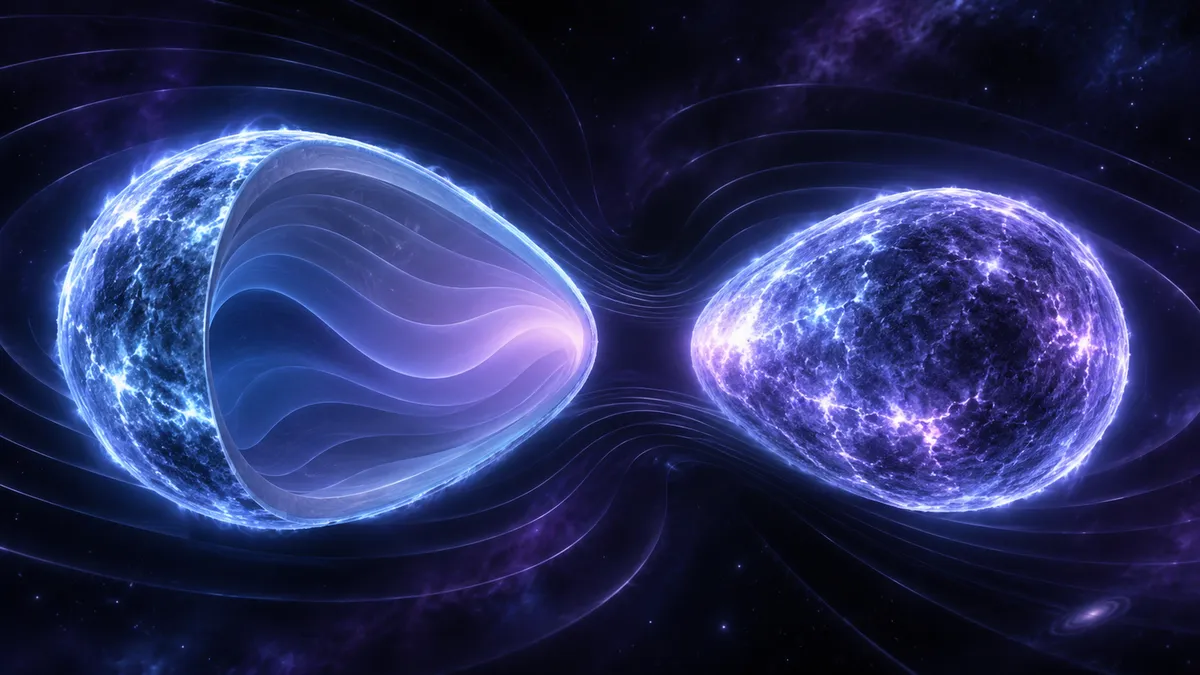
As two neutron stars spiral together, each star’s gravity deforms its companion. Those changing shapes affect the gravitational waves the pair emits, carrying information about matter inside the stars. A theoretical study investigates how accurately these deformations can be described by adding together individual stellar vibrations—and where that familiar picture breaks down.
Abhishek Hegade K. R. and colleagues present their results in Relativistic mode sums for neutron-star tidal response. The work is available as an arXiv preprint, revised on November 6, 2026; its listing states that this version matches the published version. It is a mathematical and numerical investigation, not a new gravitational-wave observation.
From a steady deformation to a vibrating star
Early in a binary’s inspiral, tidal deformation is approximately steady: the star has time to respond to its companion’s slowly changing pull. Later, the time dependence becomes important. Researchers then need a description of how the response changes with the frequency of the tidal forcing.
In Newtonian gravity, a useful approach treats each stellar oscillation pattern, or mode, as an effective harmonic oscillator. Adding their contributions gives a mode sum. This offers a relatively simple way to describe a complicated fluid body, including its enhanced response near resonant frequencies.
Transferring that construction into general relativity is harder. The researchers sought to define the relevant oscillations, the tidal field inside the star and the mathematical quantities describing how strongly that field excites each oscillation. These coupling quantities are called overlap integrals.
Building and checking the calculation
The team modeled non-rotating stars using relativistic equations for their equilibrium structure and small disturbances of both their fluid and spacetime. They worked in Regge–Wheeler gauge, a particular convention for representing those disturbances.
A central approximation concerns the conditions imposed outside the star. Rather than following outgoing waves all the way to infinity, the calculation uses a nearby region and a low-frequency expansion, retaining terms through the square of the angular frequency. These near-zone boundary conditions define the oscillations used in the sum.
The researchers checked their results against two benchmarks. First, they compared mode frequencies and internal profiles with quasinormal-mode calculations, which impose outgoing-wave conditions at infinity. Second, they compared the summed tidal response with a direct matching calculation that connects interior and exterior solutions without requiring the interior mode decomposition.
For the SLy equation of state, the near-zone fundamental-mode frequency differed from the real part of the quasinormal-mode frequency by less than 1% across the compactness range examined. Compactness measures how much mass is packed into a given stellar radius. The internal oscillation profiles also closely agreed in the example tested.
A strong result from one mode
The main practical finding concerns the fundamental fluid oscillation, known as the f-mode. Its contribution alone reproduced the direct matching response to within about 3% across the equations of state studied. An equation of state describes the relationship between pressure and energy density inside the star.
Those comparisons included static forcing and a driving frequency of 1,200 hertz, as well as two different prescriptions for extending the exterior tidal field into the stellar interior. The percentage describes agreement between theoretical calculations under these conditions—not the precision of a measurement of a real neutron star.
The interior prescription matters because relativity does not provide a unique separation between the applied tidal field and the star’s own response inside the star. The team tested polynomial and sinusoidal extensions that satisfy the required constraints and surface matching conditions. They produced noticeably different interior fields, but the dominant f-mode response remained comparatively robust.
Why more modes are not necessarily better
Adding higher-frequency modes did not make the sum converge to the direct matching result. The researchers connect this behavior primarily to the mathematical operator used to define mode orthogonality: it is not positive definite over the full function space in their formulation. Consequently, the usual argument that the modes provide a complete expansion is unavailable. Simple driven-string models illustrated a related obstruction.
The low-frequency approximation also becomes less accurate for higher-frequency modes. In particular, a near-zone solution resembling a high-frequency spacetime oscillation did not closely reproduce its quasinormal-mode counterpart. More careful numerical treatment did not remove the observed failure of convergence.
These limitations apply to this specific construction, not to every possible relativistic mode expansion. The convergence tests also used piecewise-polytropic stellar models without g-mode contributions, and the study does not establish equivalent accuracy for rotating stars or arbitrary interior prescriptions.
The practical conclusion is therefore selective: a controlled description using the dominant low-frequency mode can work well, even when an increasingly long sum lacks guaranteed improvement. Different formulations, or a modal description supplemented by a non-modal remainder, remain open possibilities.
- neutron stars
- dynamical tides
- general relativity
- stellar oscillations
- gravitational waves
- f-mode
Related reading
Automatically matched by shared topic keywords. These links do not imply that the sources agree or establish a consensus.
New method sorts newborn neutron stars’ vibrations by their physics
Source published
Shared keywords: gravitational waves, stellar oscillations
Neutron Star Tides Could Complicate Tests of Einstein’s Gravity
Source published
Shared keywords: general relativity, gravitational waves, neutron stars
Can a simpler star simulation recover tides in gravitational waves?
Source published
Shared keywords: general relativity, gravitational waves, neutron stars
A dark-star model links a mass ceiling to gravitational-wave signatures
Source published
Shared keywords: general relativity, gravitational waves
Simple patterns emerge in models of magnetic neutron stars
Source published
Shared keywords: gravitational waves, neutron stars