TRANSMISSION // 2605.07807v2
Testing Whether AI-Designed CAD Models Follow the Prompt
Source published
CADTests checks text-generated CAD models against executable tests of their geometry and topology. The authors also explore using tests to guide generation, while noting that no test suite catches every mistake.
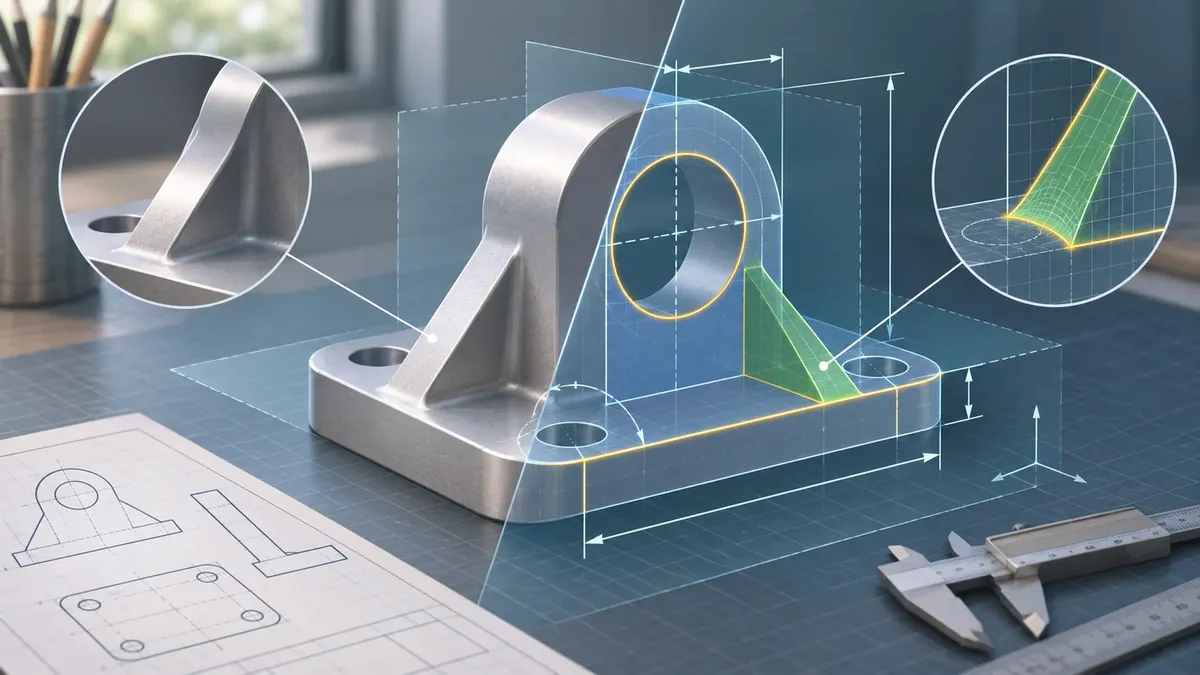
A 3D model can look convincing and still miss a written design requirement. A new benchmark tests computer-aided design models directly, checking prompt-specific properties rather than relying only on resemblance to a single reference model.
Turning a sentence into a computer-aided design (CAD) model is not just a matter of drawing a plausible shape. A prompt might require a hole to be enclosed, a feature to be centered or a part to have a particular dimension. A model can look roughly right while missing one of those details. And because a prompt often leaves some choices open, there may be several correct designs—not just one reference shape to copy.
In Text-to-CAD Evaluation with CADTests, Dimitrios Mallis and colleagues propose evaluating generated models with executable software checks. Their paper introduces CADTests and CADTestBench, a benchmark pairing design prompts with test suites intended to check whether a model meets the prompt’s geometric and topological requirements.
What a CAD test checks
The tests are Python snippets that inspect a model’s boundary representation, or B-rep: a description of a solid through its faces, edges and vertices, and how they connect. Using the CadQuery library, a test can examine properties such as bounding-box dimensions, volume, counts or types of geometric elements, and spatial relationships between parts of the shape. The tests inspect the resulting geometry and topology, not the feature-by-feature history used to build it.
This differs from comparing a generated model with one reference model. A similarity score can penalize a valid design variation simply because it differs from the reference in a way the prompt never specified. Tests can instead focus on stated requirements, and failing tests can provide messages describing what did not pass.
The researchers built the benchmark from CADPrompt, which contains 200 CAD programs, each associated with an abstract and a more detailed prompt. They created separate test suites for the two prompt types, with 5,937 tests in total. The examples cover different modeling operations: the supplementary material reports that 23% use only sketch-and-extrude, 53% only 3D primitives, 17.5% a combination of the two, and 6.5% other operations such as fillet, shell or sweep.
To develop the suites, a language model generated tests and deliberately altered CAD programs to create “mutants”—models designed to violate prompt requirements. The researchers iteratively refined tests using execution results, aiming for tests that pass on reference models and detect the altered versions. They also tested transformed models to reduce dependence on a particular position or orientation, and, for prompts without specified dimensions, scale. This process improved detection, but did not catch every mutant: on a separate held-out set, the reported mutation scores were below complete coverage.
Tests as a design aid
The team evaluated existing text-to-CAD methods and tested two approaches that bring CADTests into generation. In these baselines, a language model produces CAD code and tests, runs them, and uses the results to revise its output. One version also prints information about intermediate geometric states.
The authors report that these test-guided baselines were the most effective feedback mechanism among those they evaluated, improving performance across the reported metrics. They also report that ReAct-style integration with a CAD kernel—software that executes CAD operations—achieved higher performance and much lower invalidity than the evaluated baselines without that integration. Adding rendered visual feedback did not improve performance in the reported experiments. These are findings within the study’s particular benchmark and comparisons, not a general guarantee for other systems.
The researchers also compared benchmark evaluations with human judgments. Five postgraduate researchers with experience in computer vision and CAD-related research assessed 125 generated models against their prompts. Their agreement was moderate, reflecting the ambiguity of deciding whether a model satisfies a prompt. For this sample and these annotators, CADTests-based measures aligned more closely with the majority-vote judgments than the other evaluated measures, including geometric-similarity and visual-language-model-based metrics. That comparison does not establish that automated tests will match human judgment in every setting.
What remains uncertain
A test suite can only check what its tests cover. A model might pass while still violating a requirement the tests failed to express. The authors acknowledge that test coverage is finite and that CADTest verification may diverge from human judgment. Mutation testing helps assess whether tests detect selected, deliberately introduced faults; it cannot represent every possible mistake.
The benchmark also has a defined scope. Its examples come from CADPrompt and are weighted toward sketch-and-extrude operations and basic primitives. Some checks are less suitable for mesh-based or implicit-surface models, which do not expose the same parametric geometric elements as a B-rep. Results should not be read as a complete measure of CAD ability across all tasks and model formats.
The manuscript labels itself as a NeurIPS 2026 Evaluations and Datasets track paper, but the source available here is an arXiv preprint and does not independently establish acceptance or peer review. The authors say the benchmark data and code are publicly available. Overall, CADTests offers a way to make some design requirements explicit and actionable—but passing a test suite is not proof that a design is correct in every respect.
- Text-to-CAD
- CAD evaluation
- CADTests
- artificial intelligence
- software testing
- 3D design
Reviewed cross-references
These connections were reviewed by a model, not independently fact-checked by a human. Similarity does not imply agreement; consult the original papers and the evidence below.
An AI CAD system plans mechanical operations instead of writing long programs
Shared method: Both papers assess prompt-derived requirements directly on generated CAD geometry without requiring one unique reference model: CADTests uses executable tests on B-reps, while GOPR-CAD checks structural conditions on reimported STEP/B-rep models. Their test designs and benchmarks differ, so this connection does not establish comparable performance; the evidence is from selected preprint excerpts.
Model review: · openai-codex/gpt-6-luna
Evidence and provenance
Selected excerpts, not complete papers. PDF extraction can omit figures or damage equations, tables and reading order; sources may be preprints.
2605.07807v2 — Original paper
Excerpt reference:
static/papers/2605.07807v2.md:137-186
Basis: Paper text
Source SHA-256:c23e299326be2bb81cd2bb297ef3efa0f1620e14c42e544070150164d424e9a22611.11470v1 — Original paper
Excerpt reference:
static/papers/2611.11470v1.md:82-143
Basis: Paper text
Source SHA-256:c1528dbcd6b71254a46682a447189be4aa8ec31c17487fbf224014fb0e4caee0
Related reading
Automatically matched by shared topic keywords. These links do not imply that the sources agree or establish a consensus.
An AI CAD system plans mechanical operations instead of writing long programs
Source published
Shared keywords: artificial intelligence, text to cad
PhyCAD trains AI-generated CAD designs against geometry and physics checks
Source published
Shared keywords: text to cad
What Coding Agents Can—and Can’t—Do With Tests
Source published
Shared keywords: software testing
DynaFix gives AI code repairs a closer look at execution
Source published
Shared keywords: software testing
Why Passing Tests May Not Prove an AI Patch Is Correct
Source published
Shared keywords: software testing