TRANSMISSION // 2605.07707v3
Can language models help hierarchical planners search better?
Source published
A benchmark study tests whether LLM-generated heuristics can guide hierarchical task-network planning. Results are promising, but the abstract leaves important methodological details unanswered.
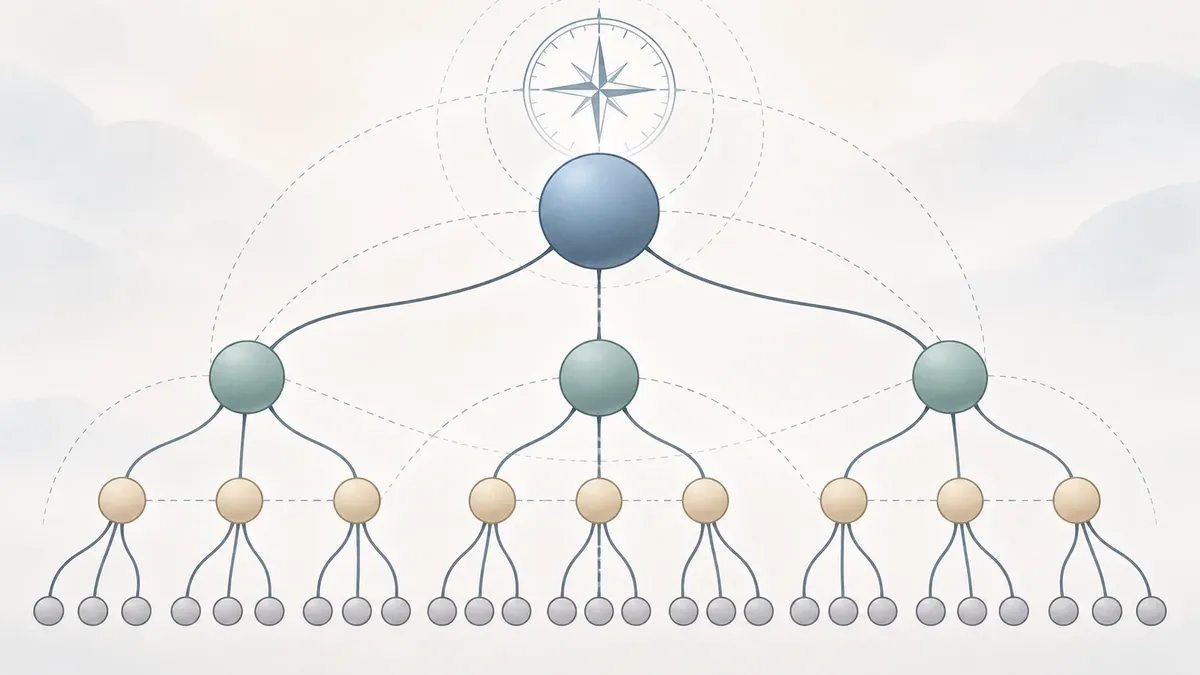
Planning is not always a matter of choosing one action after another. In hierarchical task-network planning, a system breaks broad tasks into smaller ones using a library of methods. Researchers tested whether language models could supply useful search guidance—and reported encouraging results on standard benchmarks. The abstract, however, does not provide enough detail to assess the results fully.
Planning by breaking tasks into smaller tasks
Many planning systems search for a sequence of actions: move here, pick up an object, deliver it there. Hierarchical task-network (HTN) planning works differently. It starts with a higher-level task and repeatedly decomposes it into smaller tasks using a library of methods, until the remaining tasks are executable actions.
That hierarchy can encode useful knowledge about how a domain works. But choosing among possible decompositions creates its own search problem. A heuristic—a rule used to guide which options a planner considers—can help direct that search. The authors say HTN heuristics have not yet been as informative as those available in classical planning. They ask whether large language models (LLMs) can generate effective heuristics for HTN planning.
Testing generated guidance
The researchers extended an earlier approach for classical planning to hierarchical planning. They used the Pytrich planner and evaluated heuristics generated by nine LLMs. The study used seven standard benchmark domains for total-order HTN planning, in which tasks follow a specified order.
The generated heuristics were compared with two established, domain-independent heuristics in the same planner and with the PANDA planner. The abstract says the LLMs received domain-specific prompts, but does not provide the prompts, model names, benchmark-by-benchmark results, or experimental settings needed to examine the comparisons in detail.
A heuristic does not itself produce a plan. Instead, it guides the planner’s search through possible task decompositions. The abstract reports both the number of nodes expanded during search and coverage—the number of benchmark instances solved. These are distinct measures: one concerns search activity, while the other concerns whether instances were solved.
Promising results, with qualifications
The abstract reports three main findings. First, a configuration fixed in advance solved more benchmark instances than either of the two domain-independent heuristics. Second, the best generated heuristics expanded fewer nodes than both of those heuristics on most instances. Third, a “virtual best,” which takes the strongest result across all tested models, was on par with PANDA in coverage.
These findings suggest that LLM-generated guidance can help an HTN planner in the reported benchmark settings. They do not show that any LLM can reliably improve any hierarchical planner, or that the results will carry over to practical planning problems. The virtual-best result is a best-of-many comparison; it does not show that one model achieved that performance consistently. The abstract does not explain how the fixed configuration was selected or how the virtual best was calculated, so those details cannot be assessed here.
Fewer node expansions are a measure of search activity, but the abstract does not define how nodes are counted or establish that fewer expansions mean lower wall-clock runtime. Coverage indicates whether instances were solved, but the abstract does not give the number of instances or report solution quality, runtime, or statistical uncertainty.
What the abstract leaves unanswered
The evidence available here is the paper’s abstract, not its full methods and results. It leaves important questions open: how sensitive performance was to prompts and model choice, how results varied across the seven domains, and what computational costs were involved. The reported evidence concerns standard total-order HTN benchmarks; the abstract does not establish how the approach would perform in other planning settings.
The work is identified as an arXiv preprint. This article draws on the abstract alone, so it cannot evaluate the full experimental design or conclusions. The reported benchmark results make LLM-generated heuristics a promising approach to investigate, while leaving their broader performance and practical value uncertain.
- hierarchical task-network planning
- large language models
- AI planning
- search heuristics
- benchmark evaluation
Reviewed cross-references
These connections were reviewed by a model, not independently fact-checked by a human. Similarity does not imply agreement; consult the original papers and the evidence below.
A Language Model Helps Search for Better Satellite Imaging Schedules
Shared method: Both studies use an LLM to produce search guidance: Meneguzzi et al. generate domain-specific heuristic code for HTN search, while Wang et al. generate and adapt candidate-scoring rules during ant-colony satellite scheduling. The shared approach is LLM-generated heuristics within a search algorithm, not the same planner or evaluation; the reported results concern different tasks and benchmarks.
Model review: · openai-codex/gpt-6-luna
Evidence and provenance
Selected excerpts, not complete papers. PDF extraction can omit figures or damage equations, tables and reading order; sources may be preprints.
2605.07707v3 — Original paper
Excerpt reference:
static/papers/2605.07707v3.md:95-143
Basis: Paper text
Source SHA-256:713a72a0d8bdbad7ca30d5531113242de82df510516a2f56a7c5d8ca53fe16552605.07707v3 — Original paper
Excerpt reference:
static/papers/2605.07707v3.md:144-195
Basis: Paper text
Source SHA-256:713a72a0d8bdbad7ca30d5531113242de82df510516a2f56a7c5d8ca53fe16552611.04458v1 — Original paper
Excerpt reference:
static/papers/2611.04458v1.md:17-55
Basis: Paper text
Source SHA-256:2119d94d8d06b1e137beff56c708beac31c4845d997559a5a6ae6a307637662d2611.04458v1 — Original paper
Excerpt reference:
static/papers/2611.04458v1.md:112-223
Basis: Paper text
Source SHA-256:2119d94d8d06b1e137beff56c708beac31c4845d997559a5a6ae6a307637662d
Related reading
Automatically matched by shared topic keywords. These links do not imply that the sources agree or establish a consensus.
Hand-set neural networks master small games but struggle to turn tactics into plans
Source published
Shared keywords: large language models
DualWorldBench tests whether AI agents can turn delivery goals into workable plans
Source published
Shared keywords: benchmark evaluation
Making an AI planner’s checks hold when the action starts
Source published
Shared keywords: hierarchical task network planning
A three-part profile of AI misuse capabilities
Source published
Shared keywords: benchmark evaluation, large language models
WoW maps educational training data—and shows where its gains stop
Source published
Shared keywords: benchmark evaluation, large language models