TRANSMISSION // 2605.06401v3
A Preprint Revisits SN1987A’s Neutrino Timeline
Source published
A preprint estimates how Kamiokande-II and Baksan line up with IMB, then weighs possible origins for Kamiokande-II’s first event.
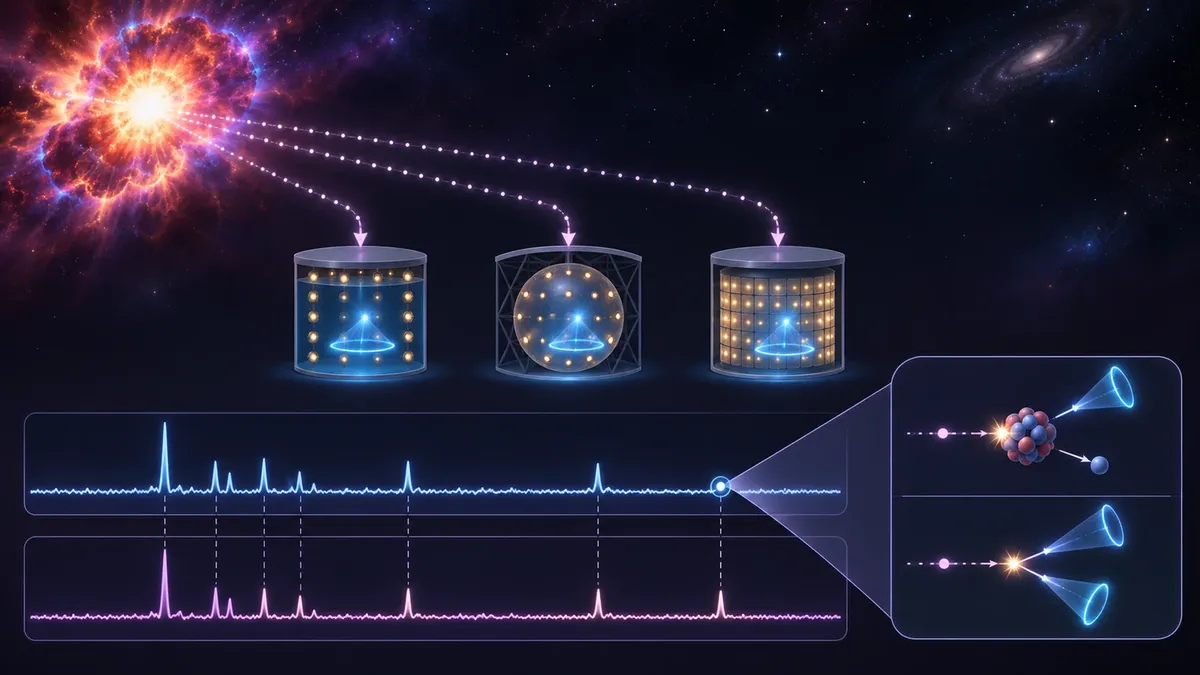
Three detectors recorded neutrinos from supernova SN1987A in 1987, but their clocks were not synchronized. An arXiv preprint estimates timing offsets relative to IMB and tests whether Kamiokande-II’s first event could have come from the neutronization burst—the brief phase at the start of the collapse.
In February 1987, Kamiokande-II, IMB and Baksan detected neutrinos associated with supernova SN1987A. The observations offered a rare glimpse of a stellar collapse, but the detectors kept time independently. Reconstructing the sequence requires separating uncertainty in when each detector registered its first event from differences between detector clocks.
A new arXiv preprint by Riccardo Maria Bozza and colleagues addresses that timing problem and a related question: could Kamiokande-II’s first recorded event, called K1, have come from elastic scattering during the neutronization phase, rather than from the inverse beta decay (IBD) interpretation considered in the paper?
Estimating offsets relative to IMB
The authors distinguish intrinsic timing offsets from relative timing offsets. An intrinsic offset is the statistical delay between a neutrino’s arrival and the detector’s first recorded event. A relative offset describes how one detector’s clock differs from another’s. The first quantity alone cannot establish the order of events recorded by separate detectors.
The analysis adopts IMB as its timing reference and estimates offsets for Kamiokande-II and Baksan. For this timing fit, the authors use a likelihood based on first-event timing information and marginalize over parameters in their model of neutrino emission. They account for non-Gaussian statistical distributions and correlations. The paper’s broader framework also considers event energies, directions, backgrounds and detector responses; these should not be mistaken for a list of direct inputs to the relative-offset fit.
The authors also calculate differences in the neutrino wave-front’s arrival time at the separated detector sites. These geometric corrections are small compared with the uncertainty in IMB’s absolute clock measurement.
The paper estimates that Kamiokande-II’s reported absolute timestamps should be shifted later by about 6.35 seconds, and Baksan’s earlier by about 30.43 seconds. The authors report that the inferred first-event timing uncertainty is reduced by roughly two orders of magnitude, to below a second.
These are model-dependent inferences from a sparse historical dataset—not a new calibration of the detectors’ clocks. The result depends on the model of how the neutrino signal changes over time, including how quickly it rises. The authors vary the assumed rise time and report modest changes in the offsets, while noting that other descriptions of the earliest emission could affect synchronization.
Weighing possible origins for K1
K1’s reconstructed direction makes elastic scattering (ES), in which a neutrino scatters off an electron, a possibility worth testing. The specific comparison is between an ES event during the neutronization phase—the brief neutrino burst at the onset of collapse—and the IBD interpretation. The neutronization burst is distinct from the later accretion and cooling phases of the supernova’s neutrino emission.
To compare these hypotheses, the authors calculate likelihoods using K1’s timing, energy and direction, while accounting for Kamiokande-II’s angular response and matter-driven neutrino flavor conversion. They report that the IBD likelihood is about three to six times the maximum likelihood for ES during the neutronization burst. The ratio depends on the assumed neutrino mass ordering.
This makes the proposed neutronization-burst ES origin less favored under the models examined; it does not prove K1’s interaction or establish its origin beyond those assumptions. Separately, the authors combine their result with a previously published time-integrated analysis of the accretion-plus-cooling signal. On that basis, they state that the SN1987A data do not support ES events. That broader statement is not a finding from the K1 timing comparison alone. The paper says the angular anomaly may reflect statistical fluctuation or unknown systematic uncertainties, while not excluding every possible alternative explanation.
What the result does—and does not—settle
The timing estimate depends on assumptions about the supernova’s early signal, and the event-origin comparison relies on models of the neutronization burst and neutrino flavor conversion. With only a small number of detected events, the likelihood ratio compares specified hypotheses; it is not a complete accounting of every possible source of uncertainty. Different emission descriptions or assumptions could affect the interpretation.
The authors propose the method as a possible tool for future Galactic supernova observations, where neutrino timing could be considered alongside other signals. That is a proposed application, not a demonstration using a new supernova. This is an arXiv preprint, so the findings should be read as the authors’ analysis, not as settled consensus. Its estimates and interpretations remain contingent on the data and modeling choices described in the paper.
- SN1987A
- neutrinos
- supernova
- Kamiokande-II
- neutrino timing
- neutronization burst
- elastic scattering