TRANSMISSION // 2605.06068v3
Can coding agents build better-fit LLM servers?
Source published
VibeServe uses coding agents to generate complete serving systems for specific models and workloads. Its abstract reports competitive results in standard settings and gains in selected specialized scenarios, but broader generalization remains uncertain.
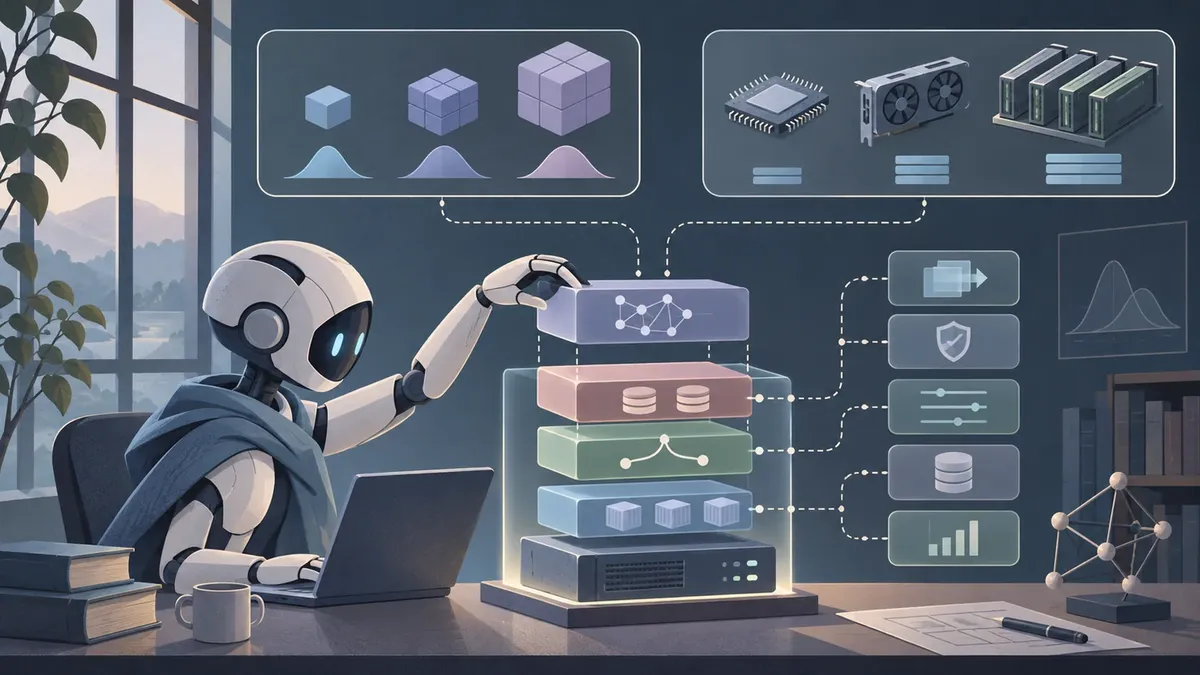
VibeServe asks whether coding agents can build complete large language model (LLM) serving systems tailored to particular deployment scenarios—and how those systems perform against established alternatives.
Building a system for a specific job
The paper VibeServe: Can AI Agents Build Bespoke LLM Serving Systems? explores an alternative to relying on one general-purpose serving stack: use coding agents to create systems for particular models and usage scenarios. The central question is whether agents can build these systems end to end and produce results that are competitive with existing software.
The authors describe VibeServe as an agentic loop with two parts. An outer loop plans and tracks the search over possible system designs. An inner loop implements candidate designs, checks correctness and measures performance against a target benchmark. The aim is to have agents build complete serving stacks, rather than only propose isolated changes.
What the abstract reports
The abstract summarizes results in standard serving settings and five non-standard scenarios. In standard settings, VibeServe reportedly matches vLLM and SGLang on Llama-3.1-8B. For a 397B mixture-of-experts model running on four AMD MI300A accelerators, the authors report 2.3 times the goodput of a tuned SGLang system. The abstract does not define goodput or give the measurement details, so the figure is best treated as the authors’ reported comparison, not interpreted through a more specific metric definition.
In the five non-standard scenarios, the authors report that VibeServe outperformed existing systems. They say the agent-built systems exploited opportunities associated with non-standard model architectures, workload knowledge and hardware-specific optimization. This suggests that, in the tested cases, tailoring a system to its target can yield advantages that general-purpose systems miss.
The abstract does not describe each scenario, provide detailed benchmark methods or show the individual results. It therefore does not allow a close assessment of how correctness was checked, how performance was measured across tests, or how much effort the search required.
What the findings do—and do not—show
These results are evidence that coding agents can construct competitive serving systems in the reported evaluations. They do not establish that every agent-built system will outperform existing software, or that specialization is always preferable. The 2.3-times result applies to the stated model and hardware configuration against a tuned SGLang baseline; it should not be generalized to other models, machines or systems without further evidence. Likewise, matching vLLM and SGLang on one model is a result for that standard setting, not proof of universal equivalence.
The abstract leaves important practical questions unanswered. It does not establish how well the approach transfers to deployments beyond those tested, what level of human oversight it requires, or how the systems perform in long-running production use. These are open questions rather than evidence of shortcomings in the reported experiments.
An early result to examine further
This article is based on the abstract of the arXiv paper, not a full review of its methods, results tables or limitations. The work is available as a preprint, which may be shared before peer review. The abstract says the code is available; that may support inspection and reproduction, but availability alone is not independent validation.
VibeServe offers a demonstration: agents can build and specialize serving systems that the authors report as competitive in standard tests and stronger in selected non-standard ones. Whether this approach can do so reliably across a wider range of real deployments remains to be tested.
- VibeServe
- LLM serving
- coding agents
- AI systems
- specialized serving systems
- preprint
Reviewed cross-references
These connections were reviewed by a model, not independently fact-checked by a human. Similarity does not imply agreement; consult the original papers and the evidence below.
ServerBench tests whether coding agents can build better LLM serving systems
Supporting evidence: Both studies report that coding agents produced serving systems with measured gains in their tested settings: VibeServe reports performance improvements across specified deployments and scenarios, while ServerBench reports a verified score above its vLLM reference for one model-deployment result. This supports only the bounded claim that agents can yield measurable serving gains under some evaluated conditions; the workloads, objectives, hardware, and verification protocols differ, so the results are not directly comparable.
Model review: · openai-codex/gpt-6-luna
Evidence and provenance
Selected excerpts, not complete papers. PDF extraction can omit figures or damage equations, tables and reading order; sources may be preprints.
2605.06068v3 — Original paper
Excerpt reference:
static/papers/2605.06068v3.md:147-218
Basis: Paper text
Source SHA-256:e69330c950f3d76ab5ae4621055835937d6fc9b5ed70919e0389c3a3e2ace2552605.06068v3 — Original paper
Excerpt reference:
static/papers/2605.06068v3.md:219-270
Basis: Paper text
Source SHA-256:e69330c950f3d76ab5ae4621055835937d6fc9b5ed70919e0389c3a3e2ace2552611.06841v1 — Original paper
Excerpt reference:
static/papers/2611.06841v1.md:109-150
Basis: Paper text
Source SHA-256:01b8a72865313e6e21b5b79b76c55c021e42308e83a94051e7a5192d2c5009a1
Related reading
Automatically matched by shared topic keywords. These links do not imply that the sources agree or establish a consensus.
ServerBench tests whether coding agents can build better LLM serving systems
Source published
Shared keywords: coding agents, llm serving
Why AI recovery must be checked at the point of use
Source published
Shared keywords: ai systems, llm serving
Why the computing setup can change an AI team’s score
Source published
Shared keywords: llm serving
Can coding agents make language models smaller without breaking them?
Source published
Shared keywords: coding agents
AMD’s InferaSim predicts which LLM serving setups are worth testing
Source published
Shared keywords: llm serving