TRANSMISSION // 2605.03298v2
A molecular attoscope follows electrons and nuclei in benzene
Source published
Shaped deep-ultraviolet pulses let researchers track fast electronic coherence alongside slower nuclear motion in neutral benzene. The technique is a step toward fuller molecular measurements, not a complete molecular movie.
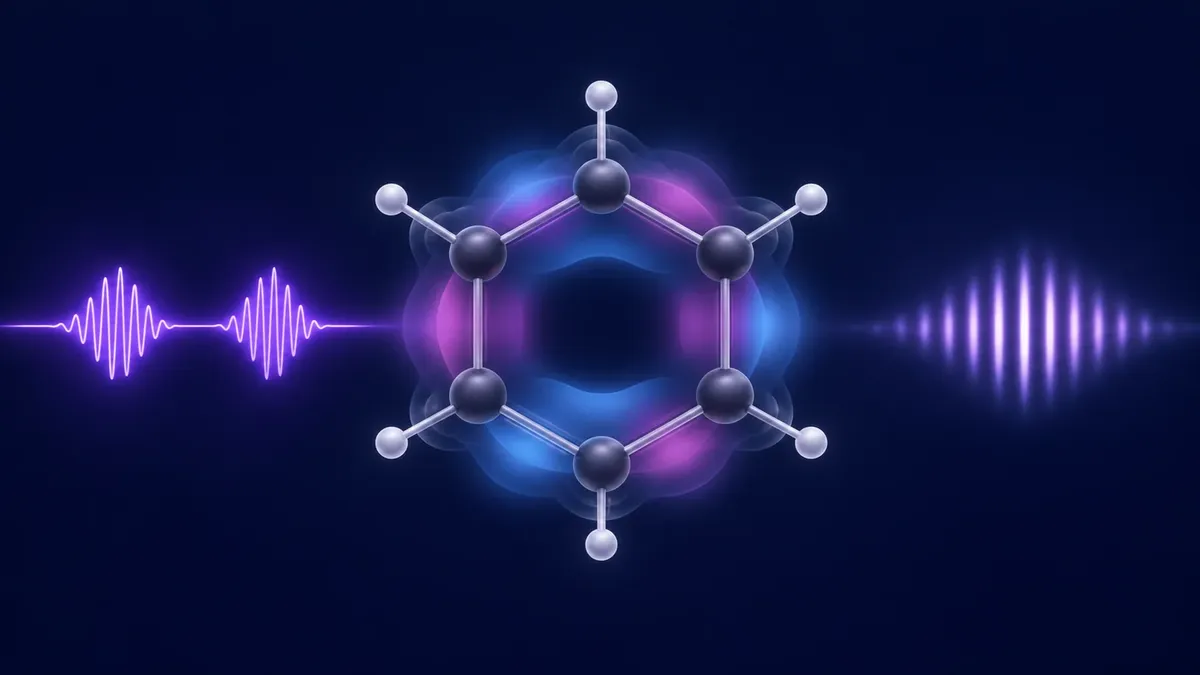
Electrons and nuclei evolve on very different timescales after a molecule absorbs light. In a study of neutral benzene, researchers use shaped laser pulses to measure both motions together—and find that nuclear vibration modulates electronic coherence.
After absorbing light, a molecule can occupy a quantum state in which electronic states and nuclear vibrations evolve together. Tracking both parts at once is challenging: the electrons’ relative phases can change in attoseconds, while nuclei move on femtosecond timescales. A new study reports a technique called a “molecular attoscope” for measuring this coupled motion in neutral benzene.
The central question is whether researchers can detect electronic coherence—the phase relationship between parts of a quantum state—alongside nuclear motion in a neutral molecule. The authors describe how many attosecond approaches focus on ions, with nuclear motion often neglected or inferred indirectly. Their alternative uses deep-ultraviolet (DUV) light and precise control over laser-pulse timing and phase.
Turning pulse phase into a molecular signal
The team generated DUV pulses and used an acousto-optic pulse shaper to create a pump–probe pair. The pump prepares a coherent superposition, or wave packet, of electronic and vibrational states. The probe ionizes the molecule. By varying the delay and relative phase between the pulses, the researchers measured benzene’s ionization yield under different conditions.
They compared measurements with the pulses in phase and with a relative phase shift of π. Taking the difference between the yields highlights a signal linked to electronic coherence. In effect, interference between different routes to ionize benzene provides information about the evolving molecular state.
A key check was whether the phase-dependent signal came from interference between molecular pathways, rather than interference in the laser light. The researchers placed notches in the probe’s spectrum at important benzene absorption features. Even when optical interference at those features was removed, the molecular ionization signal still varied with pulse phase. This supports their interpretation that interference between molecular ionization pathways produces the observed signal.
Two clocks in one trace
The benzene measurement showed two timescales. A fast oscillation had a period of 856 attoseconds, which the authors associate with the energy separation between the molecule’s ground and excited electronic states. A slower beat, repeating every 36 femtoseconds, was attributed principally to the molecule’s symmetric breathing vibration.
The electronic signal varied in strength with the slower nuclear motion. The authors interpret this modulation in terms of overlap between nuclear wave packets associated with the ground and excited electronic states: when the packets overlap more, the modeled changes in electronic density are more pronounced; when they separate, the measured modulation weakens. This is evidence of coupled dynamics, not a direct photograph of every electron and nucleus.
The paper reports electronic coherence persisting over hundreds of optical cycles. The apparatus had an estimated upper limit of 6 attoseconds for timing-stability uncertainty. The team also compared the measurements with time-dependent Schrödinger-equation calculations. These reproduced the principal fast and slow periods, though a small phase difference remained in the slower modulation. The authors attribute that difference to a mismatch in pulse spectral phase between experiment and simulation.
What the result does—and does not—show
The study demonstrates a way to extract information about electronic coherence and nuclear dynamics together from a neutral molecule. The authors also discuss measurements on other molecules in supplementary material, but benzene is the main example. Its detailed model treats nuclear motion along one principal vibrational coordinate. Extending the approach to multiple nuclear dimensions and more complicated couplings remains future work.
That limitation matters: a clear measurement in benzene does not establish a complete real-time reconstruction for arbitrary molecules or show that the technique will readily scale to complex chemistry. The authors present it as groundwork for more comprehensive coherent measurements, rather than as a finished molecular-imaging method.
This account is based on the supplied arXiv version 2 preprint. A preprint is a research manuscript shared before or outside the completed journal-review process; its claims may be revised and should not be treated as independently confirmed. The paper reports experiments supported by modeling, while broader applications remain prospects rather than demonstrated outcomes.
- molecular attoscope
- benzene
- electronic coherence
- nuclear motion
- attosecond spectroscopy
- pulse shaping
Related reading
Automatically matched by shared topic keywords. These links do not imply that the sources agree or establish a consensus.