TRANSMISSION // 2605.01945v2
A fairer test for peptide-spectrum prediction AI
Source published
PepSpecBench compares six peptide mass-spectrometry predictors under shared tests. Its results show that model rankings shift across datasets and accuracy alone does not guarantee robustness to experimental conditions.
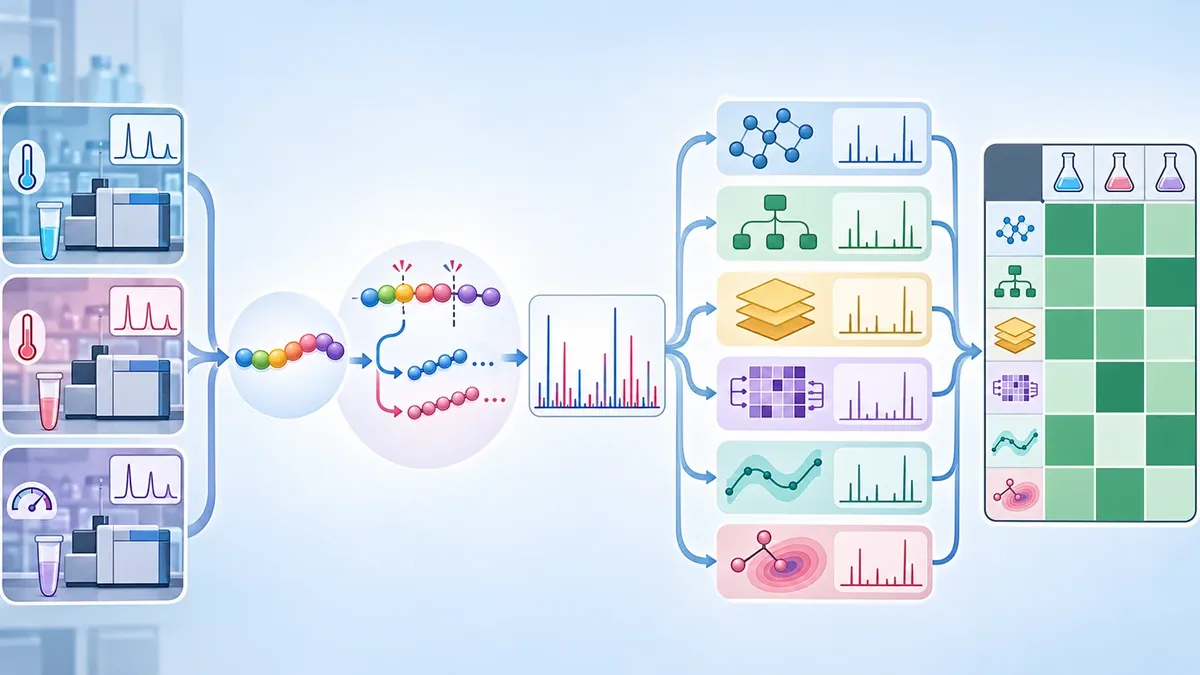
AI models can predict the fragments produced when peptides are analyzed by tandem mass spectrometry. Comparing models is difficult, however, when they use different data, output formats and rules for separating training from test examples. PepSpecBench brings six predictors into a common evaluation—and highlights how results depend on what and how researchers test.
Predicting a peptide’s mass-spectrometry pattern can help researchers identify peptides in complex samples and build reference libraries. In tandem mass spectrometry, a peptide is broken into smaller charged fragments, and instruments record their mass-to-charge ratios and intensities. Machine-learning models predict those signals from peptide sequences and experimental settings. But scores are useful to compare only when models face comparable targets and the test data are suitably separated from the training data.
The authors of PepSpecBench set out to make these comparisons more consistent. They evaluate six predictors on harmonized public data from PROSPECT and MassIVE-KB. The models span recurrent neural networks, Transformers, a convolutional model, a dictionary-based model and a lightweight linear approach; all are retrained under the benchmark’s protocols.
One important design choice is to split examples by peptide backbone: the amino-acid sequence after chemical-modification labels are removed. This is intended to keep the same backbone, including versions with different modifications, from appearing in both training and test sets. The authors report an audit of the PROSPECT split with no exact backbone matches between those sets. That addresses one form of leakage, though it does not rule out close sequence similarities.
To compare models with different native output formats, the benchmark maps their predictions into a shared representation of b and y ions, common types of peptide-backbone fragments. This makes the main scores comparable, but also narrows what is being tested: the leaderboard evaluates these fragment-ion intensities, not every signal in a full mass spectrum.
The authors add tests on seven external data subsets, where models are evaluated without further training, and probes that alter normalized collision energy or precursor charge at inference. These tests ask whether strong performance on familiar data carries over to other datasets and whether predictions respond to experimental inputs relevant to fragmentation.
The rankings varied with the data source. In the shared b/y evaluation on MassIVE-KB, Prosit and Prosit Transformer formed the top-performing group. On PROSPECT, Prosit had the best median spectral-angle score, while UniSpec ranked ahead of PredFull among the mid-tier models. UniSpec’s performance was much weaker on MassIVE-KB than on PROSPECT. Rankings also changed across the external, zero-shot tests; no single model led across every tested condition.
The split protocol affected measured performance as well. In a controlled PROSPECT experiment using Prosit, a row-level random split gave more optimistic results than a backbone-disjoint split. This supports the concern that allowing related examples to appear on both sides of a test can inflate scores. The backbone-based split is designed to prevent exact overlap, and the authors report zero exact matches in their audit. It does not eliminate all similarity: some test sequences remain very close to training sequences.
The condition probes point to another gap between accuracy and robustness. On PROSPECT, which includes multiple collision-energy settings, the Prosit family reached its minimum error at the tested true energy. On MassIVE-KB, reconstructed with a single default collision energy, models’ predictions generally shifted very little when energy was changed at inference. In a separate artificial charge-change probe, AlphaPeptDeep’s predictions were nearly unchanged for most tested peptides, while the other three models included in that probe changed more often. These are tests of model behavior under altered inputs, not evidence about biological outcomes.
The findings have boundaries. The main comparison covers a shared b/y task, and the paper reports that rankings can change when broader output spaces are considered. External datasets differ in several respects at once—including species, modifications and acquisition conditions—so the tests cannot identify which difference explains every change in performance. The authors also note that public data make instrument and collision-energy effects difficult to disentangle. The benchmark covers three common modifications, and the paper identifies broader modification and instrument coverage as future work.
PepSpecBench is best understood as an evaluation framework and a comparison of specific models under specific data and scoring choices, not a universal ranking of peptide-spectrum predictors. The source is an arXiv preprint. Although the manuscript includes a NeurIPS 2026 Datasets and Benchmarks track line, the available evidence does not independently establish acceptance or peer review. Its claims therefore remain provisional pending peer-reviewed publication and independent evaluation. The authors say code and data are available through the project repository.
- PepSpecBench
- mass spectrometry
- proteomics
- peptide spectra
- machine learning
- benchmarking
Related reading
Automatically matched by shared topic keywords. These links do not imply that the sources agree or establish a consensus.
Shared chemical clues connect tomato genes to unidentified metabolites
Source published
Shared keywords: mass spectrometry
GameDojo puts AI agents in the boss arena
Source published
Shared keywords: machine learning
Why epidemic forecasts may not benefit from maps
Source published
Shared keywords: machine learning
How machine learning might spot faults in chemical processes
Source published
Shared keywords: machine learning
A small learned model tackles larger quantum circuits
Source published
Shared keywords: machine learning