TRANSMISSION // 2604.26774v2
A satellite-image AI uses memory to spot change
Source published
MemOVCD uses regions tracked across image dates and shared features from an unlabeled target collection to guide change detection on five benchmarks.
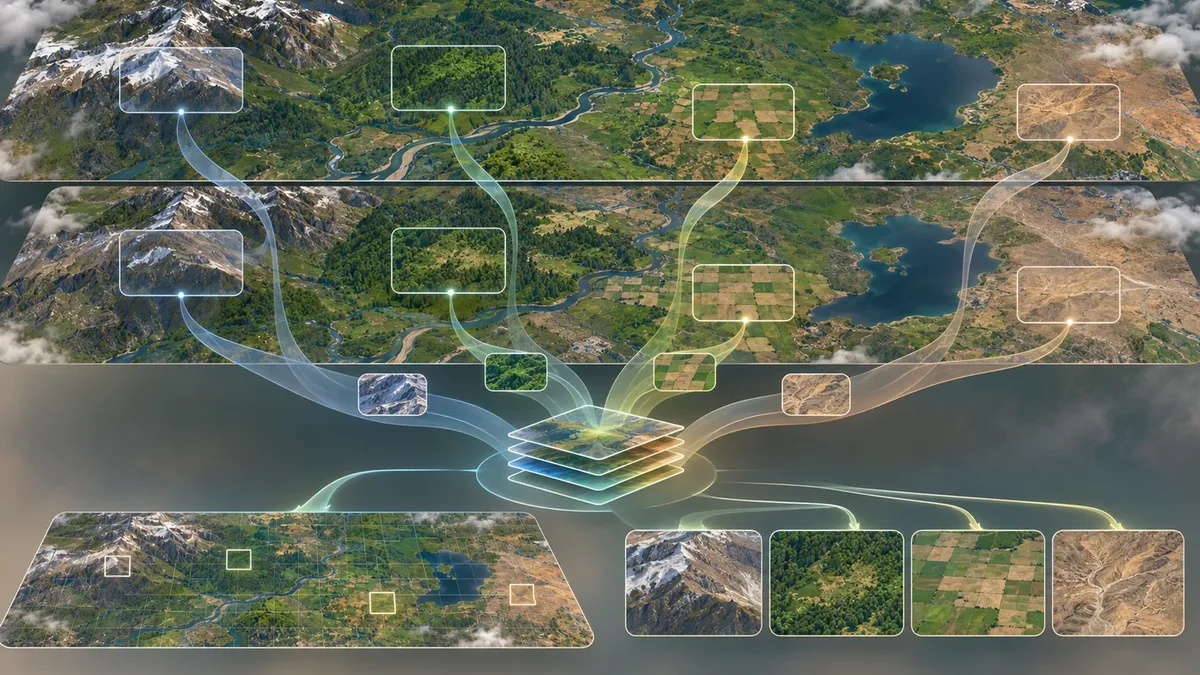
When comparing satellite images from two dates, a system must separate meaningful changes from differences in lighting, season or viewpoint. MemOVCD uses visual evidence linked across dates to guide its predictions before comparing them.
Why compare images with memory?
Satellite images taken at different times can reveal changes in a landscape. For example, a new building or a shifting shoreline might appear in a comparison; these are illustrative examples, not specific cases evaluated in this study. Finding a difference is not the same as identifying what changed. Open-vocabulary change detection aims to locate changes matching a category named in text, such as “building,” without training a dedicated model for each requested category.
The authors argue that systems which interpret each image independently and compare their predictions afterward may miss clues that connect the two dates. Seasonal, lighting or viewpoint differences can complicate interpretation. Large images are also often processed in patches, which can produce fragmented predictions or inconsistencies near patch boundaries.
How MemOVCD works
MemOVCD is described as training-free: its underlying model weights remain frozen rather than being learned on the target task. That does not mean every setting is fixed in advance, however. The paper says thresholds are selected for each dataset or semantic category.
Given two aligned images and a text query, the method uses the memory mechanism of SAM 3 to propagate candidate regions in both directions between dates. Features pooled from those regions form local visual exemplars that help guide semantic segmentation—the assignment of categories to image regions.
MemOVCD also builds shared memory by aggregating regional features from an unlabeled target collection of image pairs. The number of shared prototypes depends on how often local exemplars are available: the method allocates more prototypes when such evidence is scarcer. Together, available local exemplars and shared prototypes condition segmentation. The authors also introduce synthetic transition frames to help propagation bridge appearance differences.
For larger images, the method combines predictions from the whole image with predictions made on smaller patches and stitched together. Its global-local rectification gives more weight to the whole-image prediction when patch predictions provide insufficient coverage of a connected region. After segmentation, the system compares regions across dates to decide which count as changed.
The full MemOVCD uses shared memory built from the unlabeled target collection, a transductive setting. The authors also test L-MemOVCD, an inductive variant that relies only on local exemplars. This distinction matters when comparing results with methods that do not draw on collection-wide information.
What the paper reports
The evaluation covers five benchmarks: LEVIR-CD, DSIFN, S2Looking and BANDON for binary change detection, and SECOND for semantic land-cover change. Among the compared training-free methods, the authors report that L-MemOVCD ranks first on three of the four binary benchmarks and second on DSIFN. On SECOND, it reports class-average intersection over union (IoU) of 28.7% and F1 of 43.7%. Full MemOVCD reports 28.7% class-average IoU and 43.8% class-average F1 there.
Ablations, which test method components, found that adding local exemplars improved results on four of the five benchmarks, with a marginal drop on DSIFN. Under identical conditions, the shared-memory S-CTMC variant improved on the local-only L-CTMC variant across all five datasets. But adding the adaptive rule for choosing the number of prototypes did not help every dataset: the paper reports that this CTMC variant slightly underperformed S-CTMC on SECOND.
Rectification was omitted on DSIFN and SECOND. On the other three benchmarks—LEVIR-CD, S2Looking and BANDON—it improved IoU in the reported ablation results. The paper also shows a DSIFN failure case: local memory introduced additional false changes, which shared memory only partly removed. These tests support the components under the evaluated conditions, not a guarantee that they will help in every setting.
What remains uncertain
Benchmark scores do not establish reliability across every satellite sensor, location, season or category. The paper evaluates selected datasets and listed comparison methods using chosen prompts, implementation settings and thresholds. The authors’ dataset- or category-specific threshold choices are relevant when considering use beyond those tests.
Results from full MemOVCD should not be treated as equivalent to results from a method using only an image pair, because its shared memory draws on an unlabeled target collection. The abstract says the code will be made public, but the supplied source does not provide it; this article therefore cannot assess the implementation directly. The paper is an arXiv preprint, and the supplied material does not establish peer-review status. Its results are evidence of performance on the reported benchmarks, not proof of general real-world accuracy.
- satellite imagery
- change detection
- remote sensing
- open-vocabulary AI
- computer vision
- MemOVCD
Related reading
Automatically matched by shared topic keywords. These links do not imply that the sources agree or establish a consensus.
Teaching aerial-image AI to spot change without drawing every change map
Source published
Shared keywords: change detection, remote sensing
Can remote-sensing AI learn without perfectly matched pairs?
Source published
Shared keywords: computer vision, remote sensing
How SRCWDNet links landscape features and labels
Source published
Shared keywords: remote sensing, satellite imagery
Can an AI disaster report show its evidence?
Source published
Shared keywords: remote sensing, satellite imagery
AI satellite analysts struggle to separate land change from sensor change
Source published
Shared keywords: remote sensing, satellite imagery