TRANSMISSION // 2604.23216v2
A Cryogenic Testbed Takes PRIMA Detectors Into a Proton Beam
Source published
DRACuLA held detector arrays intended for PRIMA at 120 millikelvin during a 12-hour proton irradiation run. The report describes how the mobile facility performed and the challenges the team encountered.
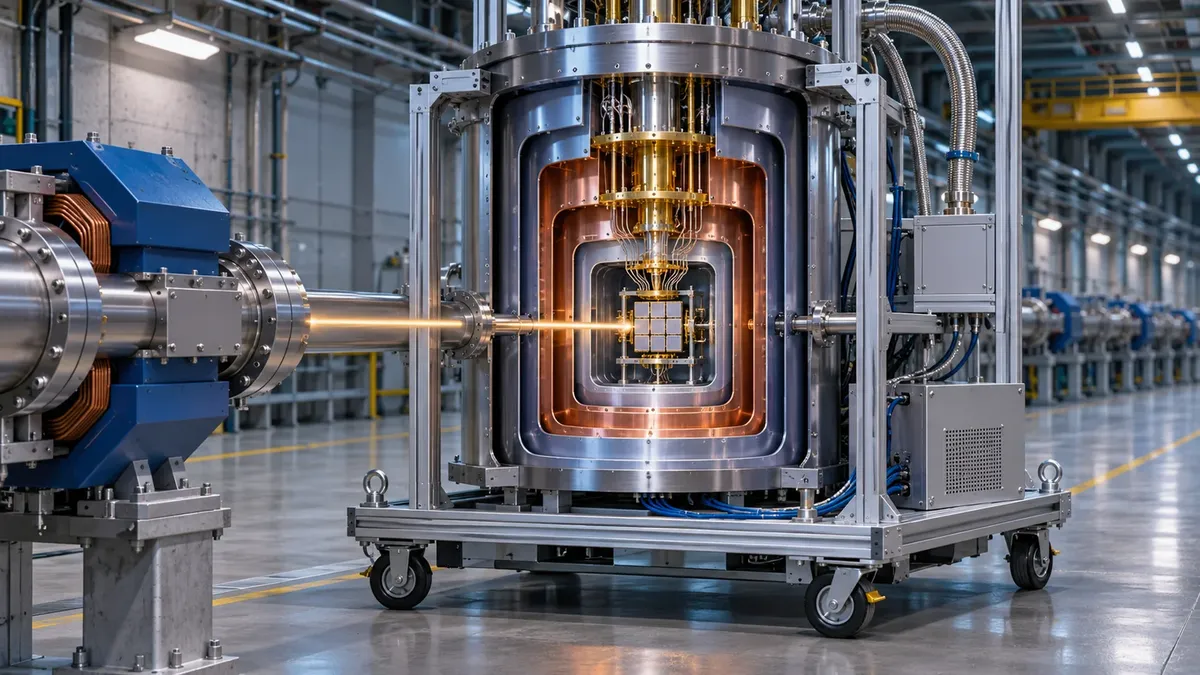
Space telescopes need detectors chilled to extremely low temperatures, but energetic particles can disrupt their signals and may damage them over time. A mobile facility called DRACuLA exposed detector arrays developed for the PRIMA mission to protons while the arrays were cold. This report focuses on the facility and the test; detailed detector-performance results are reported in a companion study.
Testing detectors while they are cold
Kinetic Inductance Detectors, or KIDs, are superconducting sensors. In space, energetic particles can disturb detector readings, and accumulated radiation may damage detector materials. Testing at room temperature may not capture the full effects: some radiation-induced defects can move or anneal before a detector is cooled for measurement. Testing at the operating temperature can help researchers examine the devices under more relevant conditions.
Valentin Sauvage and colleagues report on DRACuLA, a mobile dilution-refrigerator facility designed to expose detectors to particle beams while they operate at sub-kelvin temperatures. The paper describes the facility, its integration with a proton beamline in Groningen, the Netherlands, and its operation during a September 2025 campaign involving KID arrays developed for PRIMA.
A refrigerator built for beam access
DRACuLA uses a dilution refrigerator to cool detector samples to extremely low temperatures. Its modular setup has beam-access ports at several angles, allowing it to be aligned with different accelerator beamlines without redesigning the cryostat. For this campaign, the team transported the system from France to the Particle Therapy Research Center (PARTREC), aligned it with the beam, and used a collimator to shape the beam at the detector position.
The researchers mounted absorber-coupled and antenna-coupled KID arrays in a light-tight, magnetically shielded enclosure. They monitored the cold stages with resistance thermometers and used heaters and feedback control to regulate temperature. Before irradiation, they characterized the arrays at the beam facility to establish reference measurements in that environment.
The proton beam had an energy of 184 mega-electronvolts at the accelerator exit. Simulations estimated that it had about 150 mega-electronvolts by the time it reached the detectors, after passing through materials in the setup. During a run lasting about 12 hours, the detectors received an ionising dose of 5.7 kilorad in their aluminium film, close to the dose specified for the PRIMA mission. The team periodically paused the beam to measure detector performance.
What worked—and what did not
The report’s main result is operational: DRACuLA kept the detector stage at 120 millikelvin throughout the irradiation run. Temperature stability worsened when the beam was on. Fluctuations and interruptions in beam intensity caused temperature overshoots, and the team reports that the facility’s cooling margin was limited.
The 1-kelvin shield warmed during irradiation. Beam heating coincided with the failure of one of two pump controllers, reducing cooling capacity. The cold detector stage nevertheless remained at 120 millikelvin. The campaign also exposed practical vulnerabilities: the pump-controller failure and a control-computer issue were considered most plausibly related to stray beam radiation, but the authors had no dosimetry at the electronics to confirm the cause. They plan to bring spare controllers, computers and temperature-measurement equipment to future campaigns.
After the beam was switched off, the researchers observed a sharp increase in data points flagged as glitches. They identify radioactivity induced in the gold-plated copper sample enclosure as the main source, with copper-64 the dominant activated isotope. The team delayed science measurements for 24 hours to allow the activity to decay.
Detailed detector-performance results are outside this report’s main scope and appear in a companion paper. The authors summarize those results as showing no significant change in quasiparticle lifetime or dark responsivity after irradiation. They tentatively attribute an increase in dark noise-equivalent power to incomplete removal of glitches from the post-irradiation data. These findings do not establish that radiation has no effect under other conditions.
What the test can tell us
The campaign shows that a mobile cryogenic platform can maintain detector samples near their operating temperature during a prolonged proton exposure. It also illustrates the challenges: beam fluctuations, limited cooling capacity, activated materials and possible radiation effects on nearby electronics.
There are limits to what this single campaign establishes. The beam intensity was not recorded by the facility, and some estimates of deposited heat are bounds rather than direct measurements. One test cannot represent every detector design, radiation environment or mission exposure. The work describes a particular experimental setup and run, while the companion paper is the source for the detailed detector measurements.
The report is available on arXiv. The supplied source does not establish whether it has also appeared in a peer-reviewed publication. Its results are therefore best read as a technical account of the campaign, not as a complete qualification of detector performance across a space mission.
- DRACuLA
- PRIMA
- Kinetic Inductance Detectors
- cryogenic testing
- proton irradiation
- space instrumentation