TRANSMISSION // 2604.21903v2
A reusable recipe for sharpening rain in space and time
Source published
A diffusion-based model reconstructs finer precipitation patterns across several spatial and temporal scales, but its ensembles remain imperfectly calibrated.
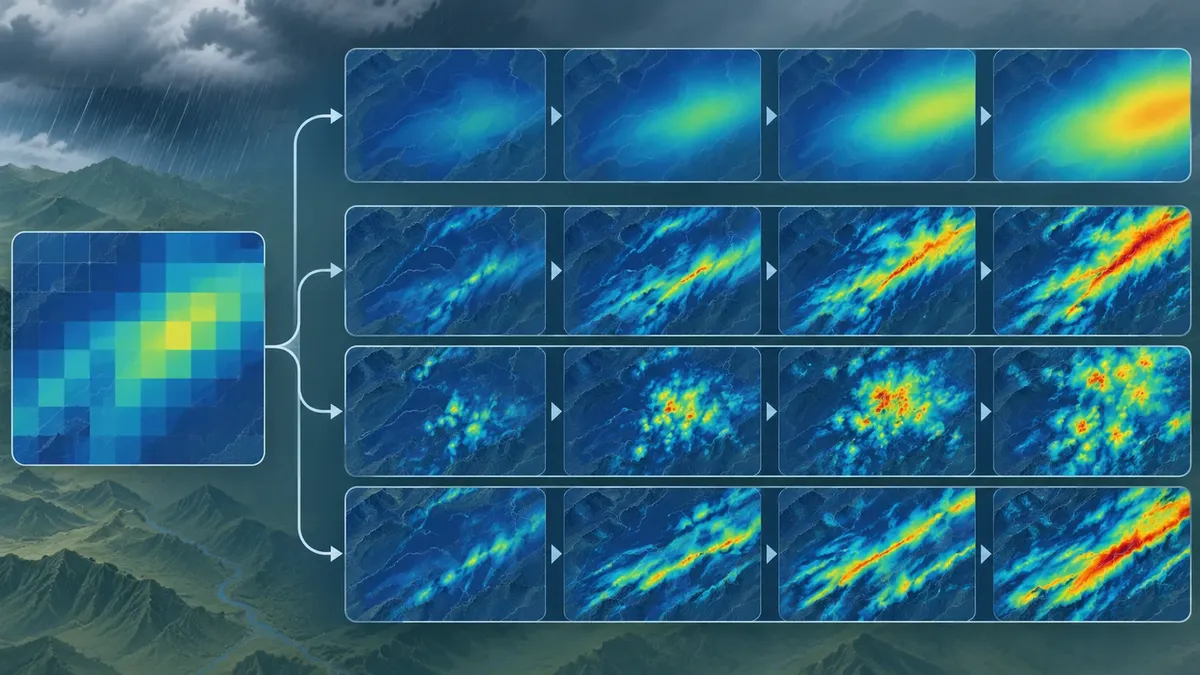
Rainfall data can lose local detail when averaged over larger areas or longer periods. A new framework tests whether one model design can reconstruct both spatial and temporal detail across different levels of refinement.
A rainfall map is not just an image: it is a changing field, with downpours appearing and moving over time. When observations are averaged across larger areas or longer intervals, local peaks and short-lived changes can disappear. Super-resolution methods try to reconstruct some of that missing detail. But models built for one particular grid size and sampling interval may need substantial redesign to work at another scale.
In A Scale-Adaptive Framework for Joint Spatiotemporal Super-Resolution with Diffusion Models, Max Defez and colleagues ask whether the same model design can handle different combinations of spatial and temporal refinement. Their answer is a qualified yes: they reuse the architecture, but train separate model instances for each setting and tune a small number of settings beforehand.
A mean prediction, plus plausible alternatives
The method splits reconstruction into two stages. First, an attention-equipped U-Net predicts an average, or conditional mean, for the finer-resolution rainfall sequence. Then a diffusion model generates possible fine-scale residual patterns—the details not captured by that average. In simple terms, the first stage estimates the broad pattern, while the second produces varied possible versions of the missing detail.
The researchers also test an optional mass-conservation step. It rescales predictions so their totals match the totals implied by the coarser input. The transformation can help preserve aggregated rainfall amounts, though the study also adjusts its behavior to limit excessive amplification of intense rain.
The scale-adaptation recipe changes three settings: how many past frames the model considers, the amplitude of the diffusion noise schedule, and, optionally, the mass-conservation function. The authors generally increase the noise-schedule amplitude for larger refinement factors to encourage more varied outputs. They also adjust temporal context to maintain comparable attention horizons across sampling intervals. The model’s architecture stays the same, but its learned weights do not: each refinement-factor pair gets its own trained instance.
Tested on French precipitation reanalysis
The evaluation uses Coméphore, a French precipitation reanalysis that merges radar and rain-gauge observations. The authors train on 2023 data and test on 2024, using a selected region divided into tiles for spatial cross-validation during training. They create coarser inputs by averaging blocks of the finer data in space and time—a “perfect-model” setup in which the low-resolution data are constructed from the high-resolution reference rather than supplied by a separate observing system.
They test four spatial-temporal refinement pairs, spanning spatial factors from 1 to 25 and temporal factors from 1 to 6. Comparisons include nearest-neighbor and bicubic interpolation, a deterministic version of the model without diffusion, and a version without attention. The team evaluates pixel-level errors as well as the distribution and spatial structure of rainfall. For the main generative comparison, some scores are calculated from an ensemble mean, while others assess the generated members collectively; those are different questions and should not be conflated.
More fine-scale variation, but uncertainty remains
For the illustrated setting, with spatial factor 10 and temporal factor 3, individual generated members restore small-scale variability that the deterministic prediction smooths away. The authors report that generated members better match the target’s power spectrum, a measure of how much variation occurs at different spatial scales. In that setting, the ensemble also has a lower continuous ranked probability score than the deterministic model, indicating better probabilistic performance under their evaluation.
That does not mean the generative model wins on every measure. The deterministic model performs best on several pixel-wise and image metrics, including mean squared error and mean absolute error. The generated ensemble is under-dispersed at the pixel level: its spread is too narrow to cover observations as often as a calibrated ensemble should. The paper reports that the observation falls outside the range of eight members in 33% of pixels, compared with 22% expected under its stated comparison. The authors therefore describe the diffusion component as a way to produce realistic ensembles, with some cost in pixel-wise accuracy—not as a uniformly better or fully calibrated forecast.
There are further limits. The hyperparameters were selected using the 2024 test period, so that selection was not independent of the test data; the authors call the resulting trends indicative rather than optimal. The evaluation covers one precipitation dataset and a limited set of refinement pairs. Diffusion sampling is also computationally expensive, making the approach better suited to offline analysis than real-time operations, according to the paper. And although the architecture is reusable, training is still required for each factor pair. The authors identify sharing weights across scales as a goal for future work.
The supplied paper text states that the work was accepted in Environmental Data Science through the Climate Informatics 2026 peer-review process; this article has not independently verified that statement. The findings support a reusable modeling recipe in this particular experiment, not proof that it will transfer unchanged to other regions, data sources, or operational forecasting. The paper is available as an arXiv preprint, and the results should be read with the study’s evaluation limits in mind.
- precipitation
- super-resolution
- diffusion models
- climate AI
- uncertainty
Reviewed cross-references
These connections were reviewed by a model, not independently fact-checked by a human. Similarity does not imply agreement; consult the original papers and the evidence below.
Can moving sensors learn where to look next?
Shared method: Both papers use diffusion models for conditional generation involving physical fields: Defez et al. model precipitation residuals with a conditional diffusion model, while Zhang et al. jointly generate future fields and sensor trajectories with a latent-space diffusion model. The implementations and tasks differ, so this is a shared broad modeling approach, not evidence that either method validates the other.
Model review: · openai-codex/gpt-6-luna
Evidence and provenance
Selected excerpts, not complete papers. PDF extraction can omit figures or damage equations, tables and reading order; sources may be preprints.
2604.21903v2 — Original paper
Excerpt reference:
static/papers/2604.21903v2.md:385-429
Basis: Paper text
Source SHA-256:2e3fb8189882fef14e74e488435a267396e2ef05321bede4ec58dd96ab7b8b0a2611.06280v1 — Original paper
Excerpt reference:
static/papers/2611.06280v1.md:13-64
Basis: Paper text
Source SHA-256:52312cfc82b91da72d3da0e21d02b6d70891adbd2593f64aea7dac52f2e9dac5
Related reading
Automatically matched by shared topic keywords. These links do not imply that the sources agree or establish a consensus.
Photon-count correlations reveal two pinholes hidden in conventional ghost imaging
Source published
Shared keywords: super resolution
Synthetic root images help AI learn when real annotations are scarce
Source published
Shared keywords: diffusion models
Making diffusion-teacher gradients cheaper to estimate
Source published
Shared keywords: diffusion models
CARGO trains simulated vehicles to distinguish helpful cooperation from avoidable risk
Source published
Shared keywords: diffusion models
A Look Ahead, Not a Higher Order: Rethinking Faster Diffusion Sampling
Source published
Shared keywords: diffusion models