TRANSMISSION // 2604.19830v2
GAPS: A balloon-borne search for rare cosmic antimatter
Source published
The GAPS Antarctic balloon instrument is designed to search for low-energy antiprotons, antideuterons and antihelium nuclei—particles that could offer clues about dark matter. This paper describes how its detectors and cooling system were designed, integrated and commissioned. It reports no science findings from the flight.
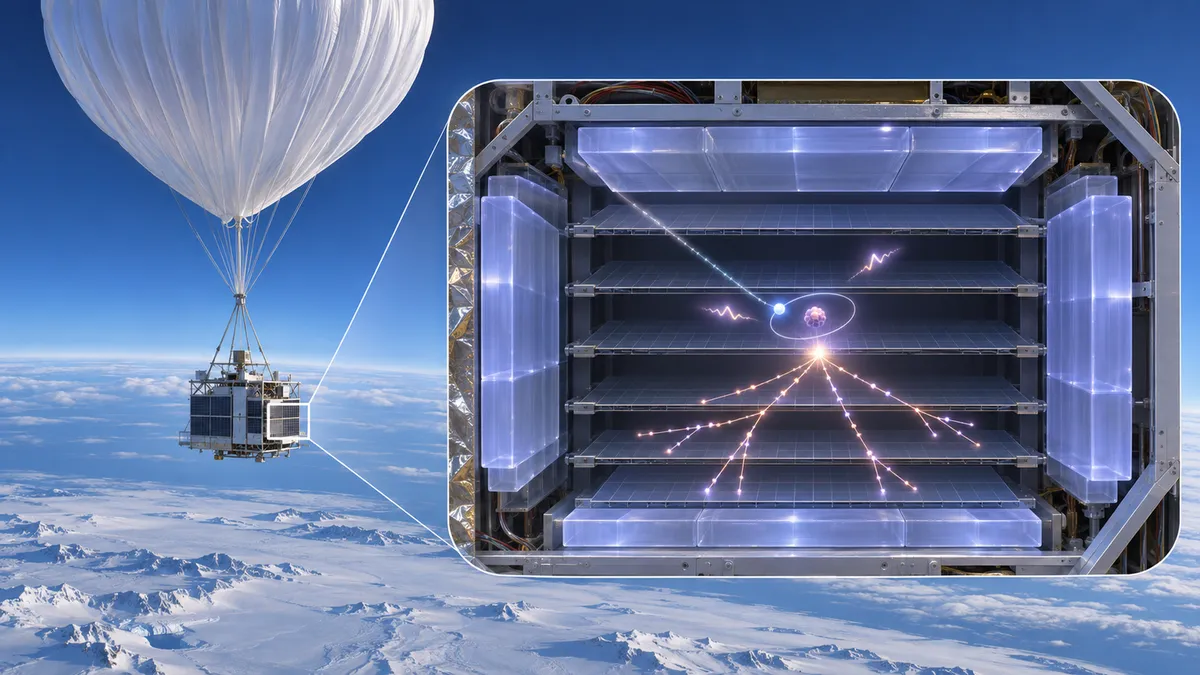
A particle slows down, is captured, then gives off telltale X-rays and other particles: that unusual sequence is the basis of GAPS, a balloon-borne experiment designed to identify rare antimatter nuclei. The collaboration’s paper explains the instrument and its preparation for flight—not whether it found evidence of dark matter.
A search based on what happens when antimatter stops
Dark matter has been inferred from its gravitational effects, but its nature remains unknown. Some theories predict that dark matter could produce antiprotons, antideuterons or antihelium nuclei. Finding such particles in cosmic rays would be intriguing, but the signal is expected to be rare and must be distinguished from more common particles.
The General Antiparticle Spectrometer, or GAPS, is designed to search for these cosmic-ray particles at low energies: below 0.25 gigaelectronvolts per nucleon, a measure of energy for each particle in a nucleus. The collaboration describes antideuterons as especially interesting because ordinary astrophysical processes are expected to produce very few at these energies. That makes them a possible dark-matter clue—not proof on its own that dark matter is responsible.
Reading a particle’s final moments
GAPS identifies particles through more than their motion: it looks for a chain of events. An incoming antinucleus loses energy and slows as it passes through the instrument. It can then be captured by an ordinary atom, forming an “exotic atom” in which the antinucleus takes the place of an electron. As the atom settles into a lower-energy state, it emits X-rays; eventually, the antinucleus annihilates with matter in the nucleus, producing other particles, mainly pions.
The particle’s energy-loss pattern, X-ray energies and annihilation products together can help distinguish antinucleus types from one another and from ordinary positive nuclei. The paper describes a central tracker made from more than 1,000 custom silicon detectors, surrounded by a plastic-scintillator time-of-flight system. The tracker records energy deposits and particle paths; the surrounding detectors help measure the incoming particle’s speed and register tracks from the later interaction.
GAPS is designed for long-duration balloon flights over Antarctica. The high-altitude polar setting suits the search for low-energy cosmic rays, while also imposing engineering challenges: the payload must manage power, heat and communications, and withstand stresses during launch and parachute deployment.
Engineering for a cold tracker
One design feature highlighted in the paper is a multi-loop capillary heat-pipe system. It transports heat from the tracker to a radiator facing space. Circulation is passive, driven by changes in the working fluid as it heats and cools, rather than by a conventional pump. The tracker is designed to operate below −35°C. The authors describe the system’s design and earlier testing, and its integration into the payload; the paper does not provide a separate account of its measured performance during the science flight.
The team also describes tracker and time-of-flight electronics, triggering and data handling, calibration, and integration and commissioning of the full payload. Ground checks included cosmic-ray muons and X-ray sources. For example, the paper reports a time-of-flight timing resolution of about 0.320 nanoseconds in ground commissioning, below its stated 0.400-nanosecond requirement. Such tests assess whether components meet design goals; they are not detections of cosmic antimatter.
What this paper does—and does not—show
This is primarily a technical account of the payload: it presents design, integration and commissioning, rather than a measured cosmic-ray spectrum, an antinucleus candidate or a dark-matter result. The authors report that the first GAPS science payload flew for 25 days during NASA’s 2025/26 Antarctic balloon campaign. The paper gives no science findings from that flight, so its duration should not be read as evidence that GAPS detected an antinucleus.
The article is a preprint hosted on arXiv, and the supplied source does not establish whether it has undergone peer review. Its technical claims should therefore be understood as the collaboration’s account, not an independent assessment. Even a future antinucleus observation would require careful interpretation: scientists would need to assess backgrounds and competing explanations before determining its origin.
For now, GAPS is best understood as a specialized instrument built to make a difficult search possible. This paper explains how its unusual identification method is implemented in a balloon payload—and leaves the central scientific question open.
- GAPS
- cosmic rays
- antimatter
- antideuterons
- dark matter
- balloon experiment
- particle detectors
Related reading
Automatically matched by shared topic keywords. These links do not imply that the sources agree or establish a consensus.
South Pole radio array sets new limits on extreme-energy neutrinos
Source published
Shared keywords: cosmic rays
A Southern Window on the Highest-Energy Gamma Rays
Source published
Shared keywords: cosmic rays, dark matter
Jupiter’s atmosphere offers an indirect way to study faint cosmic gamma rays
Source published
Shared keywords: cosmic rays
How ground-based telescopes are tracing the Universe’s most extreme particles
Source published
Shared keywords: cosmic rays
A lingering ultraviolet glow at the Milky Way’s poles
Source published
Shared keywords: dark matter