TRANSMISSION // 2604.19827v2
How Faults Could Spread Across AI-Written Code Changes
Source published
A model of overlapping pull requests estimates when faults could spread through repositories. Its results describe possible risk under the model, not observed fault transmission.
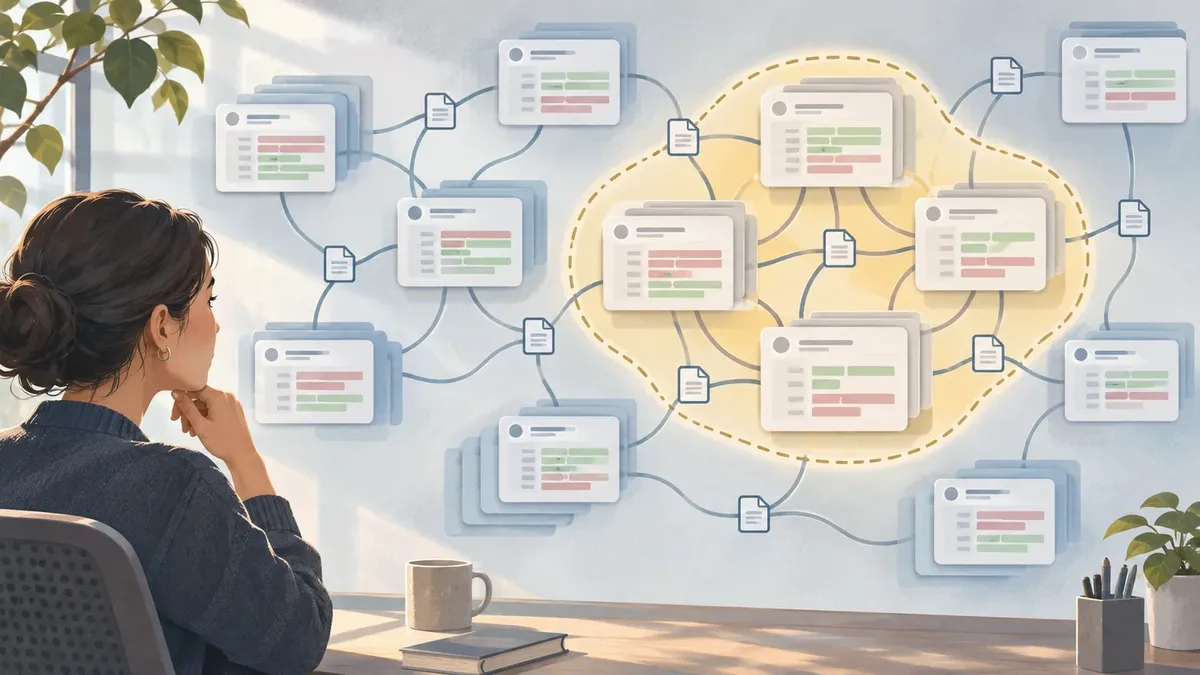
When coding agents edit the same repository at once, one change may overlap with another. A preprint models how a fault could pass between overlapping changes and asks which repository structures might allow it to keep spreading.
A fault in a software change may not stay confined to that change. If another open change incorporates the faulty code, repairing the original may no longer be enough. Daniel Russo’s preprint, “A Threshold Model of Fault Propagation in AI-Native Software Ecosystems,” examines how concurrent coding work could create pathways for this kind of spread.
The paper asks a structural question: given the pattern of overlapping work in a repository, how readily could a fault pass from one change to another and continue spreading? Pull requests are usually reviewed individually, the paper notes, but that view may not show how concurrent changes connect.
Modeling overlapping changes
The model represents open changes as connected when they are open at the same time and modify a common file. The paper calls this relationship “contention.” It treats fault transfer across a connection as a probability.
The approach draws on branching processes and an analogy with epidemic spread: in the model, propagation sustains itself when each faulty change passes the fault to more than one other change on average. Russo defines a reference threshold for each repository: the crossing probability per contention link above which spread would sustain itself in a random graph with that repository’s contention degrees. The threshold is therefore a model-based measure of how the overlap structure relates to potential propagation—not a measured rate of real faults moving between changes.
To estimate contention patterns, the study reconstructed them among 33,105 agent-authored pull requests in 2,731 repositories. The abstract does not give enough detail to assess the reconstruction procedure or the full modeling assumptions.
What the paper reports
Thirteen repositories had reference thresholds below 5%. The abstract reports that these repositories contained 42.5% of the changes. Under the model, in those repositories a fault crossing one contention link in twenty would be enough for spread to sustain itself.
This does not mean that one in twenty real overlaps transmitted a fault. Rather, it describes a condition under which propagation would sustain itself in the paper’s model. The paper’s central argument is that repository structure may matter: examining each change separately may not reveal the potential for faults to spread across concurrent work. Russo says engineers could compute this exposure from repository records they already keep.
What remains uncertain
The abstract does not establish how often faults cross contention links in practice, whether the thresholds predict actual incidents, or whether using them reduces failures. It also does not compare fault rates in agent-authored and human-authored work. The results concern possible propagation under the proposed model, not a demonstrated difference in reliability or a causal effect of coding agents.
Real projects might differ from the model in ways that affect propagation. For example, overlap patterns may not match a random graph, and review or testing might interrupt a pathway. These are possibilities to investigate, not findings reported in the abstract.
The evidence available for this account is the abstract alone, so important details—including how pull requests were selected and how the model was validated—cannot be assessed here. The source is an arXiv preprint; the supplied information does not establish peer review.
The study offers a way to look beyond individual pull requests and ask whether concurrent edits create conditions for fault propagation. Whether its thresholds identify real-world risk remains an empirical question.
- AI coding agents
- software engineering
- fault propagation
- pull requests
- code review
- complex systems
Related reading
Automatically matched by shared topic keywords. These links do not imply that the sources agree or establish a consensus.
When AI coding agents get a map to the rules
Source published
Shared keywords: ai coding agents, software engineering
Can developers’ actions benchmark AI code reviews?
Source published
Shared keywords: pull requests, software engineering
Why AI coding agents need more than a rulebook
Source published
Shared keywords: ai coding agents
When AI code review speeds up work—and adds more of it
Source published
Shared keywords: code review, pull requests
What Do AI Coding Tokens Actually Measure?
Source published
Shared keywords: ai coding agents, software engineering