TRANSMISSION // 2604.17196v2
A measurement criterion for quantum coherence transfer
Source published
Researchers propose a criterion for detecting coherence transfer in quantum networks and report evidence from four- and six-photon entanglement experiments.
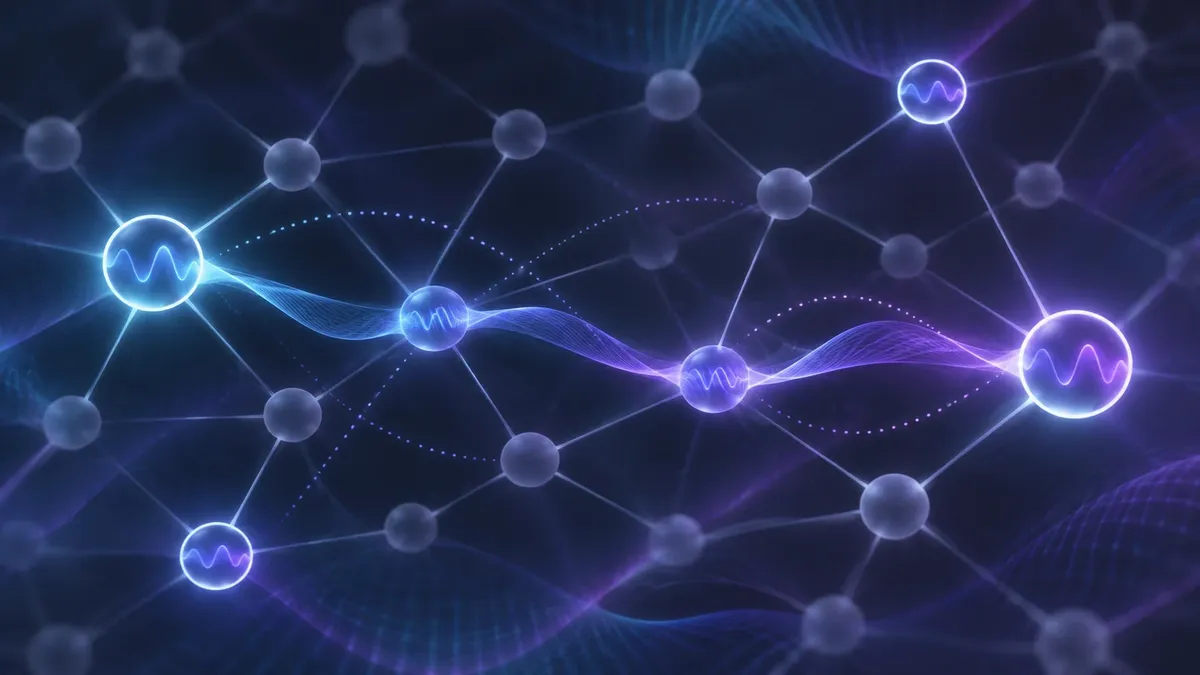
How can researchers tell whether coherence has been transferred through a quantum network when experimental conditions are not fully characterized? A new study proposes a test based on limited output measurements and reports applying it to multiphoton entanglement networks.
Testing for coherence transfer
Detecting coherence transfer in a complex quantum network can be difficult when researchers have limited access to the system or do not know how well intermediate nodes can verify what passes through them. In Coherence Transfer in Quantum Networks, the authors propose a criterion designed to address these challenges.
The test uses the coexistence of what the authors call static and dynamic coherence to derive a nonlinear criterion for transfer. The available source is the paper’s abstract, which does not provide the criterion’s mathematical details or derivation. Its assumptions and precise interpretation therefore cannot be assessed here.
What the proposed test requires
According to the abstract, the criterion does not depend on characterized verification capabilities at checkpoint nodes. It requires analysis of outputs from one network, with the amount of analysis limited by the output-state dimensions. Each output requires measurements of state populations in two settings, regardless of network size.
The authors say the approach applies to spatial and temporal networks, networks with multiple coherence sources, and quantum transport in solid-state nanostructures. These are claims about the criterion’s scope; the abstract does not describe separate experimental demonstrations in each of those settings.
Multiphoton network experiments
The researchers report experiments using entanglement swapping in four- and six-photon entanglement networks. They say the criterion provided experimental evidence of coherence transfer in those networks.
This reported evidence is specific to the stated multiphoton experiments and the proposed criterion. The abstract does not provide numerical results, uncertainty estimates, or a comparison with other verification methods, so it is not possible to judge those aspects from the available material. Nor does the abstract report experimental tests in solid-state nanostructures.
What the abstract cannot establish
The proposal aims to make coherence-transfer tests possible with limited output analysis, even when intermediate nodes are not fully characterized. Whether and how well it works under other experimental conditions requires details beyond the abstract, including the mathematical derivation, protocol, data, and limitations.
This account is based on the abstract of an arXiv preprint, rather than a full-paper review. The abstract summarizes the authors’ claims but is not enough to independently evaluate the method or its experimental evidence. The cautious conclusion is that the authors propose a criterion with specified measurement requirements and report evidence of transfer in four- and six-photon entanglement networks; broader applicability remains a claim to assess against the full paper and further evidence.
- quantum coherence
- quantum networks
- entanglement swapping
- quantum measurement
- quantum physics
Related reading
Automatically matched by shared topic keywords. These links do not imply that the sources agree or establish a consensus.
A measurement-based way to quantify quantum superposition
Source published
Shared keywords: quantum coherence, quantum measurement
The control cost of resetting a qubit without revealing its past
Source published
Shared keywords: quantum physics
Can measurements help spin chains link distant qubits?
Source published
Shared keywords: quantum measurement, quantum networks
How interacting spins may protect quantum coherence
Source published
Shared keywords: quantum coherence, quantum physics
A quantum bound-breaking claim hinges on time evolution
Source published
Shared keywords: quantum measurement, quantum physics