TRANSMISSION // 2604.12646v2
How squeezed light can tip the balance of electron emission
Source published
Simulations suggest that a weak bright squeezed-vacuum field can greatly amplify directional asymmetry in electrons released from helium, mainly by changing the tunneling probability. The result is theoretical, not an experimental demonstration.
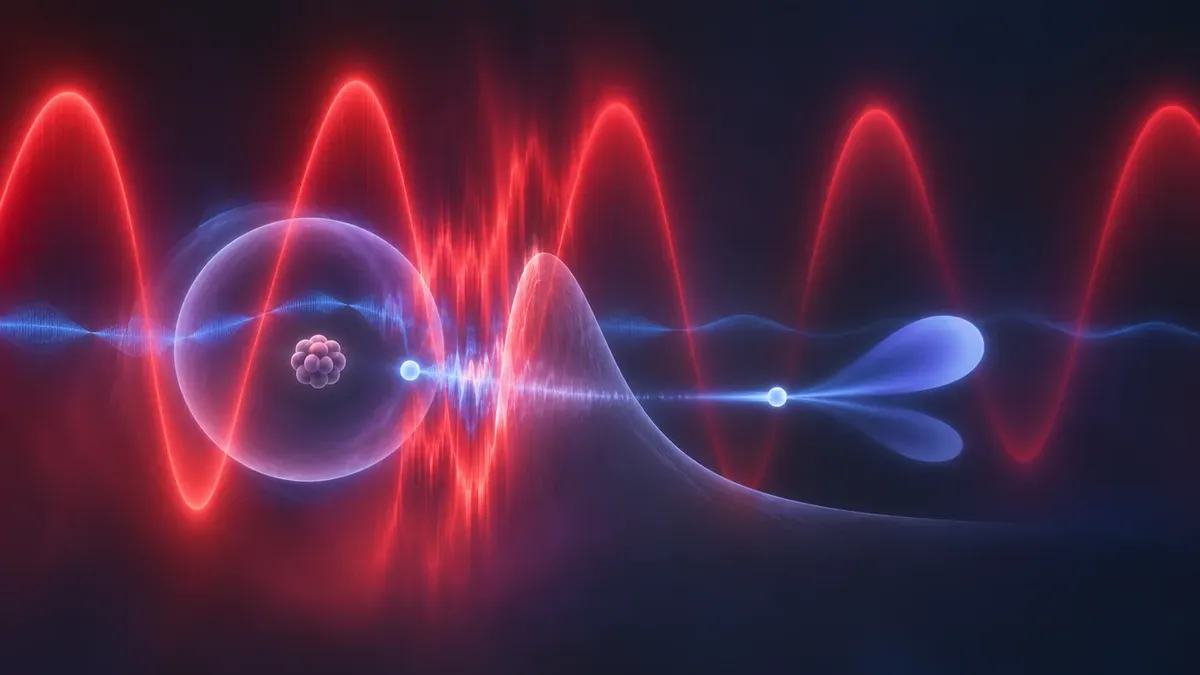
Could changing light’s quantum fluctuations make atoms emit electrons more strongly in one direction—without substantially changing the electrons’ later motion? A theoretical study says yes, in simulations of strong-field ionization. It finds that a weak bright squeezed-vacuum component can make a photoelectron signal much more lopsided than an equally weak coherent-light perturbation.
When an intense laser hits an atom, an electron can tunnel through the atom’s binding barrier and escape. The final directions and energies of many such electrons form a photoelectron momentum distribution. Its shape can reveal details of when electrons were released during the laser cycle.
Researchers often create directional asymmetry by combining light at two frequencies. But making the weaker component stronger can also alter how electrons move after they escape, complicating the interpretation. The question in this study is whether a different kind of weak second component could strongly affect the moment of escape while leaving the average driving field unchanged.
A different kind of weak light
The authors model a linearly polarized field made from a strong coherent wave at twice a base frequency and a weaker bright squeezed-vacuum (BSV) wave at the base frequency. “Squeezed” light has quantum fluctuations distributed unevenly between two complementary field properties. BSV is a bright form of this light, rather than the faint squeezed vacuum used in some familiar quantum-optics examples.
The team calculates photoelectron momentum distributions for helium using a quantum description of the light and a semiclassical strong-field approximation (SFA) for ionization. In the analysis, the BSV field is represented as a probability-weighted range of possible field amplitudes, using a phase-space distribution called the Husimi distribution. The researchers compare its effects with those of weak coherent and thermal perturbations. They also examine the calculated ionization probabilities and saddle-point ionization times—quantities used in the SFA to describe likely electron-release events.
The comparison is designed to separate changes in the average field from changes in its statistics. The reported field intensities make the weak component about one-hundredth the intensity of the strong component. The paper’s numerical examples use helium and specified laser parameters; the results should not be read as a measurement across atoms, laser settings or experimental apparatus.
A much more skewed distribution
In the simulations, some BSV settings produce a pronounced imbalance between electrons with positive and negative momentum along the laser’s polarization direction. The paper reports that the distribution’s skewness—a measure of how unevenly its tail extends to either side—can be roughly two orders of magnitude greater than for an equally weak coherent perturbation. The enhancement depends on the relative phase, controlled for BSV by its squeezing angle: at another setting, the distribution retains left-right symmetry.
The proposed explanation centers on tunneling. The average driving field can stay unchanged while individual field-amplitude fluctuations are asymmetric. Because tunneling probability depends very strongly—approximately exponentially—on the instantaneous field, higher-amplitude realizations can contribute disproportionately to ionization. The calculated probabilities then favor some release events and momenta over others. The paper finds that, in the parameter range it studies, the squeezed component has negligible effect on the electron’s subsequent continuum propagation; the enhanced asymmetry is attributed mainly to the tunneling step.
The BSV simulations also show blurred interference patterns and changes to other features of the momentum distribution. Those effects matter: the result is not simply a cleaner version of the signal. A larger asymmetry may make some phase-sensitive features easier to identify, but changes in contrast and distribution shape could also complicate interpretation.
What the result does—and does not—show
The central result is a simulation and theoretical analysis, not a reported experiment demonstrating this asymmetry. The authors describe it as a proof of concept, and suggest that such amplification might help make subtle signatures of sub-cycle ionization dynamics more measurable. Extracting ionization times, phases or individual pathways would require further work; the study does not establish a complete experimental method for doing so.
There is also an important distinction between a striking signal and proof that the signal itself is nonclassical. For the photoelectron distribution studied here, the authors say the result can be represented as a Husimi-weighted ensemble of responses to coherent fields. They caution that the asymmetry is therefore not, on its own, a standalone witness of nonclassical light. This does not mean the incident BSV or the joint light–matter state is classical; rather, the particular observable does not reveal all of their quantum properties.
The analysis uses approximations, including the SFA, and focuses on direct above-threshold ionization. The authors note that rescattered electrons could introduce additional effects from the field statistics, which they do not investigate. Their conclusion about negligible influence on electron propagation applies to the parameter range considered, not every possible setup.
The work is available as an arXiv preprint. Preprints may not have undergone peer review, and a theoretical prediction needs independent scrutiny and experimental testing before it can be treated as established behavior. The study’s contribution is a proposed way to use light’s fluctuations—not a change in its average field—to magnify a directional signature of electron release.
- strong-field ionization
- bright squeezed vacuum
- photoelectron momentum distributions
- quantum optics
- tunneling ionization
- laser physics
Related reading
Automatically matched by shared topic keywords. These links do not imply that the sources agree or establish a consensus.
A hybrid cavity could let light read a molecule’s vibrations
Source published
Shared keywords: quantum optics
How unequal cavity losses could steady single-photon emission
Source published
Shared keywords: quantum optics
How an electron’s quantum connection passes from an ion to light
Source published
Shared keywords: quantum optics
How photon-pair graphs make NOON states
Source published
Shared keywords: quantum optics
A vibrating mirror could shuttle complex quantum light
Source published
Shared keywords: quantum optics