TRANSMISSION // 2604.11621v2
A More Cautious Mass–Radius Estimate for PSR J0030+0451
Source published
Different hotspot models yield different estimates of a pulsar’s mass and radius. A Bayesian method combines eight published results while allowing for shared data and systematic uncertainty.
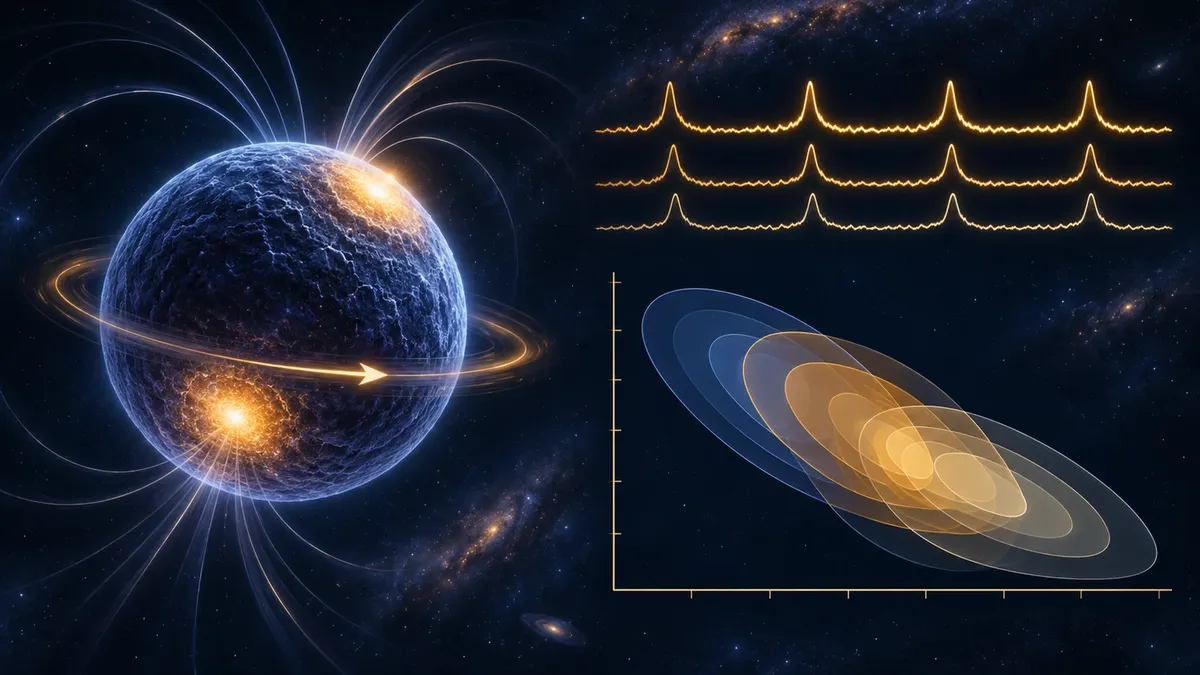
NICER observations let astronomers estimate neutron-star masses and radii from X-ray pulses, but those estimates can depend on how the star’s bright surface regions are modeled. A new preprint combines eight published analyses of PSR J0030+0451, aiming to preserve their disagreements rather than treating them as independent measurements.
Neutron stars are probes of matter at densities that cannot be reproduced in terrestrial experiments. Their masses and radii can help scientists test theories of ultra-dense matter. But estimating those properties from X-ray data is not straightforward: the answer can depend on assumptions about hot regions on a star’s surface.
NASA’s Neutron Star Interior Composition Explorer, or NICER, measures X-ray pulses as a rapidly spinning neutron star rotates. Researchers model how those pulses change over time to infer the star’s mass and radius. This technique, called pulse-profile modeling, requires a description of the emitting hotspots. Different plausible hotspot models can fit the observations yet produce different mass–radius estimates.
That problem is especially visible in PSR J0030+0451, an isolated millisecond pulsar studied by several groups. The preprint by Ryan O’Connor, Chun Huang and Alexander Y. Chen asks how to combine those estimates without treating them as independent or choosing one hotspot model as definitive.
Combining results that share data
The team combined eight published mass–radius probability distributions drawn from four studies. These are not eight independent observations: the analyses overlap in their use of NICER data, and some also use XMM-Newton observations. Treating them as independent could make the final uncertainty look too small.
The researchers used a Bayesian mixture framework. In plain language, it allows each input result either to contribute with its published uncertainty or to be treated as potentially affected by additional, unaccounted-for error. The method’s “good” and “bad” labels are statistical categories, not judgments about whether a hotspot model is physically right or wrong.
To preserve the shapes of the published results, including skewed or multiple-peaked distributions, the team represented them with smoothed estimates based on their posterior samples rather than forcing them into simple bell curves. They also tempered the combined contribution to allow for unknown correlations and included a possible systematic shift shared across analyses.
The reported combination gives PSR J0030+0451 a mass of 1.53 solar masses, with a 68% credible interval from 1.26 to 1.84 solar masses, and a radius of 13.44 kilometres, with an interval from 11.06 to 16.38 kilometres. The corresponding compactness—roughly, how much mass is concentrated within the star’s radius—is estimated as 0.169, with a 68% interval from 0.148 to 0.187.
The combined distribution retains both lower- and higher-mass solutions present among the hotspot analyses. Its central values summarize a spread of allowed results; they do not establish that the pulsar has one uniquely determined mass and radius. The authors also estimate a radius of 11.84 kilometres for a 1.4-solar-mass neutron star by conditionally combining their result with observations of PSR J0437−4715. That estimate depends on the interpolation method and on information from the second pulsar, not just J0030’s radius distribution.
What the uncertainty means
The uncertainty treatment depends on modeling choices. For their main result, the authors assign a uniform prior to the correlation parameter, spanning fully uncorrelated through fully correlated cases. They use equal weights for the eight input posteriors. This is not evidence-based model averaging, and it does not mean the hotspot models are equally supported by their original data analyses.
The paper compares limiting cases: treating the inputs as independent produces a substantially narrower radius interval than the adopted combination. That illustrates why assumptions about the relationship among analyses matter. But the scalar correlation parameter is a simplified way to represent dependence; it does not reconstruct the full covariance between studies. The authors also note that their common-systematic model cannot reveal a bias shared by every analysis, and that parts of the broad posterior approach the boundaries of the computational grid.
The study does not perform a full inference of the dense-matter equation of state. Its results are a proposed way to summarize existing J0030 analyses for future work, especially when there is no external basis for selecting among hotspot configurations. The authors report that posterior samples and reproduction scripts are publicly available.
This account is based on the supplied paper text and abstract for an arXiv preprint, not an independent reanalysis. The supplied material does not establish whether this version has been peer-reviewed. The combination is best read as a methodological proposal and an uncertainty-aware summary, not a final resolution of PSR J0030+0451’s mass and radius.
- neutron stars
- NICER
- PSR J0030+0451
- mass-radius measurement
- Bayesian statistics
- astrophysics
Reviewed cross-references
These connections were reviewed by a model, not independently fact-checked by a human. Similarity does not imply agreement; consult the original papers and the evidence below.
How three datasets constrain neutron-star matter
Supporting evidence: Both analyses place the canonical 1.4-solar-mass radius near 12 km: the origin reports 11.84 km using conditional interpolation with PSR J0437–4715, while RoyChowdhury et al. report 11.93 km from a joint gravitational-wave, NICER and radio-pulsar EoS inference. The estimates are compatible, but use different methods and data combinations, and their quoted intervals have different credibility levels, so this is not a like-for-like comparison.
Model review: · openai-codex/gpt-6-luna
Evidence and provenance
Selected excerpts, not complete papers. PDF extraction can omit figures or damage equations, tables and reading order; sources may be preprints.
2604.11621v2 — Original paper
Excerpt reference:
static/papers/2604.11621v2.md:1170-1239
Basis: Paper text
Source SHA-256:27ff59c12d5a2c3be706d4ddb3bb460b245a96a72ac19f39a9928f505d05c1402611.24664v2 — Original paper
Excerpt reference:
static/papers/2611.24664v2.md:12-66
Basis: Paper text
Source SHA-256:23e38eb269d253a7b5b5a4f18afc132e3b33c27a4d64a232467e721b64c7aea3
Related reading
Automatically matched by shared topic keywords. These links do not imply that the sources agree or establish a consensus.
How three datasets constrain neutron-star matter
Source published
Shared keywords: neutron stars
Why nuclear measurements may not settle neutron-star tides
Source published
Shared keywords: neutron stars
GX 9+9 Offers Clues to Its Inner Accretion Flow
Source published
Shared keywords: neutron stars
How viscous neutron-star tides vary with temperature
Source published
Shared keywords: neutron stars
Nuclear pasta may reshape a young neutron star’s crust
Source published
Shared keywords: neutron stars