TRANSMISSION // 2604.00528v3
How an AI agent builds a 3D object from video
Source published
TAB combines a vision-language model with camera geometry to find objects in RGB-D video, but its results depend on depth data and benchmark choices.
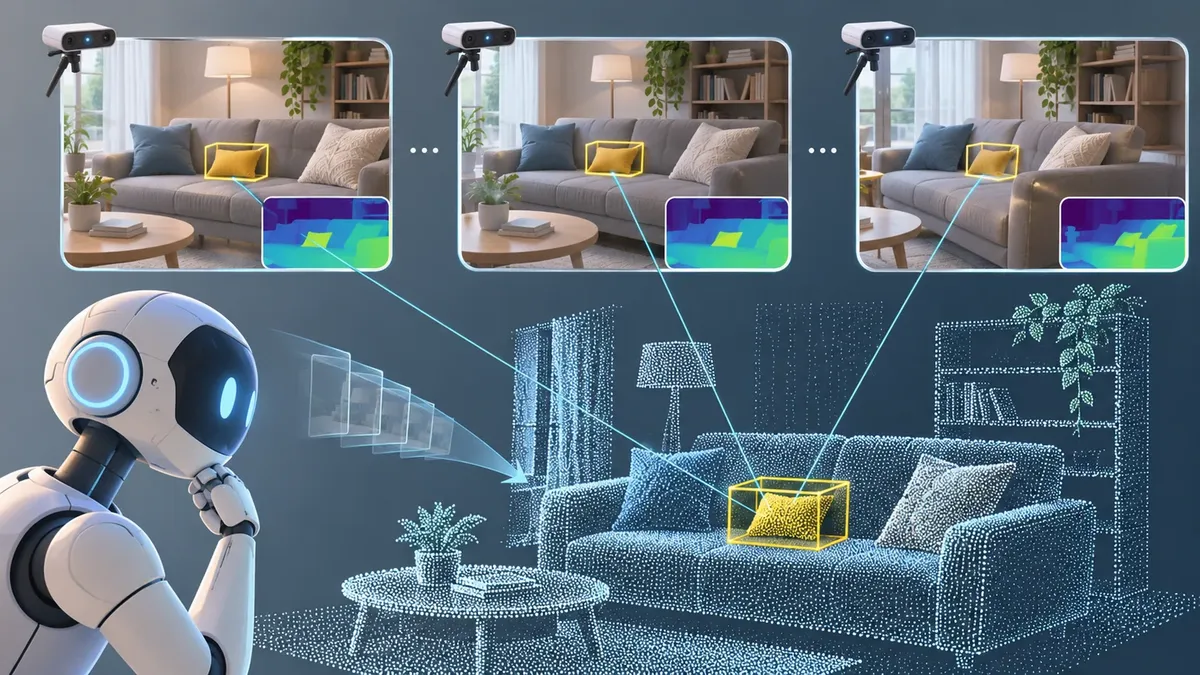
Finding the right object in a 3D scene from a phrase such as “the pillow on the left bed” is more than recognizing an object: a system must identify which pillow, then estimate its location and shape in 3D. A new preprint proposes an AI agent that builds that answer from video frames and depth measurements rather than starting with a pre-made 3D map.
From a description to a 3D box
3D visual grounding asks a system to locate an object in a scene using natural language. A person might hear “the top pillow on the side of the bed closer to the table” and use the surrounding scene to pick the right one. The challenge for AI is to resolve those relationships and produce a location in three-dimensional space.
Many existing zero-shot approaches, the paper argues, first rely on a preprocessed 3D point cloud and a set of candidate object boxes. The model then selects among those proposals. The authors of Think, Act, Build (TAB) instead ask whether a system can start from a sequence of ordinary colour images paired with depth maps—an RGB-D stream—and construct a 3D representation as it goes.
Their key design idea is to split the work. A vision-language model (VLM) interprets the description and visual context; geometric calculations use the depth data and camera parameters to connect observations across views. TAB organizes this as an iterative agent: it reasons about the query, calls visual tools, and builds up a reconstruction.
Finding the target, then following its geometry
First, TAB parses a description into elements such as the object category, visual attributes, and spatial relationships. Detection tools narrow down frames that contain the object category. The VLM then checks which frames fit the broader scene description and helps select a reference view. Segmentation tools mark possible instances in that image, and the VLM chooses the mask that matches the query.
Following the object across views using visual meaning alone can fail when the camera angle changes, the object is partly hidden, or the surrounding context disappears. TAB’s proposed Semantic-Anchored Geometric Expansion addresses this by first tracking the target through nearby frames and combining its masked depth measurements to estimate a 3D centroid. The system projects that anchor into other frames using camera geometry, checks whether it appears within the image and is not hidden according to the depth data, then uses the projected location to seek more masks. Finally, it combines the masked pixels from multiple views into a point cloud and estimates a 3D bounding box.
This geometry-guided step is intended to extend the search beyond frames where the VLM can confidently identify the object from semantics alone. The method also includes fallback adjustments when some filtering or reconstruction steps fail. The authors cap the expansion processes at 32 frames.
What the tests report
The authors evaluate TAB on ScanRefer and Nr3D, two benchmarks based on indoor ScanNet scenes. On ScanRefer, in the setting where TAB uses raw RGB-D streams without preprocessed 3D proposals, the paper reports 71.2% Acc@0.25 and 46.4% Acc@0.5. These measures count a prediction as correct when its 3D box overlaps the reference box by more than the stated intersection-over-union threshold. On Nr3D, which measures top-one selection accuracy, the paper reports 68.0% overall in the proposal-free setting.
The paper also reports comparisons with earlier methods and supervised baselines, and says TAB exceeds them on some of these evaluations. Such comparisons should be read in context: the methods may use different inputs or evaluation settings. The authors additionally test a proposal-assisted version of TAB, but that is distinct from the raw-stream setting and should not be confused with the system’s proposal-free result.
Ablation tests—comparisons that remove parts of the method—support the importance of combining local temporal tracking with geometric expansion. Removing geometric expansion lowers reported ScanRefer Acc@0.5 from 46.4% to 36.0%; relying on a single reference frame also performs worse in the reported tests. These results suggest that the components help on the chosen benchmarks, not that the method will work equally well in every environment.
Important caveats
The authors manually reviewed 500 sampled queries—250 from each benchmark’s evaluation subsets—and corrected ambiguities, category mistakes, and spatial-description errors. Cleaning examples can make evaluation more meaningful, but it also means results on the refined queries may not be directly comparable with results on the untouched benchmark. The paper does not establish how broadly the identified annotation issues affect all benchmark examples.
TAB also depends on aligned RGB-D data and camera information. The authors note that reliable depth may be unavailable outdoors, and that repeated VLM and tool calls add inference latency. Both constraints matter for practical deployment. The tests described here concern indoor benchmark scenes; they do not by themselves demonstrate performance in outdoor or real-time settings.
This account is based on the arXiv preprint, not an independently verified review of the claims. The paper presents its approach and results, but benchmark performance is not proof of general reliability. The authors identify better depth and camera-pose estimation and faster inference as future directions. Whether TAB’s combination of language-guided selection and geometric reconstruction transfers to messier real-world video remains an open question.
- 3D visual grounding
- vision-language models
- RGB-D
- computer vision
- AI agents
- 3D reconstruction
Reviewed cross-references
These connections were reviewed by a model, not independently fact-checked by a human. Similarity does not imply agreement; consult the original papers and the evidence below.
Urbex turns city-scale 3D object finding into a search
Supporting evidence: The authors report successful grounding without precomputed candidate boxes in two distinct benchmark settings: TAB reports proposal-free results on indoor ScanRefer and Nr3D using RGB-D streams, while Urbex reports candidate-free localization on city-scale scenes and results on CityRefer. These findings support the bounded point that proposal-free grounding is feasible in the evaluated settings; the datasets, methods, and metrics differ, so they do not establish a direct performance comparison or generalize beyond those evaluations.
Model review: · openai-codex/gpt-6-luna
Evidence and provenance
Selected excerpts, not complete papers. PDF extraction can omit figures or damage equations, tables and reading order; sources may be preprints.
2604.00528v3 — Original paper
Excerpt reference:
static/papers/2604.00528v3.md:745-823
Basis: Paper text
Source SHA-256:78c5353bf1ec2aa8b1c8c498907b1e2767632b081fff7efbd8eb51df5c1b0c952610.18356v2 — Original paper
Excerpt reference:
static/papers/2610.18356v2.md:122-153
Basis: Paper text
Source SHA-256:974be874103094f442296dfcbe8cffc97580601cfd58c1dd1ffbc229efa7e00a2610.18356v2 — Original paper
Excerpt reference:
static/papers/2610.18356v2.md:490-552
Basis: Paper text
Source SHA-256:974be874103094f442296dfcbe8cffc97580601cfd58c1dd1ffbc229efa7e00a
Related reading
Automatically matched by shared topic keywords. These links do not imply that the sources agree or establish a consensus.
PruneGround narrows the search for objects in 3D scenes
Source published
Shared keywords: 3d visual grounding, computer vision, vision language models
Giving self-driving AI a sense of motion
Source published
Shared keywords: 3d visual grounding, computer vision
A robot learns to grasp by remembering local examples
Source published
Shared keywords: computer vision
A 360-degree image can map a room—but not every surface
Source published
Shared keywords: 3d reconstruction, computer vision
A pixel-level test for when generated videos bend reality
Source published
Shared keywords: 3d reconstruction, computer vision