TRANSMISSION // 2603.25063v3
TopoPilot adds checks to AI science workflows
Source published
TopoPilot separates workflow planning from verification for topological data analysis and visualization. Its authors report over 95% success in simulated conversations, though the abstract leaves evaluation details unclear.
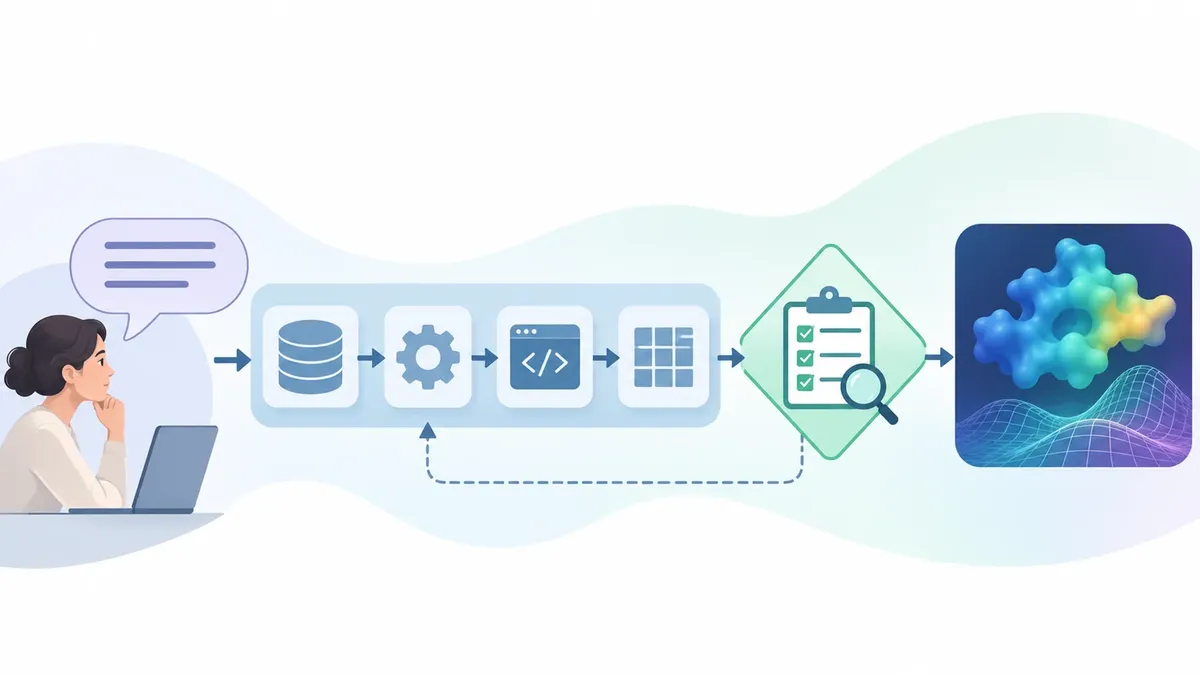
Can a conversational AI turn a scientist’s request into a dependable analysis workflow? TopoPilot is designed to plan and check workflows for topological data analysis and visualization before they run.
TopoPilot is a framework for translating conversational requests into scientific visualization workflows. In their arXiv preprint, Nathaniel Gorski, Shusen Liu and Bei Wang focus on topological data analysis and visualization, while describing a design intended to extend to other visualization domains.
The motivation is a reliability challenge identified by the authors: agentic systems can produce invalid operations, subtle errors, or fail to resolve requests that are underspecified. A workflow that sounds plausible is not necessarily one that executes correctly or matches the intended analysis.
Planning and verification
TopoPilot uses two agents. An orchestrator translates a user’s prompt into a workflow composed of atomic backend actions. A verifier evaluates that workflow before execution. The system also uses deterministic guardrails intended to support semantic consistency and accurate execution.
The framework is modular. The authors say new topological descriptors and domain-specific workflows can be added without modifying the core system. They also describe a taxonomy of failure modes, with targeted safeguards for each class. The abstract does not enumerate those failure modes or explain the safeguards in enough detail to assess them individually.
Separating workflow planning from checking is the central design idea: a proposed sequence of actions is evaluated before the system carries it out. The abstract does not claim that the verifier catches every error, or that passing its checks guarantees a scientifically appropriate result.
Results from simulated conversations
The authors tested TopoPilot across 2,000 simulated multi-turn conversations spanning 100 prompts, including adversarial and infeasible requests. They report a success rate above 95%. A baseline without comprehensive guardrails and verification achieved less than 50%, according to the abstract.
The authors also report that TopoPilot outperformed Claude Code and Codex on similar prompts in accuracy, completion time and token usage. The abstract provides no exact figures for these comparisons. It also does not specify how success was scored, what models and settings were used, or how the test prompts were distributed across task types. Those details are important for interpreting the results and judging how broadly they apply.
The figures describe performance on simulated conversations, not a general guarantee of reliability with real scientific datasets or workflows outside the tested setting. The abstract does not provide uncertainty estimates or a breakdown of outcomes by request type.
What the evidence can—and cannot—show
TopoPilot’s reported results suggest that combining a workflow orchestrator, a pre-execution verifier and deterministic safeguards can improve performance on the authors’ tests. Whether the approach transfers to other scientific visualization domains, or handles the range of requests encountered in practice, remains an open question based on the available evidence.
This account is based on the paper’s abstract rather than a full examination of its methods and results. The source is an arXiv preprint, and the supplied material does not establish whether it has undergone peer review. The reported comparisons should therefore be understood as the authors’ claims, with evaluation details that cannot be checked from the abstract alone.
- TopoPilot
- scientific visualization
- topological data analysis
- AI agents
- workflow automation
- verification
Reviewed cross-references
These connections were reviewed by a model, not independently fact-checked by a human. Similarity does not imply agreement; consult the original papers and the evidence below.
ChatAtom aims to simplify molecular-dynamics workflows
Shared method: Both use specialized agents and a review step before execution: TopoPilot’s verifier checks workflow validity and alignment with user intent, while ChatAtom pairs script generators with reviewers. The checks apply to different artifacts—workflows versus scripts—and this design similarity does not establish comparable reliability.
Model review: · openai-codex/gpt-6-luna
Evidence and provenance
Selected excerpts, not complete papers. PDF extraction can omit figures or damage equations, tables and reading order; sources may be preprints.
2603.25063v3 — Original paper
Excerpt reference:
static/papers/2603.25063v3.md:219-279
Basis: Paper text
Source SHA-256:851ffe80061a7e14debd32fe2eb3ef07f01f3b2b704f2cf380ed335578a6e8342611.26782v1 — Original paper
Excerpt reference:
static/papers/2611.26782v1.md:109-147
Basis: Paper text
Source SHA-256:f8d00dc0f87b05cdbed755cb394b2bd374afa5e8f18f48fc647942228c483863
Related reading
Automatically matched by shared topic keywords. These links do not imply that the sources agree or establish a consensus.
Keeping AI workflow instructions separate from implementation know-how
Source published
Shared keywords: ai agents, workflow automation
AutoDFT lets calculations change course as they run
Source published
Shared keywords: ai agents
Turning AI agent traces into reusable workflows
Source published
Shared keywords: ai agents, workflow automation
What happens to a language model’s attention when it is compressed?
Source published
Shared keywords: topological data analysis
Could the shape of word connections help evaluate AI reasoning?
Source published
Shared keywords: topological data analysis