TRANSMISSION // 2603.24944v2
When stellar flares may help—and harm—planetary chemistry
Source published
A model suggests flares can supply UV light needed for prebiotic chemistry on some planets around low-mass stars, while also posing risks.
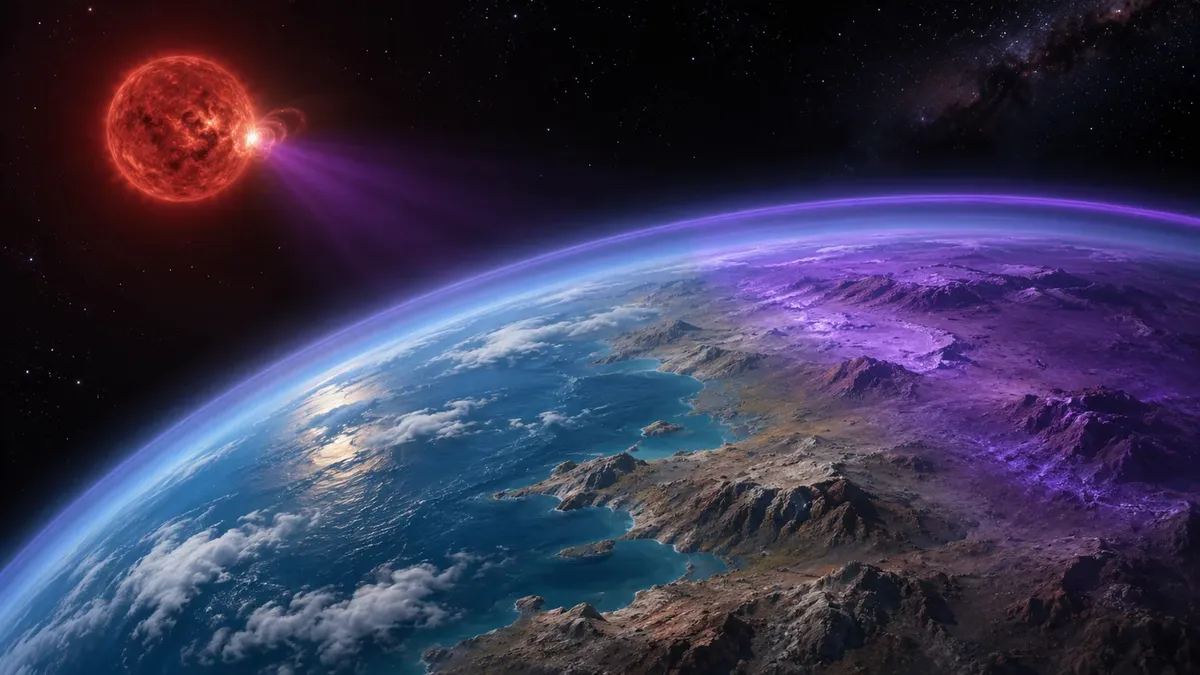
A planet may have the right temperature for liquid water yet receive too little ultraviolet light for some proposed prebiotic reactions. Gao and colleagues model whether stellar flares could fill that gap—and where flare risks might outweigh the benefit.
A star’s habitable zone is usually described as the range of distances where a planet might maintain liquid water on its surface. But water is only one ingredient in the story of life’s possible beginnings. Some laboratory-studied pathways for making RNA building blocks rely on ultraviolet (UV) light. Low-mass stars can be faint in the relevant UV wavelengths when calm, even if nearby planets sit in the liquid-water zone.
Flares complicate that picture. These bursts of energy can increase a star’s UV output, potentially helping prebiotic chemistry. They can also expose a planet to damaging radiation and may contribute to ozone loss. The question in this study is whether a planet could receive enough UV for proposed RNA-precursor chemistry while remaining in a region where liquid water is possible—and without flare activity exceeding the authors’ adopted ozone-depletion limit.
A model of light, chemistry and distance
The researchers constructed a model of flare light across ultraviolet wavelengths. Rather than treating a flare as a simple hot blackbody, their spectrum includes an enhanced near-UV component intended to represent features such as the Balmer jump. They used observations and earlier flare models to set parameters for different stellar types, then interpolated across stars from cool M types to G types.
They combined this spectrum with an empirical relationship describing how often flares of different energies occur. The model estimates the long-term average UV contribution from flares and adds it to a star’s quieter UV output. Separately, the team calculated liquid-water-zone boundaries and estimated the UV needed for RNA-precursor chemistry as a function of modeled planetary surface temperature. This temperature dependence matters: in their framework, warmer conditions require more UV for the reactions to proceed at the assumed rate.
The authors applied the approach to stars of different masses and to nine known or candidate planets around flaring Kepler stars. They also compared estimated flare rates with a threshold drawn from previous work on ozone depletion. These are model-based estimates, not direct measurements of chemistry or habitability on the planets.
What the calculations suggest
In the modeled general cases, flares expand the UV habitable zone—the region receiving enough UV for the specified chemistry—especially around lower-mass stars. That UV zone can overlap with the liquid-water zone. The flare contribution changes the modeled liquid-water-zone boundaries much less than it changes the UV boundaries.
For the nine Kepler systems, the paper identifies three planets or candidates in both modeled zones without their host stars exceeding the study’s ozone-depletion limit: the rocky candidate KOI-8012.01 and the larger candidates KOI-8047.01 and KOI-7703.01. This classification means their modeled conditions meet the paper’s criteria; it does not show that they have life, or even that the proposed chemistry is occurring there. Other planets in the sample fall outside one or both zones under the adopted assumptions. The authors flag some cases for further study, particularly because their surface temperatures are uncertain.
Why the result is provisional
Several inputs are difficult to pin down. Flare spectra vary, and the authors note a lack of observed near-UV flare spectra for some stellar types. Their model uses representative spectra and interpolations rather than a bespoke spectrum for every star. Flare-frequency estimates are also uncertain: missed low-energy flares and limited observing coverage can affect the inferred distribution. The paper’s tests show that these choices can change the modeled UV-zone width, especially for low-mass stars. The assumed lower energy limit for included flares matters too.
The model averages flare UV over time. That is a practical way to estimate long-term input, but real flares arrive in bursts, and the chemical consequences of pulsed UV are not fully established. Nor does the calculation capture every factor that could shape surface conditions, including detailed atmospheric composition, shielding, and planetary climate. The authors call for more UV observations, flare monitoring and laboratory work on the effects of UV on prebiotic chemistry.
The study therefore broadens one way scientists can screen for potentially interesting worlds: it considers not just whether liquid water may be possible, but whether a modeled UV supply could support a particular class of prebiotic reactions. Its conclusions are conditional on that chemistry and on the model’s assumptions. The source is an arXiv preprint, which may not have undergone peer review; its results should be treated as a proposed analysis, not a settled assessment of planetary habitability.
- stellar flares
- exoplanets
- ultraviolet radiation
- habitable zones
- prebiotic chemistry
- Kepler
Related reading
Automatically matched by shared topic keywords. These links do not imply that the sources agree or establish a consensus.
By eye, astronomers search for subtle clues in planet transits
Source published
Shared keywords: stellar flares
Can Electron Radiation Help Glycine Form Peptide Bonds in Space?
Source published
Shared keywords: prebiotic chemistry
Magnesium-rich dust could offer another route to formamide in space
Source published
Shared keywords: prebiotic chemistry
TV Cassiopeiae’s X-rays hint at an active stellar corona
Source published
Shared keywords: stellar flares
Optical spectra reveal magnetic activity in 46 MeerKAT-selected stars
Source published
Shared keywords: stellar flares